
#18 Who Wrote This? — AI Text and the Parts You Should Still Write Yourself
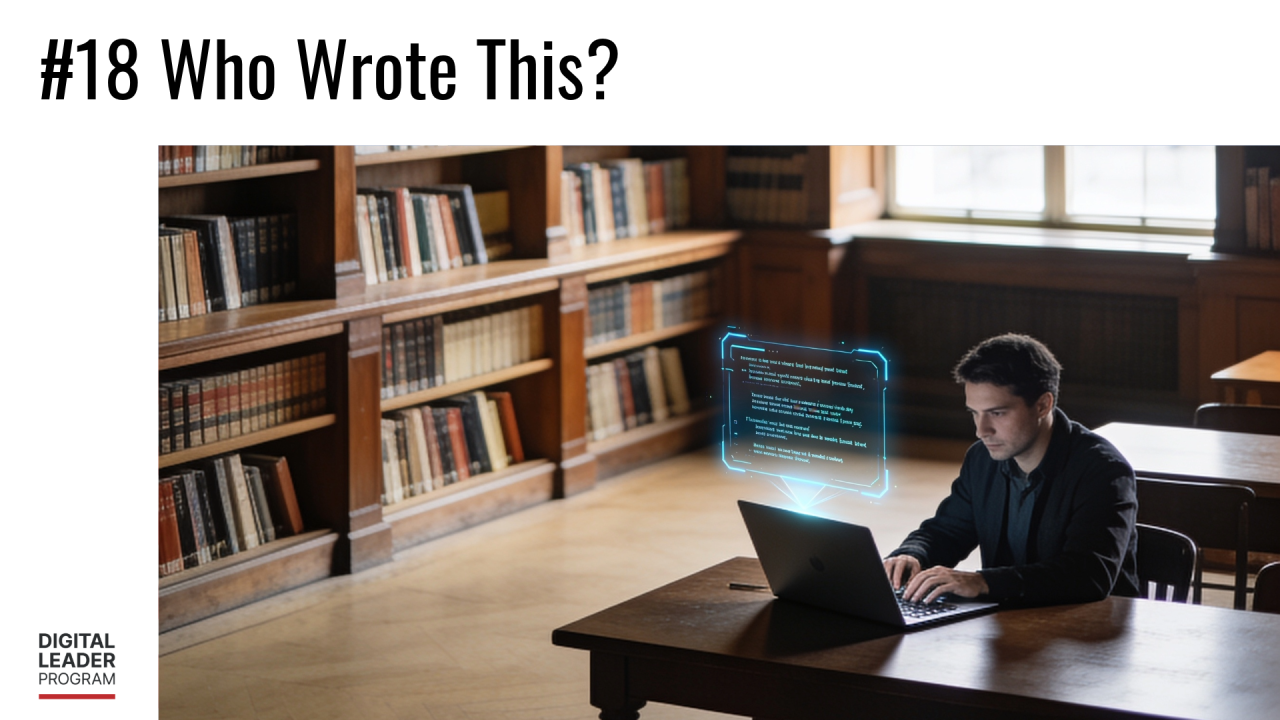
A while ago a business partner replied to one of my emails, and I knew within two lines that he hadn't written it. The phrasing was too smooth, too balanced, too eager to acknowledge my points before answering them. Even the formatting was too perfect: tidy paragraphs of near-identical length, a neat bulleted list, not one of the small irregularities a person leaves behind when they type in a hurry. Nothing about it sounded like him.
What surprised me a bit was my own reaction. The technology didn't bother me; I use it every day. I felt something smaller and more personal: that I hadn't been worth the minutes. Somewhere in his inbox my message had come up, he'd clicked "generate reply", skimmed it, and sent. The content was fine. The signal was: you're a queue item.
That reaction is the subject of this edition, because it puts a price tag on something we're all now doing. And the price isn't paid in the text.
Let me implicate myself
Before I go further, the disclosure this edition needs.
Run this newsletter through a detector like Pangram and it will come back flagged as AI-generated. Not partly. All of it. And since you're most likely reading this on LinkedIn, where there is now a button for exactly that suspicion, you could act on the verdict before you finish this sentence.
So what does that verdict mean? In my case: a machine helped research it, drafted much of it, and has been over every line. What it doesn't mean is that nobody was home. The editing is mine, sentence by sentence. So is every decision about what's true, what's too strong, what I'd put my name to, and what gets cut because it sounds clever and isn't. The detector can see the fingerprints of the tool. It can't see who held it.
I say this partly because I'd rather you heard it from me, and partly because "AI-generated" has become a verdict people pronounce as though it settled something. It doesn't. Between "typed every word myself" and "clicked generate and sent" lies almost everything of consequence. That space is where your professional judgment now lives.
How this newsletter gets made
Since I'm being transparent, here's the process, because I think the shape of it is more useful than any prompt I could give you.
It starts without a machine. A topic turns up, usually out of a workshop or a client conversation, and I open a mindmap. Then I leave it alone. Over the following days whatever occurs to me on that subject goes in: a client's phrase, a contradiction I noticed, something I read on a plane. That slow accumulation is the part I'd never automate, and it's where anything original comes from.
Then the machine joins. I speak my thoughts out loud and have them transcribed. (I use Granola more for capturing my own thinking than for recording meetings, which probably isn't what it was built for.) That transcript goes into a working chat that has been fed the last seventeen editions, five years of our blog posts, and the transcripts of my podcast. It knows the rhythm I write in, the anchors I keep returning to, which claims I've already made and where.
Then the long part: questioning, cutting, arguing with the draft. Facts get checked and sometimes thrown out. Sections get moved because the argument doesn't hold in that order. New ideas arrive mid-edit and have to be worked in. From first idea to finished text takes about a week, and at least a full working day of real labour. Sometimes considerably more.
I did try to automate the whole thing once. What came back was uniform mush, plus a steady trickle of things that were plainly wrong or that I simply couldn't stand behind. Fluent, publishable-looking, and not mine. That experiment is why I no longer believe you can have both: text worth reading and a process without hands in it.
A quick aside for HR and people-development leaders: writing well is now inseparable from using these tools well — and neither shifts through a single workshop. That's the kind of thing I work on with organisations over time, in coaching, workshops and longer programmes. If it's on your list, a short call is the place to start: book 20 minutes.
Watermarks, and where the law draws the line
Detection is also about to stop being guesswork. Anthropic now watermarks the output of Claude models released from August 2026 onwards, with older ones following over the coming months, using a variant of the SynthID technique Google DeepMind published. Google marks Gemini's output the same way. Invisible provenance is becoming the default.
The limits are worth knowing. A watermark answers one narrow question, how likely it is that a text was partly written by this model, and nothing beyond it. It can't confirm that a human wrote something, it says nothing about a different AI, and it works poorly on short samples. The email that opened this edition would probably be too short to catch.
Behind the change sits a law. Under Article 50 of the EU AI Act, in force since 2 August 2026, deployers must disclose when AI-generated text is published to inform the public on matters of public interest, and the fines run to serious money. But the obligation falls away where the content has undergone human review or editorial control and a natural or legal person holds editorial responsibility for it.
Whether a newsletter like this one even falls under that provision is arguable; "matters of public interest" points more at political, financial or scientific reporting than at my thoughts on leadership. Either way I'd land in the same place, and that's the part worth borrowing. I review every line and I answer for it. The law doesn't ask how the words were produced. It asks whether a human being stands behind them, and I find that a well-drawn test.
That has a consequence for anyone in employment: pretending you wrote something unaided will not be a viable strategy for much longer. A relief, I think, rather than a threat. The question shifts from did you write this to do you stand behind this, and the second question was always the better one. Worth adopting that standard inside your organisation before anyone obliges you to.
Three tiers, and one rule that decides between them
Now the practical question, the one that prompted this edition: where can you let AI text simply flow, where must you work it over, and where should you still write it yourself?
What decides it is neither quality nor risk, but what the message is carrying. Back in the Communication editions I used Schulz von Thun's four sides: fact, self-revelation, relationship, appeal. AI is strong on the factual side and weak on the relationship side, and that maps almost perfectly onto how much of yourself a text needs.
Let it flow where the message is nearly all fact and the volume is high: meeting notes, status summaries, documentation, the first draft of a standard document, the third reminder about expenses. Nobody is reading these for warmth. Reviewing them still takes ten seconds, but that's proofreading, not authorship.
Work it over wherever the text goes outside, or carries consequences: proposals, presentations, customer replies, anything a decision hangs on. Here the machine writes the scaffolding and you do what it can't. Check the facts. Cut the flattery. Put the ask where it belongs. Make it sound like your company rather than the internet's average company. This is most business writing, and the ten-second review won't cover it.
Write it yourself when the relationship is the message. Condolences. Real praise. Difficult feedback. Thanking someone who went out of their way. Reconnecting with a person you value. Here the effort isn't the delivery mechanism for the content; the effort is the content. Outsource it and you delete the very thing you were trying to send. That reply would have taken ninety seconds to write badly, and badly would have landed better.
One test covers all three: if the recipient learned exactly how this text was made, would it change what it means to them? A generated status report, no. A generated condolence, entirely. Where the answer is yes, write it yourself.
What juniors gain, and what they might miss
Second story, and this one cuts the other way.
As an intern at IBM I helped organise a parliamentary evening, which meant writing emails to the whole German top management. I still remember reading each one perhaps ten times and checking the spelling five. It was excruciating, and it was slow, and I'd have given a lot for a tool that produced a clean draft in four seconds.
But I've come to think that agony did something. Reading your own sentence for the tenth time forces a question you can't get to any other way: how will this land on the person opening it? I wasn't learning grammar. I was learning to model a reader, a senior one, with no patience and real power. That's the same muscle the whole Communication thread of this newsletter keeps circling.
So let me be even-handed about it, because the case for the tools is real. A junior today writes clearly from week one, doesn't freeze in front of a blank page, isn't held back by writing in a second language, and can produce a structured proposal that would have taken me a fortnight to learn to draft. That's not a small gain. Access to competence has never been cheaper.
The risk sits elsewhere: in skipping the reps. If the first draft always arrives finished, you never do the ten readings, and it's the ten readings rather than the finished text that build judgment about how the other person receives it. My honest guess is that the tools have made the output easier and the learning harder, and that the difference will show up in five years, in people who can produce any document and can't tell which version of it will work.
Denmark has just done something interesting about exactly this. In August 2026 the government brought in emergency measures for upper secondary schools: chatbots barred from exam settings, screen monitoring during written tests, and, the clever part, every written exam taken at home now has to be defended out loud. Notice what that last measure does not do. It makes no attempt to detect anything. Detection is an arms race nobody wins; a five-minute conversation about your own argument settles the question completely. You can hand in a text you didn't think through. You cannot defend one.
One admission belongs here. Some of what I do with these tools only works because of the years behind it. I can spot the wrong claim, the connection that isn't there, the sentence that sounds like insight and says nothing, because I've spent two decades in rooms with the people I'm writing for. As a junior at IBM I couldn't have done that editing, no matter which tool you'd handed me. Not from lack of effort. From lack of a worldview to check the text against. Anyone building development programmes should sit with that: the tool raises the floor and does very little for the ceiling.
When machines write to machines
Follow the trend to its logical end and you get something absurd: machines producing polished text that is answered by machines producing polished text, while the humans on both ends skim, sense that nothing personal is in there, and stop reading properly.
We're closer to that than is comfortable, and there are numbers on it now. Pangram examined posts on LinkedIn and found roughly 40% of long-form and 30% of short-form posts flagged as fully AI-generated. On one of the largest professional networks in the world, a good share of what gets published is already machine-written, and the humans have noticed. In July 2026 LinkedIn added a report option to posts: "Seems like AI slop." Tap it and the post disappears from your own feed while the platform logs your verdict; posts that get classified as low quality surface less in recommendations beyond the author's own network.
Look closely at what that button asks, because it isn't what you'd expect. Not "was a machine involved" but "does this feel like slop". That's a human judgment rather than a detection result, and it now carries an economic penalty: reach.
Which takes us back to that email in my inbox. There was no button on it, and there didn't need to be. My brain ran the same verdict silently, and the cost was paid all the same, in a small downgrade of how seriously I take the sender.
The way out isn't less AI. It's keeping a visible difference between the text you produced and the text you wrote, so that when something counts, the other person can tell.
Your turn
Your 1% this week: scroll back through the messages you sent in the last seven days and sort a handful into the three tiers — flow, work over, write yourself. Most people find one item in the wrong tier, and it's almost always a relationship message that got treated as a logistics message.
Rewrite that one by hand. Badly, if necessary. Send it anyway.
If you lead juniors, add one more: borrow the Danish move. Ask one of them to talk you through why their draft is structured the way it is. Not to catch them out — nothing here is about policing tools. The reps come back the moment someone has to explain their reasoning out loud, and that works as well across a desk as it does in a school hall.
One question before you go: have you ever received a message you could tell was generated — and did it change how you felt about the sender? I read every reply.
See you next week.
The Digital Leader Canvas is free for individual use. And if you're in HR or L&D and want to bring these themes into your organisation, here's that link again — book a 20-minute call. You can also explore the Leadership Essentials Workshop Series for teams.
Recent Posts
Categories
All categories
KNOWLEDGE THAT WORKS IN PRACTICE
This is not a place for buzzwords. Or for theories that don't hold up in real life. Our blog is a space for leaders and professionals who are looking for genuine answers to genuine questions: How do I lead better in a hybrid environment? How do I communicate in a way that actually lands? How do I use AI meaningfully in my daily work? How do I build resilience in my team?
Every article in the Digital Leader Program blog is designed to be directly useful – with insights, methods and examples you can take straight into practice.
TOPICS THAT MATTER TODAY
Leadership in the digital age: How is leadership changing when teams work remotely or hybrid? What do new leaders need – and what do experienced managers need to relearn?
Human Skills under AI influence: Which human capabilities become more important as AI takes over routine tasks – and how do you develop them deliberately?
Hybrid work in practice: Concrete tips, rituals and tools for productive hybrid collaboration – what actually works, and what doesn't.
Culture Design and team dynamics: How do you build an organisational culture that attracts, retains and energises people?
Communication and feedback: The capabilities that separate average performance from real high performance.
FROM PEOPLE WHO WORK IN PRACTICE
Our articles are written by Andre Ottlik and our team – people who work in coaching sessions, workshops and training every single day. What you read here is not copy-pasted from academic studies, but knowledge drawn from lived practice.
And occasionally we feature contributions from external experts sharing insights from their own fields – such as the piece with Pascal Baumgartner on hybrid meeting optimisation.
FREQUENTLY ASKED QUESTIONS (FAQ)
How often are new articles published?
Regularly. Subscribe to our newsletter or follow us on LinkedIn to make sure you don't miss new content.
Are articles available in German too?
Yes. Many of our articles are also available in German – particularly on topics relevant to German-speaking leaders and organisations.
Can I suggest article topics?
Absolutely. Write to us or bring it up in a conversation – we welcome input from our community.
How can I go deeper than the blog?
Our workshops, coaching programmes and the podcast "3 minutes max." go further and support you systematically in your development. Browse our service pages or book an initial consultation.
Author
Andre Ottlik
Author
Andre and his Team are the authors of Digital Leader Programs Blog Posts
