
#24 Creativity — A Safety Problem, Not a Training Problem
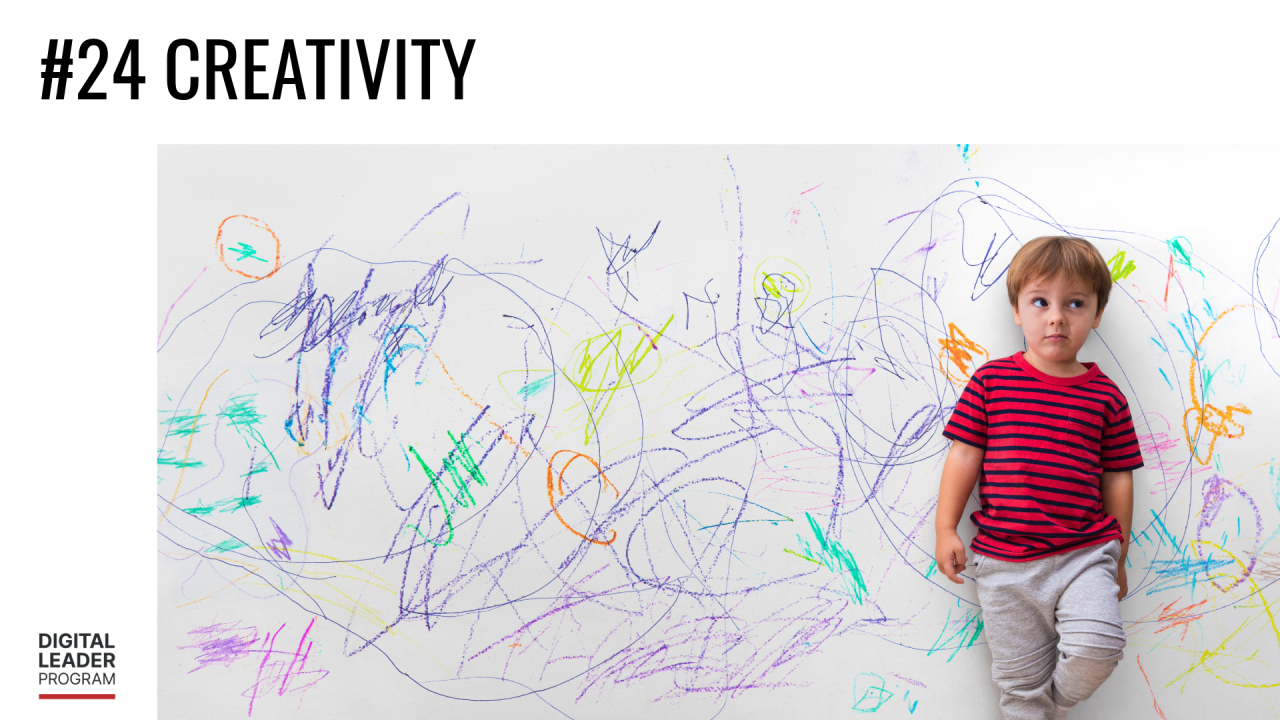
A child wants to paint on the wall. The wall is not for painting. A child paints a black flower, and an adult explains that flowers are not black. Nobody there means harm. That is where, I believe, many children learn what they may make and imagine, and what not.
A friend of mine says he is not creative at all. He can repair almost anything: the car, the boiler, a chair nobody else would touch. He does not call that creative, because in most heads creativity lives next to art. A software engineer who finds an unexpected way through a problem does what a painter does. The word is narrower than the thing.
If you run a company that wants to stand out in competition, this is your problem too. Where teams feel safe enough to show unfinished thinking, creativity goes up, and it can be measured. Since AI tools like ChatGPT arrived, there is a new reason to care: ideas from the same tool grow more alike, so the unfinished, odd, human idea is the one you cannot buy. Who may show it is decided at the top, or by nobody.
(The last of Microsoft's 5Cs in this series, after courage, curiosity and compassion; communication came earlier.)
8 min read. If you take one thing from this: a lack of creativity is rarely a lack of method. It is a question of safety, and safety is decided at the top. Ahead: what an explanation does to a four-year-old; why Germany and the US had the same schools and got different results; the study that found AI makes writers better and their stories more alike; four things to do, one for the person who signs budgets.
Where it stops
Elizabeth Bonawitz, then at Berkeley, Laura Schulz at MIT and colleagues at Harvard and Stanford gave 85 preschool children a toy with four hidden functions. When the toy was simply handed over, the children found on average more than one function. When the adult first explained one function, they found fewer than one and stopped sooner. The explanation was true. It still closed the toy.
It does not end in childhood. Teresa Amabile, who spent decades studying motivation and creativity at work, later at Harvard Business School, had 72 writers rank a list of reasons to write and then produce a poem. One list was about pay and recognition, the other about the pleasure of writing. Judges rated the poems after the pay list less creative. An earlier study found the same for people who merely expected to be judged. Being watched is enough.
Built for obedience
I have a theory about my country, and I checked it. German schools, universities and the assessment centres looked for people who arrive on time, leave on time and in between do as they are told. The system does what it was built for, and that is older than I thought. Prussia made schooling compulsory in 1763; the law names its purpose: the fear of God and "enlightened and virtuous subjects". Factories did not exist yet.
The United States took the same model. Horace Mann, the father of American public schools, travelled to Prussia in 1843, praised it above every other nation, and Massachusetts made school compulsory in 1852. So the school system is not the difference.
The difference sits around the school. Geert Hofstede's culture scores for uncertainty avoidance, how uncomfortable a society is with the unknown, put Germany at 65 and the US at 46. In the Global Innovation Index 2025 Germany ranks eleventh overall but eighth on output. Germans produce innovation through discipline, not room.
The people this system picked, the good students and assessment-centre winners, now lead the teams they must ask for creativity. I expected the research to say disciplined people are less creative. It does not. A large review by Darío Páez's group at the University of the Basque Country, combining seven meta-analyses, found almost no link between discipline and creativity. The trait that goes with creativity is openness: curiosity about new things. So a system that selects for discipline does not remove creativity. It never looks for it. That, I think, is partly why I felt drawn to start-ups and scale-ups, where being different was an asset.
And the country you grew up in? The evidence says the difference is not in the person but in the room. Miriam Erez's group at the Technion found people from different cultures about equally creative alone; with peers watching, Israelis produced more unusual solutions, Singaporeans more elaborated ones, and Chinese participants fewer original ideas with a supervisor present. Erin Meyer's Culture Map, an old companion of this series, puts Germany at the direct end of feedback and the confrontational end of disagreement, the US nearer the middle. Nobody is born less creative. Some grow up in rooms where showing it costs more.
If you sign budgets and your teams have stopped bringing you half-formed ideas, one thing is enough. Forward this edition to whoever runs people development for you, with one line: "I want us to work on this over months, not in an event. Find me something like it." What to look for: a programme that starts with the leadership team, runs over months rather than days, and treats human skills and AI as one subject. If you run people development and just received that line, or still have budget for this year: that is the work I do, since 2010 with organisations from start-ups to adidas and Fraunhofer (references). Twenty minutes, and you'll leave with a clear next step whether or not you work with me: book a call.
A safety problem, not a training problem
At work the wall has become polite. Hardly anyone says "you can't"; they say "we tried that" or "not on the roadmap". Learn all the design-thinking methods you like; if you still cannot let a half-formed idea out in front of the group, nothing changes. For many people, I think, missing creativity is a safety problem, not a training problem.
A meta-analysis of 136 studies with over 22,000 people, led by M. Lance Frazier in Personnel Psychology, links psychological safety to team creativity at 0.29. Moderate, not magic. And both halves of curiosity from the last editions return: a 2026 study using Todd Kashdan's model found that joyous exploration and stress tolerance each predicted creative achievement.
I see it in my workshops when I ask people to sit alone for twenty minutes and write. Some are done after three, because they learned fast results are wanted; the deeper phase rarely starts. One leadership task that matters, I think, is to endure the unfinished: to let it exist and grow before anyone judges it.
It also means paying for waste. My parents' word for my gaming, two editions ago, was waste of time. Creativity has the same reputation, and deserves it. Creative children tend to make a mess and break things. An artist on the way to good work throws most of it away. Thomas Edison held 1,093 US patents and abandoned an estimated 500 to 600 applications. James Dyson counts 5,127 prototypes before his first vacuum cleaner worked. Dean Keith Simonton, who spent his career at UC Davis measuring creative careers, found that the periods with the most masterpieces are also those with the most failures. If nothing in your innovation budget ends in the bin, you are paying for execution, not creativity.
Boredom helps, and I say that from experience: when television and phone stay off, first comes the boredom, then the ideas. Julia Cameron's The Artist's Way advises the same: a week without media, and a weekly "artist date" alone.
What the model does to your ideas
A Wharton working paper from 2023 compared 200 product ideas from its students with 200 from GPT-4: 35 of the 40 best came from the model. The problem is what it does to everyone's ideas together. Anil Doshi at University College London and Oliver Hauser at the University of Exeter had 293 writers write a short story, some with ideas from GPT-4, some without, and 600 readers judge them. Writers with AI ideas wrote stories that readers rated more creative; for the less creative writers, by about eleven percent. The stories were also more alike. In the authors' words: "With generative AI, writers are individually better off, but collectively a narrower scope of novel content is produced." In 2026, Emily Wenger at Duke and Yoed Kenett at the Technion compared 22 language models with 102 people; their title says it all: "Large language models are homogeneously creative."
A test follows. If the team has worked on something for weeks and the model, asked the same question, gives the same answer, it probably was not creative. Used well, it is a mirror for convention. Used without care, it pushes everyone towards it.
The second lesson came in the car. I was thinking aloud about this edition with the Claude app, by voice, and it interrupted me four times before I had finished a sentence. I have sat with leaders who do that. I told it: let me finish. That waiting time is rare at work. A model can play the CFO who doubts everything. It cannot wait. That part is yours.
It helps to break the pattern: see something new, take a walk, move. States we reach without tools matter too. Steve Jobs wrote on a security clearance form in 1988 that LSD had been "a positive life changing experience"; my guess is some of his biggest ideas came from those states. People who start meditating describe something similar. Either way, the ideas that change something come when we see the world from further away than a working day allows. Microsoft's line for this C agrees: "AI can remix what exists. Only humans reimagine what is possible." Creator, not prompt writer. At least until now.
Your turn
If you sign budgets. Bring one unfinished idea to the next leadership meeting, say it is unfinished, and ask only: what is missing? Then send this edition to whoever runs people development for you, with the line from the middle of the page.
If you lead a team. Before the next idea session, twenty minutes of silence, everyone writing alone, nobody done early. Then the mirror test: ask an AI tool like ChatGPT the same question and keep only the ideas it did not have.
If you develop people. Before buying another method training, take evaluation out of the room: one idea session a month, no scoring, no decision, and count whether people bring more. If you need the mandate, forward this upward; the opening is written for the person who signs.
Your 1% this week, whoever you are. One evening without television, phone or feed. Sit through the boredom, then write down three things you want to make.
That closes the 5Cs. Which idea did you keep to yourself this year because of the wall? Tell me in the comments. I read every reply.
If you want to bring these themes into your organisation, here's that link again: book a 20-minute call. You can also explore the Leadership Essentials Workshop Series for teams.
Recent Posts
Categories
All categories
KNOWLEDGE THAT WORKS IN PRACTICE
This is not a place for buzzwords. Or for theories that don't hold up in real life. Our blog is a space for leaders and professionals who are looking for genuine answers to genuine questions: How do I lead better in a hybrid environment? How do I communicate in a way that actually lands? How do I use AI meaningfully in my daily work? How do I build resilience in my team?
Every article in the Digital Leader Program blog is designed to be directly useful – with insights, methods and examples you can take straight into practice.
TOPICS THAT MATTER TODAY
Leadership in the digital age: How is leadership changing when teams work remotely or hybrid? What do new leaders need – and what do experienced managers need to relearn?
Human Skills under AI influence: Which human capabilities become more important as AI takes over routine tasks – and how do you develop them deliberately?
Hybrid work in practice: Concrete tips, rituals and tools for productive hybrid collaboration – what actually works, and what doesn't.
Culture Design and team dynamics: How do you build an organisational culture that attracts, retains and energises people?
Communication and feedback: The capabilities that separate average performance from real high performance.
FROM PEOPLE WHO WORK IN PRACTICE
Our articles are written by Andre Ottlik and our team – people who work in coaching sessions, workshops and training every single day. What you read here is not copy-pasted from academic studies, but knowledge drawn from lived practice.
And occasionally we feature contributions from external experts sharing insights from their own fields – such as the piece with Pascal Baumgartner on hybrid meeting optimisation.
FREQUENTLY ASKED QUESTIONS (FAQ)
How often are new articles published?
Regularly. Subscribe to our newsletter or follow us on LinkedIn to make sure you don't miss new content.
Are articles available in German too?
Yes. Many of our articles are also available in German – particularly on topics relevant to German-speaking leaders and organisations.
Can I suggest article topics?
Absolutely. Write to us or bring it up in a conversation – we welcome input from our community.
How can I go deeper than the blog?
Our workshops, coaching programmes and the podcast "3 minutes max." go further and support you systematically in your development. Browse our service pages or book an initial consultation.
Author
Andre Ottlik
Author
Andre and his Team are the authors of Digital Leader Programs Blog Posts
