
#19 Courage (Part 1 of 2) — Why Nothing Starts

"We should be careful about starting something like this."
Some version of that sentence reaches me several times a year, and it's almost never about something large. The most recent case was 360-degree feedback: one department, a few weeks, software optional, entirely reversible.
Careful about a feedback pilot.
Nobody involved was blocking anything, and I want to be clear about that before I use it as an example. The caution was reasonable by the standards of the place. In organisations like that, nothing stays small: every initiative becomes a proper undertaking, a boulder to be set in motion. Capacity is thin to begin with, so anything new has to queue. By the time it reaches the front, the energy that started it has drained away. That's how most initiatives die in established companies. Not refused. Slowed until nobody quite remembers why they mattered.
Most conversations about AI in organisations are about capability: which tools, which use cases, which skills, what it costs, ...
#18 Who Wrote This? — AI Text and the Parts You Should Still Write Yourself

A while ago a business partner replied to one of my emails, and I knew within two lines that he hadn't written it. The phrasing was too smooth, too balanced, too eager to acknowledge my points before answering them. Even the formatting was too perfect: tidy paragraphs of near-identical length, a neat bulleted list, not one of the small irregularities a person leaves behind when they type in a hurry. Nothing about it sounded like him.
What surprised me a bit was my own reaction. The technology didn't bother me; I use it every day. I felt something smaller and more personal: that I hadn't been worth the minutes. Somewhere in his inbox my message had come up, he'd clicked "generate reply", skimmed it, and sent. The content was fine. The signal was: you're a queue item.
That reaction is the subject of this edition, because it puts a price tag on something we're all now doing. And the price isn't paid in the text.
Let me implicate myself
Before I go further, the disclosure this editio...
#17 The Atlantic Gap — What to Copy From America, and What Not To
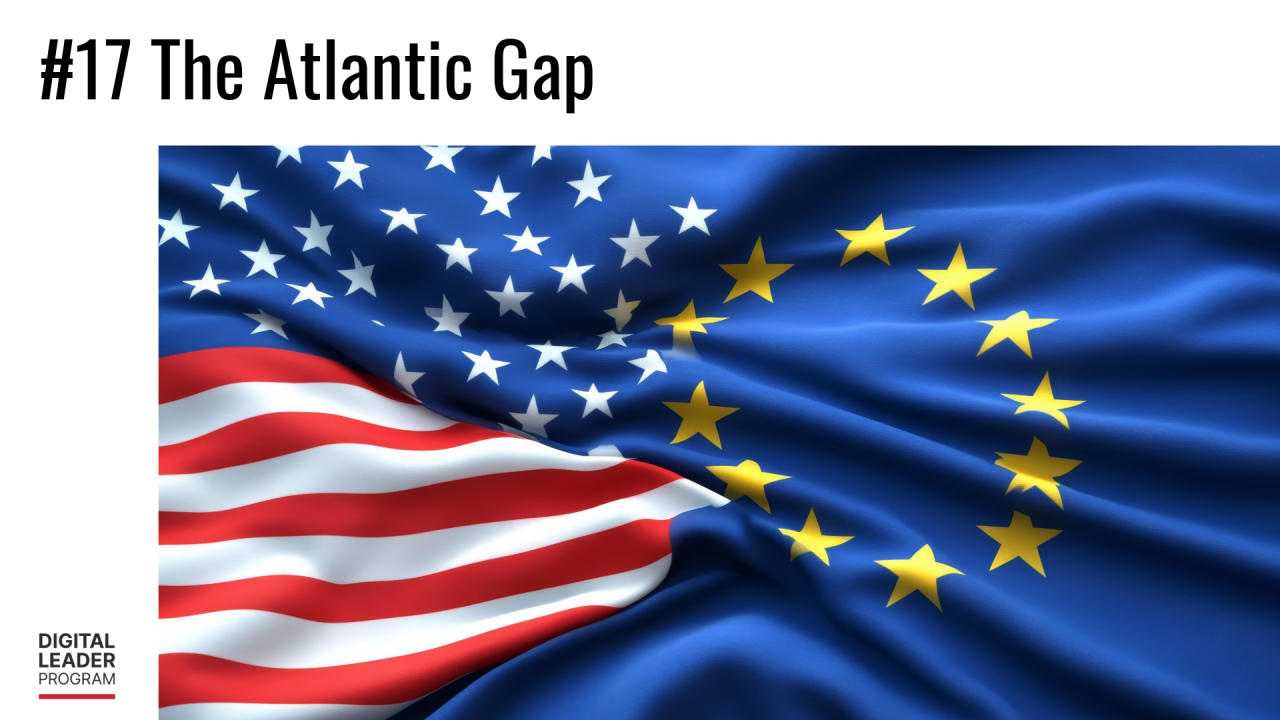
Walk through any European airport bookshop — Frankfurt, Lisbon, Amsterdam; my travel schedule gives me too many chances to test this — and look at the business shelf. Shelf after shelf, mostly American: the titles, the case studies, the advice. We fly between European cities reading playbooks largely written for a different continent, and then wonder why they don't quite fit when we land.
I promised this edition last time: the gap this newsletter has circled since the beginning without facing head-on. Europe watches America — its leadership trends, its development trends, its tools — and asks, almost reflexively, what do we need to do like they do? If that sounds overstated, run through the methods your own organisation has adopted: OKRs came from Intel and Google, the Agile Manifesto was written in Utah, Radical Candor and Lean Startup in Silicon Valley. Even the Culture Map — the standard work on European cultural difference, quoted throughout this series — was written by an America...
#16 The AI-Native Organisation — When Culture Becomes Executable
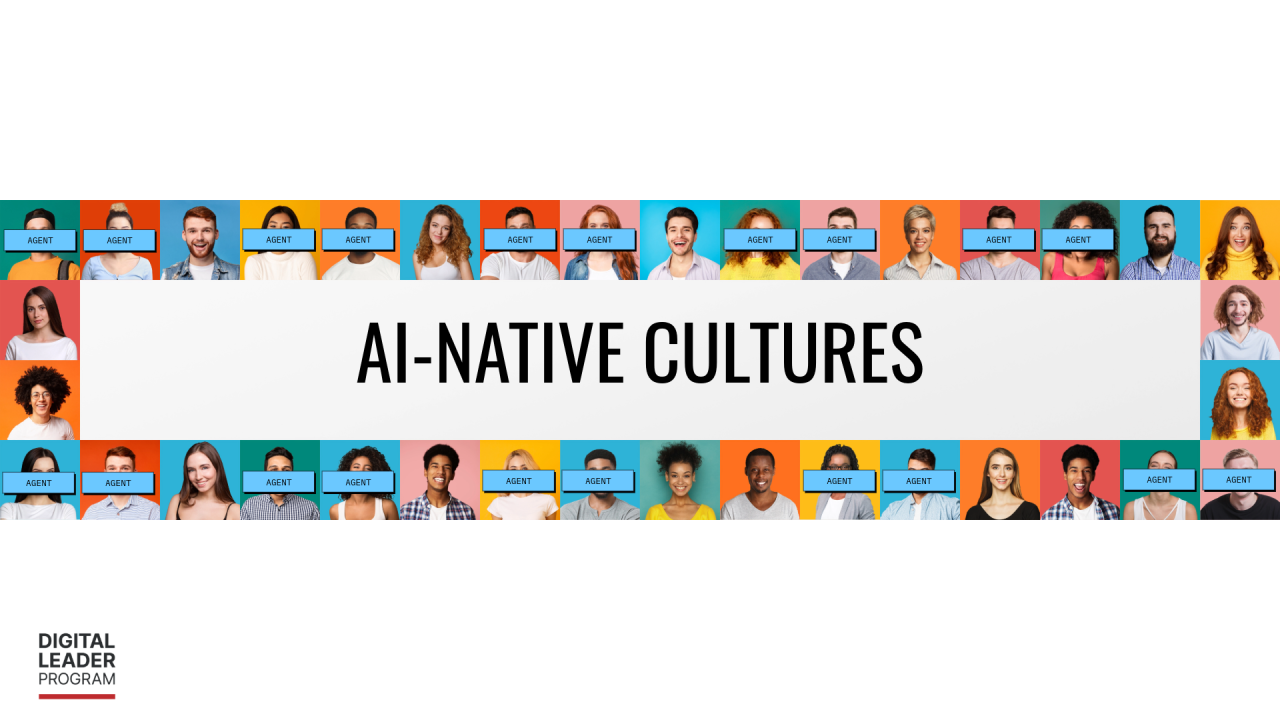
Imagine founding a company this year. Before you hire employee number three, you set up your first agents — for research, for reporting, for support. And to do that, you sit down and write their instructions: what they should optimise for, what they must never do, when they have to stop and ask a human.
Pause on that moment, because something remarkable just happened. You wrote your company's values down — precisely, or the agents misbehave. You defined your priorities as explicit trade-offs, or they optimise for the wrong thing. You set rules, or you get chaos. On day one, before the coffee machine arrives, you did the culture work most companies postpone for a decade.
That's the thought experiment for this edition, the one last week's walk through the Culture Design Canvas was building towards: if you built an organisation from scratch today, AI-native, what happens to each of the ten blocks on that canvas?
My short answer, from last time: culture stops being decoration and beco...
#15 Culture by Design — Your Company Already Has One. Did You Choose It?
The poster on the wall says "meetings start and end on time." The team wrote it themselves, that morning, with some pride. Twenty minutes into the afternoon session, a member of the executive board drifts in, phone in hand, and drifts out again before the block ends.
I've watched a version of that scene more times than I can count. Nobody says anything. Nobody has to. Everyone in the room has just learned more about the real culture than the canvas will ever teach them.
Welcome to the new chapter of this newsletter. For fourteen editions we walked the Digital Leader Canvas — the mirror for the individual. As promised, we now pull back to the room the individual stands in: the culture of a team or an entire organisation. And for that I use another canvas, one I rate highly enough to build twelve-month change programmes on: the Culture Design Canvas by Gustavo Razzetti.
(New here? The Digital Leader Canvas — the individual-level companion to everything that follows — is still a free d...
#14 Communication (Part 2 of 2) — Feedback, Conflict, and the End of the Walk
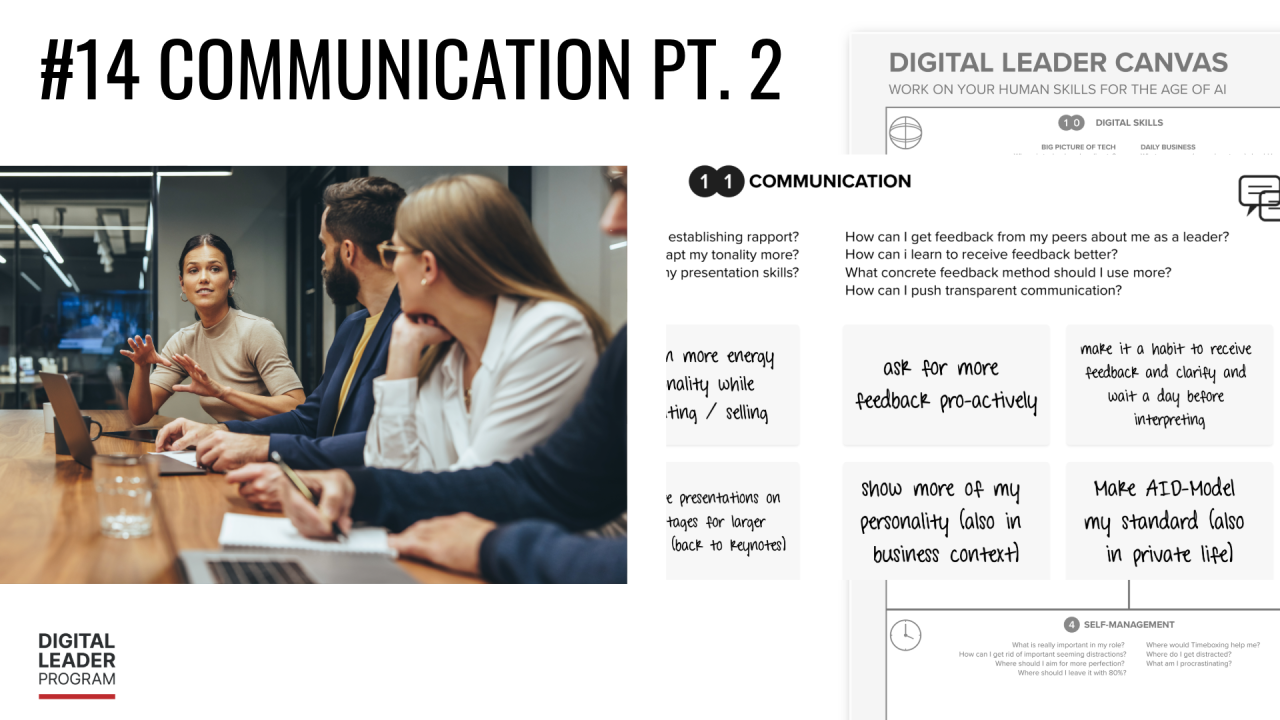
"Feedback is a gift." "Feedback is the breakfast of champions." You've met both, probably on a poster.
They're half true. Champions do take feedback and work on themselves. But I've also watched people ignore almost all of it to build something no committee would have approved — and I've watched "feedback" arrive not as a gift at all, but as a demand: one person requiring something of another, wrapped in a friendly word. Treat every piece as a present you must gratefully accept and you'll end up sanded down to the average of everyone else's preferences.
So let's take down the poster and look at what feedback and conflict actually are — and how to get better at both.
This is the fourteenth part of my walk through the Digital Leader Canvas — Communication, field ⑪, part two. It also closes the walk: field by field, we've now done all eleven. That's not the end of this newsletter, though — more on where it goes next at the end.
(New here? Download the canvas for free: https://www.digi...
#13 Communication (Part 1 of 2) — The Only Tool You Never Put Down
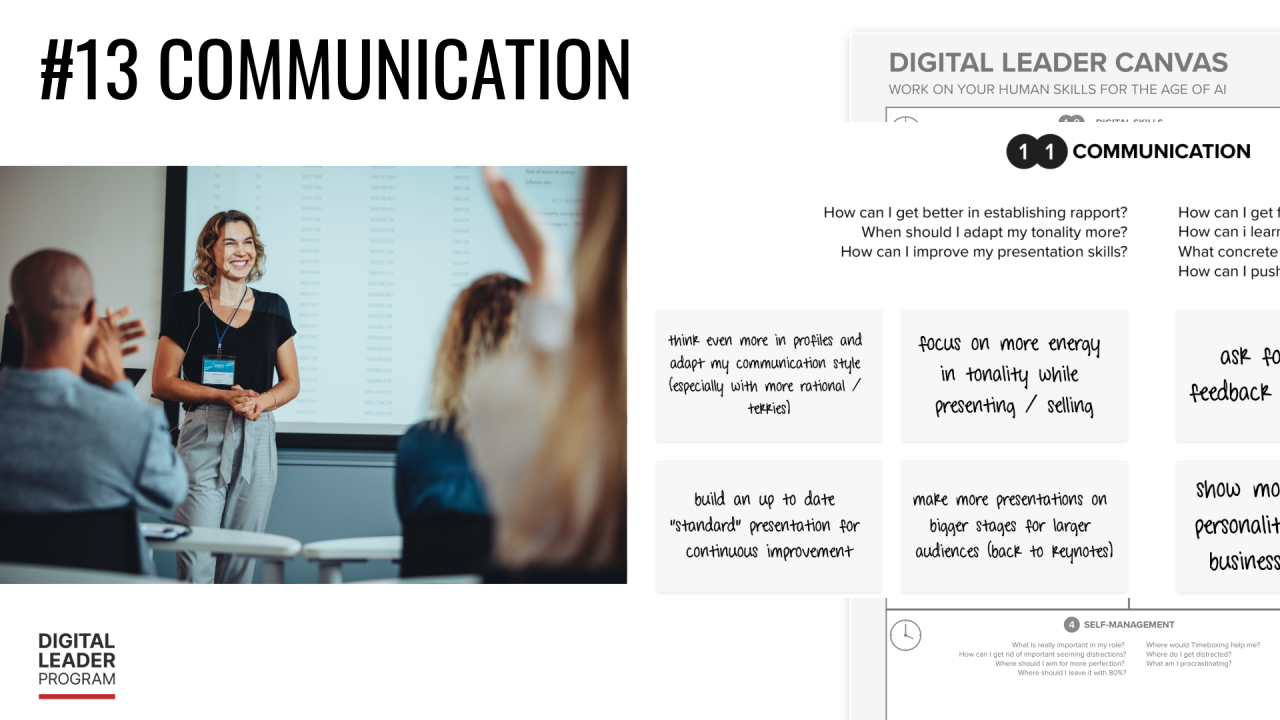
As a child, I trained as a classical singer. Three years of it — learning to place my voice, and, more than that, to hear: the small nuances in someone else's singing, the half-tones in a piece of music. Around the same time, I helped train one of our dogs for hunting. Animals don't read your slide deck. They read your body, your face, and above all your tone.
Two very different apprenticeships, one lesson: long before the words land, the message is already on its way — in the pitch of the voice, the set of the shoulders, the look on the face.
I start here because of a question I'd like you to sit with: where in your life are you already a better communicator than you are at work? In more than fifteen years of giving presentation and pitch trainings, this is the pattern that stands out most: we fall into a narrow "work voice" we quietly believe is the only one permitted — while outside the office we're warmer, sharper, funnier, more direct. The range is already in you. Too often it's...
#12 Digital Skills (Part 2 of 2) — Make One Thing Run Without You
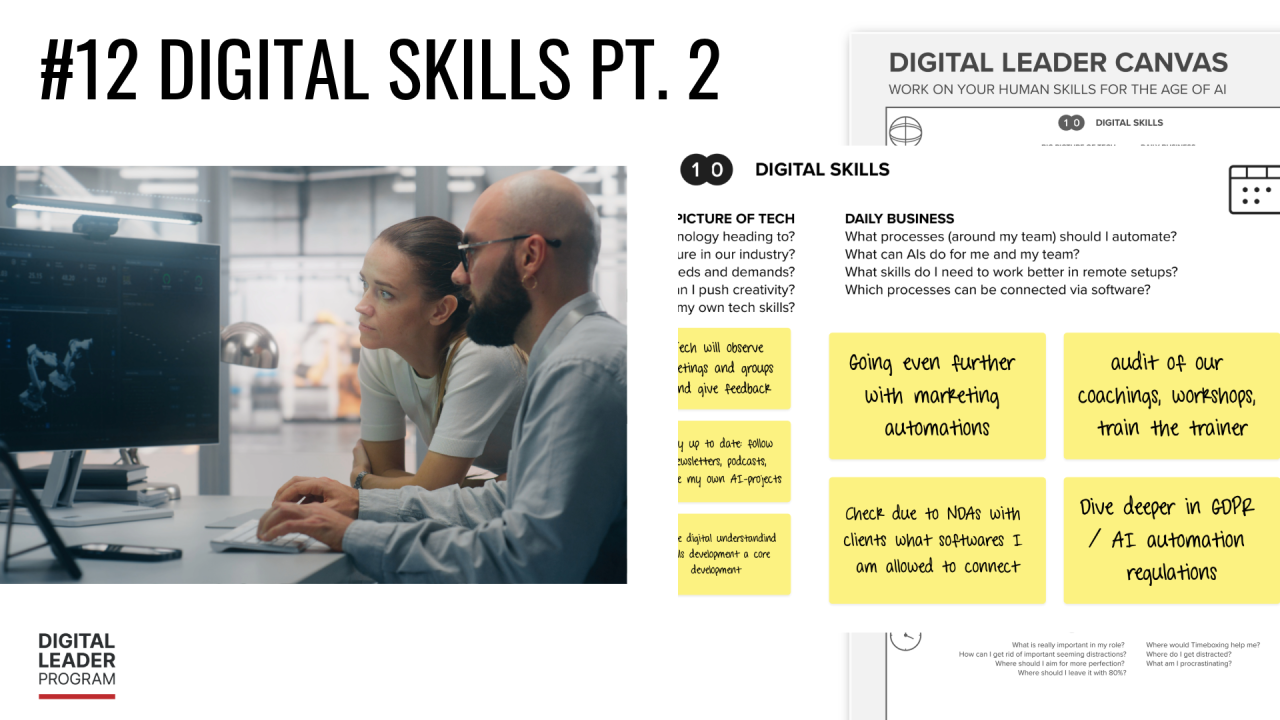
At 6am, a short brief was already waiting in an HR business partner's inbox.
Overnight, the machine had pulled the people numbers for their business unit — headcount and tenure, time off and overtime, the latest engagement pulse, the roles open in the pipeline — set them against the past few months, and written them a note: one team's engagement has slipped three weeks running while its overtime keeps climbing, and here are three things worth checking before it turns into a resignation. They read it over coffee. And they wouldn't dream of acting on it unread.
That gap — between work done and work approved — is the whole subject of this edition.
Last week was the big picture of Digital Skills: why the shift is real, and why no one gets to sit it out. This is the practical half — field ⑩ again, the Daily Business side of the canvas. Less about whether to engage, more about what to actually build.
(New here? Download the canvas for free: https://www.digital-leader-program.de/en/digita...
#11 Digital Skills (Part 1 of 2) — Learning to Drive the Machine
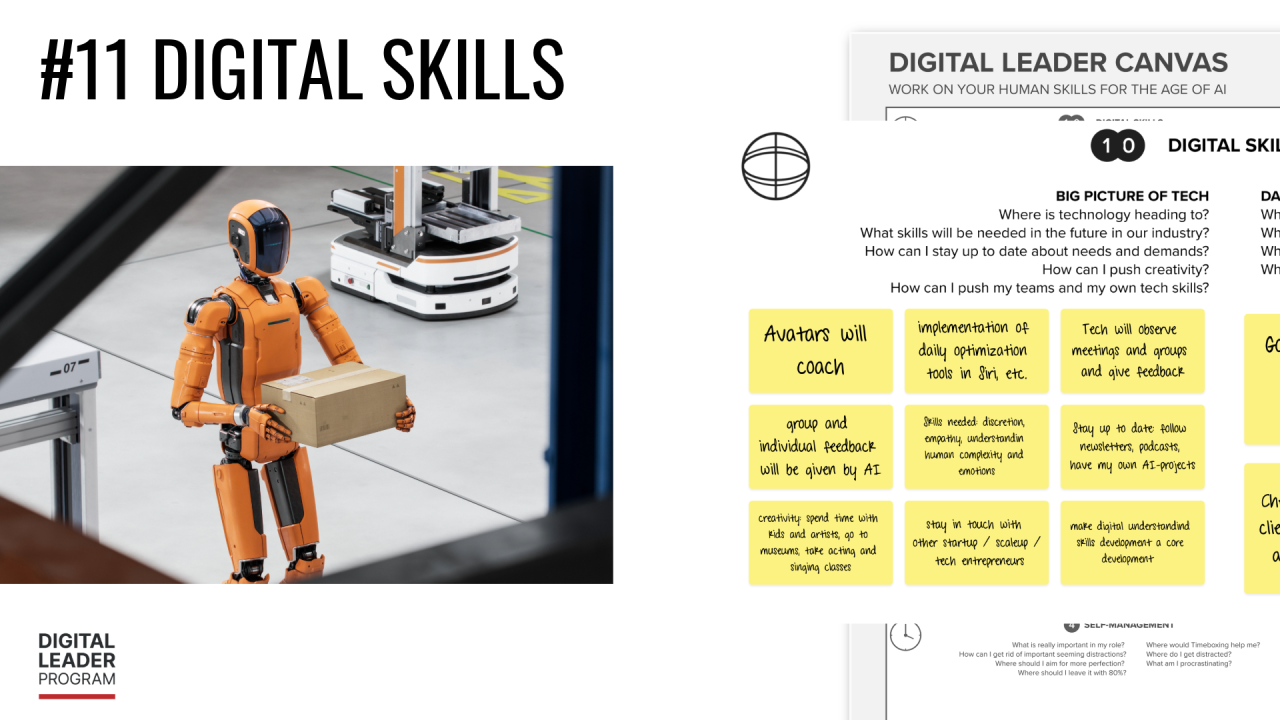
When ChatGPT arrived at the end of 2022, my calendar started to empty.
The German economy was sliding — the energy shock after Russia's invasion of Ukraine had hit hard — and the first budgets cut were always the same: coaching, training, leadership development. Mine. When companies did keep spending, the money went into software and AI, not into people in a room with someone like me.
So I let myself ask the question I'd been circling for months: in a few years, will I still be needed at all?
I'd like to say I met that calmly. I didn't. For a while I told myself AI couldn't really do what I do — less a conviction than a way of not looking at the fear underneath. So I started a podcast on AI and human skills, mostly to force myself to understand the thing I feared. Even with a business-IT background, the climb was slow. But somewhere in it the fear drained away — not because the technology got weaker, but because I finally understood what it could do, what it couldn't, and, step by s...
#10 Profiling — Reading People Without Putting Them in a Box
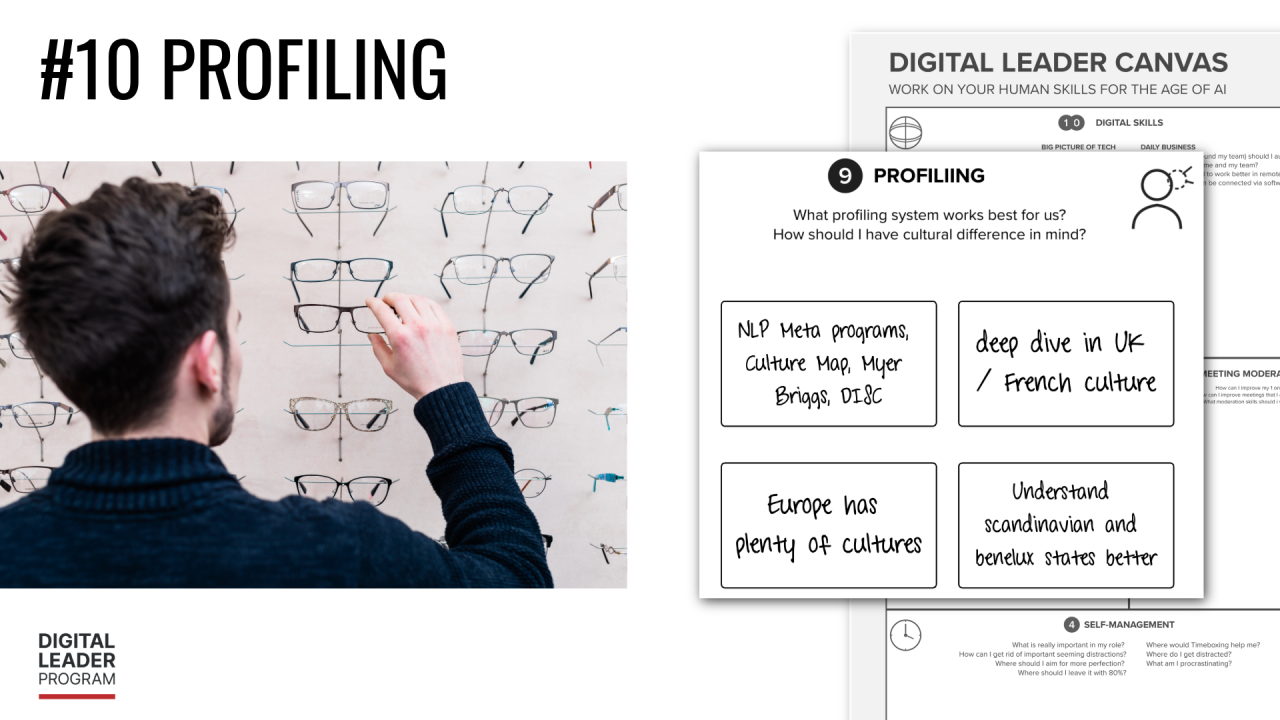
You already know what profiling is. You've seen it on television.
A detective stares at a wall of photographs and works out who the culprit is — not by catching them in the act, but by reading the pattern. How they operate, what they choose, what they avoid. From that pattern, the profiler predicts the next move and gets there first.
Business profiling works on the same logic, minus the crime. You use a model to build a quick read of how someone ticks, then adapt how you work with them. Not to manipulate — to communicate better, reduce friction, and get further together. And once you can do it, you start to see your whole working life differently.
This is the tenth part of my weekly walk through the Digital Leader Canvas — Profiling, field ⑨ — and after last week's edition on reading a room, it's the natural next step: from sensing what's in front of you to making sense of it.
(New here? Download the canvas for free: https://www.digital-leader-program.de/en/digital-leader-program-d...
Recent Posts
Categories
All categories
KNOWLEDGE THAT WORKS IN PRACTICE
This is not a place for buzzwords. Or for theories that don't hold up in real life. Our blog is a space for leaders and professionals who are looking for genuine answers to genuine questions: How do I lead better in a hybrid environment? How do I communicate in a way that actually lands? How do I use AI meaningfully in my daily work? How do I build resilience in my team?
Every article in the Digital Leader Program blog is designed to be directly useful – with insights, methods and examples you can take straight into practice.
TOPICS THAT MATTER TODAY
Leadership in the digital age: How is leadership changing when teams work remotely or hybrid? What do new leaders need – and what do experienced managers need to relearn?
Human Skills under AI influence: Which human capabilities become more important as AI takes over routine tasks – and how do you develop them deliberately?
Hybrid work in practice: Concrete tips, rituals and tools for productive hybrid collaboration – what actually works, and what doesn't.
Culture Design and team dynamics: How do you build an organisational culture that attracts, retains and energises people?
Communication and feedback: The capabilities that separate average performance from real high performance.
FROM PEOPLE WHO WORK IN PRACTICE
Our articles are written by Andre Ottlik and our team – people who work in coaching sessions, workshops and training every single day. What you read here is not copy-pasted from academic studies, but knowledge drawn from lived practice.
And occasionally we feature contributions from external experts sharing insights from their own fields – such as the piece with Pascal Baumgartner on hybrid meeting optimisation.
FREQUENTLY ASKED QUESTIONS (FAQ)
How often are new articles published?
Regularly. Subscribe to our newsletter or follow us on LinkedIn to make sure you don't miss new content.
Are articles available in German too?
Yes. Many of our articles are also available in German – particularly on topics relevant to German-speaking leaders and organisations.
Can I suggest article topics?
Absolutely. Write to us or bring it up in a conversation – we welcome input from our community.
How can I go deeper than the blog?
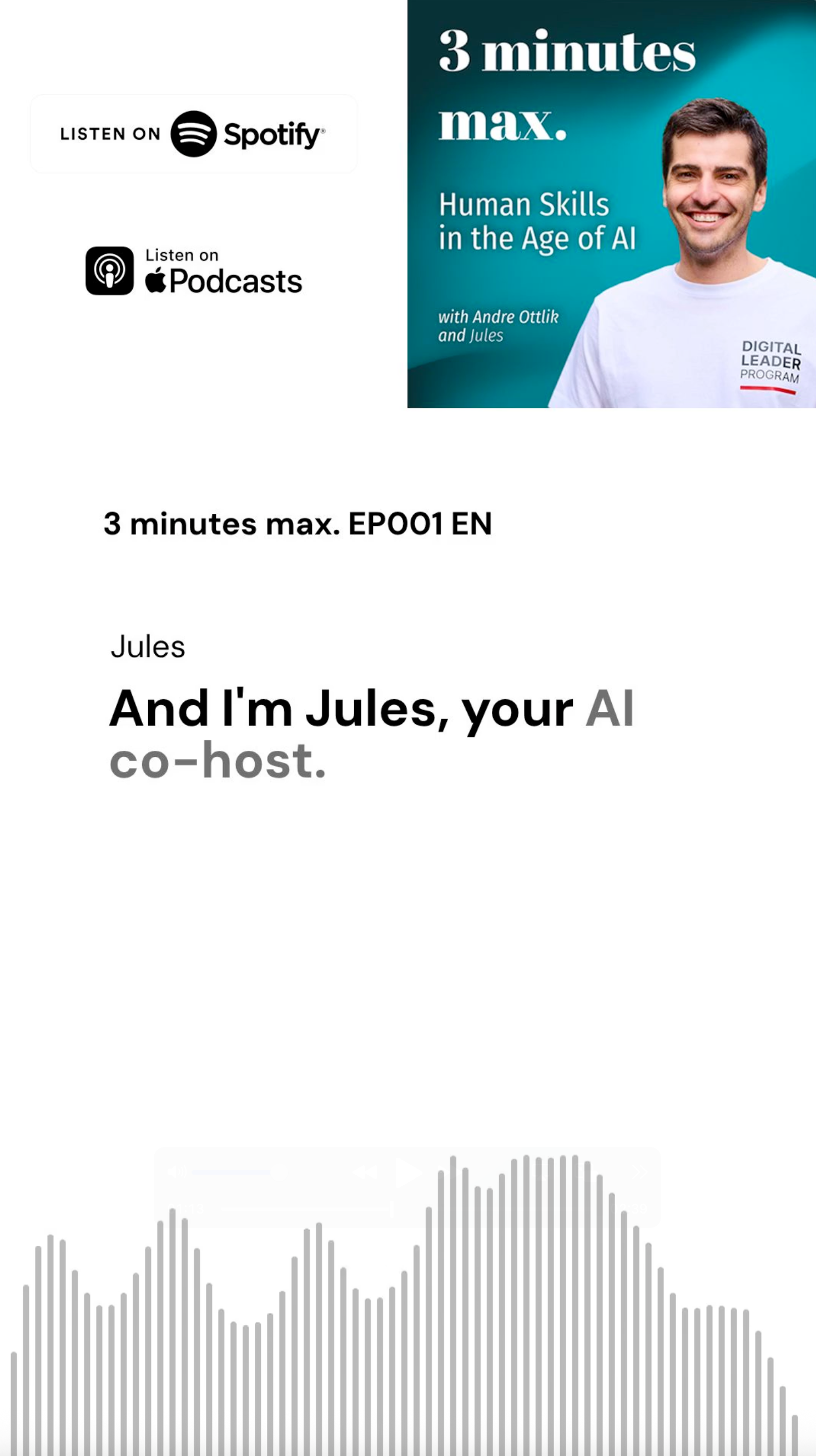
Our workshops, coaching programmes and the podcast "3 minutes max." go further and support you systematically in your development. Browse our service pages or book an initial consultation.
Author
Andre Ottlik
Author
Andre and his Team are the authors of Digital Leader Programs Blog Posts
