
#9 Senses & Emotions — The Leadership Edge No Machine Can Copy (Yet)
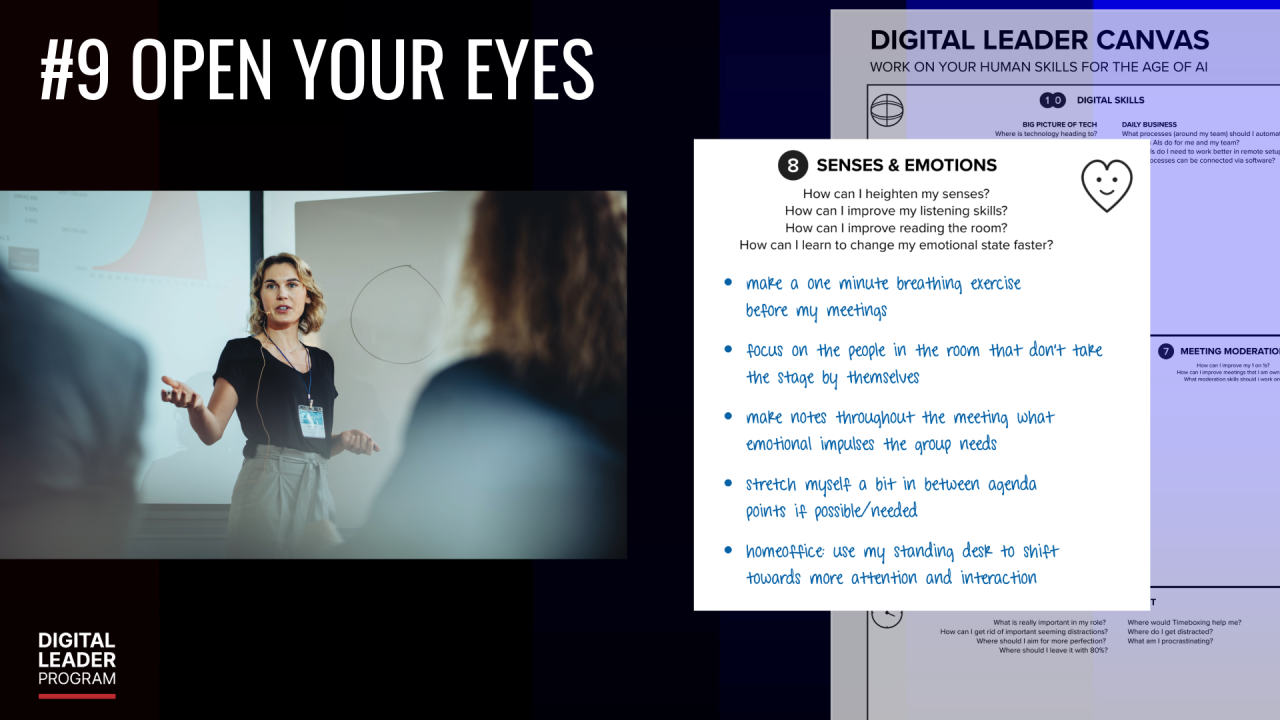
Walk into the office on a Monday morning and, within seconds, you know things no status report will ever tell you. Who's stressed before they've said a word. Which two colleagues aren't speaking. Whether the team that shipped on Friday is quietly proud or quietly burnt out. The mood of the meeting before the meeting starts. You haven't asked a single question, and you already have a read on the room.
That flood of signal — thousands of impressions absorbed and made sense of in an instant — is one of the last clear advantages humans hold over machines. And I think it'll stay that way for a while.
This is the ninth part of my weekly walk through the Digital Leader Canvas — Senses & Emotions, field ⑧ — and of all eleven, it might be the one most worth investing in to stay valuable in an AI world.
(New here? Download the canvas for free: https://www.digital-leader-program.de/en/digital-leader-program-digital-leader-canvas)
The canvas asks:
How can I heighten my senses? How can I impro...
#8 Meeting Moderation — The Most Underrated Skill in Your Calendar
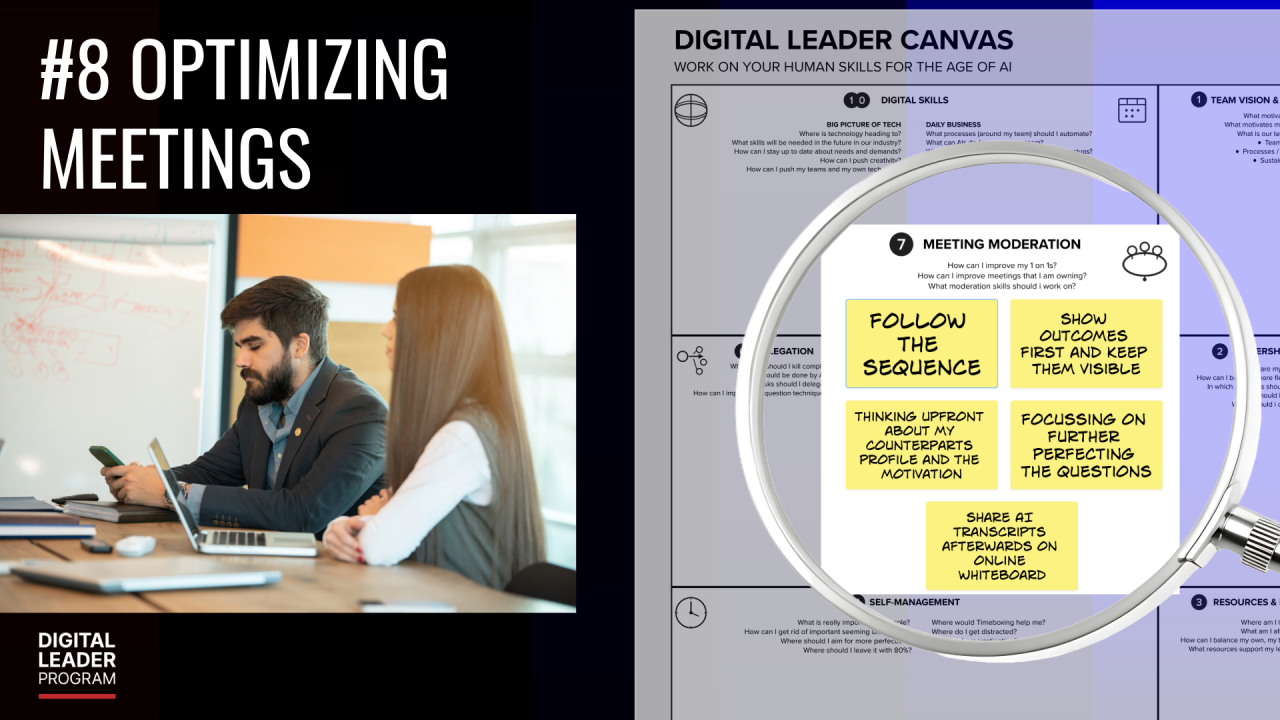
A team gathers. There's no agenda. Nobody said why. Halfway in, two people are checking email under the table, one has gone silent, and the most senior person is doing most of the talking. An hour disappears. Nothing is decided. Everyone files out and books a follow-up.
You've sat in that meeting. You've probably run it.
Executives spend an average of nearly 23 hours a week in meetings, and meetings still rank as the number one barrier to workplace productivity. Yet the skill that determines whether all those hours are useful or wasted — moderation — is, in my experience, one of the most underrated skill sets in business. Almost nobody is trained in it. And since COVID turned remote and hybrid meetings into the norm, the people who own meetings have fallen even further behind the demands of the format.
This is the eighth part of my weekly walk through the Digital Leader Canvas — Meeting Moderation, field ⑦ on the canvas.
(New here? Download the canvas for free: https://www.digital...
#7 Delegation — What to Keep, What to Hand Over, What to Automate
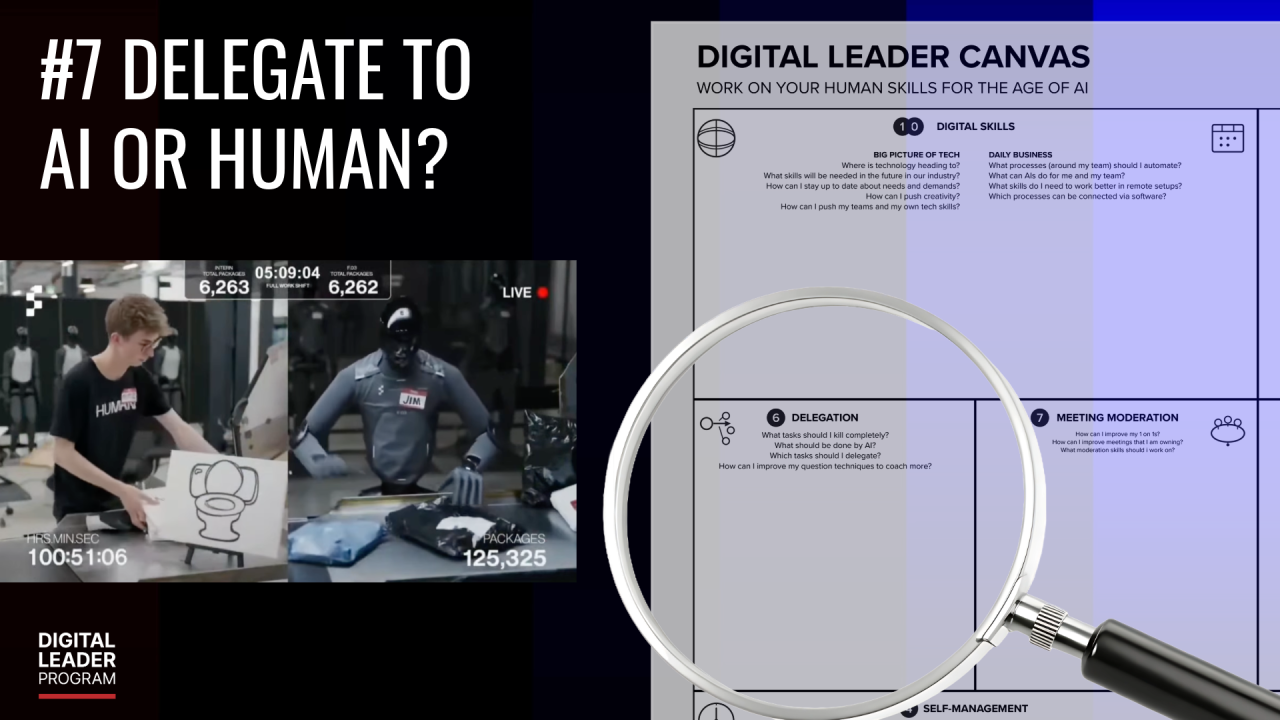
In May 2026, Figure AI staged a "Man vs. Machine" challenge: a human intern named Aime against their F.03 humanoid robot, sorting packages side by side for ten hours straight. Same task, same routine — detect a barcode, pick up a package, place it on a conveyor belt.
The human won. But barely. Aime sorted 12,924 packages; the robot managed 12,732 — a gap of about four-hundredths of a second per package. The robot had actually pulled ahead around hour five, while Aime took a bathroom break. By the end, Aime had blisters on his fingers and said his forearm felt broken. The robot can run across shifts. No breaks. No blisters.
What struck me wasn't who won. It was how little the victory meant. A tired human beat a first-generation machine by a rounding error, and the machine doesn't get tired. Physical work may still hold a slim edge. Desk work holds less. Mustafa Suleyman, the CEO of Microsoft AI, recently made one of the industry's most aggressive predictions: that most desk-based prof...
#6 Energy, Focus & Meditation - just the right balance
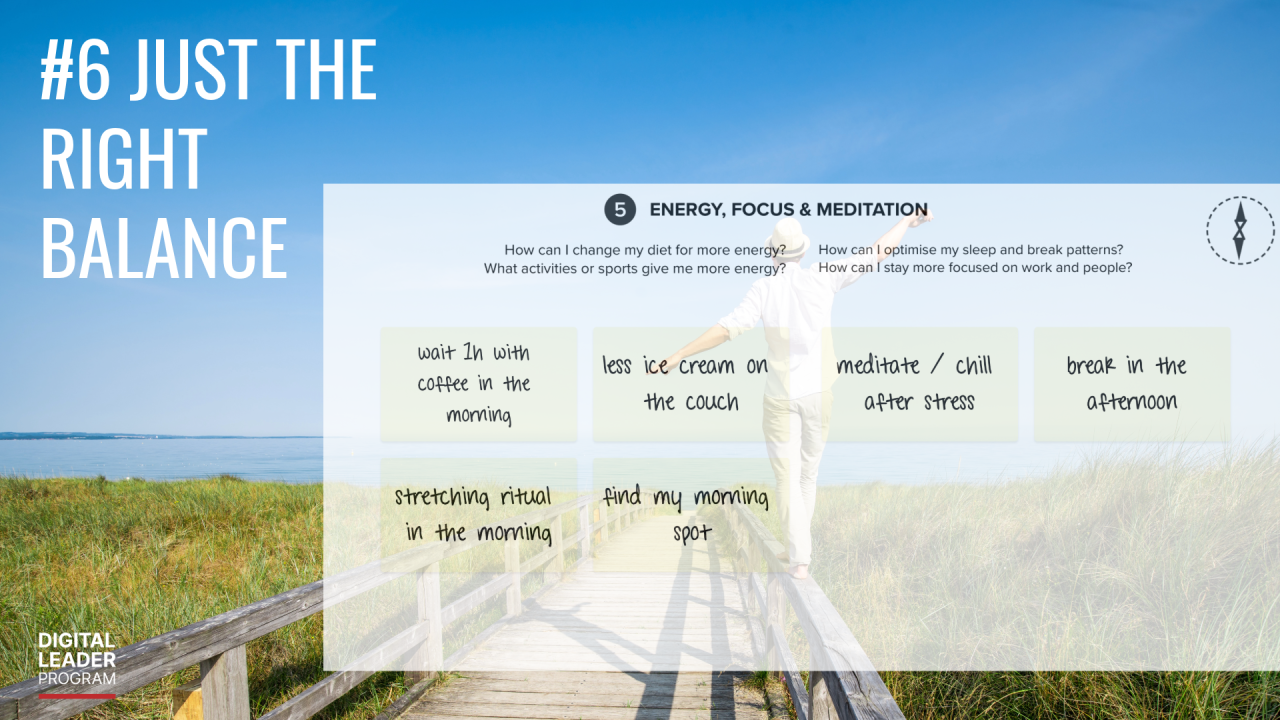
Ping. Another notification. Another dopamine hit. Another moment of focus — gone.
You probably didn't even notice it. That's the point. The attention economy is a multi-trillion-dollar global industry built on grabbing your focus before you can decide where to put it. Every notification taps into your brain's dopamine system — the mechanism behind anticipation and reward — creating a loop that keeps you reaching for your phone. And research shows it can take up to 20 minutes to fully refocus after a single interruption.
We've never lived in a time where so much information competed for so little attention. Our phones are always with us. Our laptops are always open. And in the evening, there's binge-watching to fill whatever silence is left.
The good news: AI is starting to fight back — on your side. Gmail's AI prioritisation already filters to high-priority only. Outlook's Copilot triages your inbox and summarises threads. Tools like Shortwave bundle low-priority emails into collaps...
#5 Self-Management — Where Your Intentions Become Actions
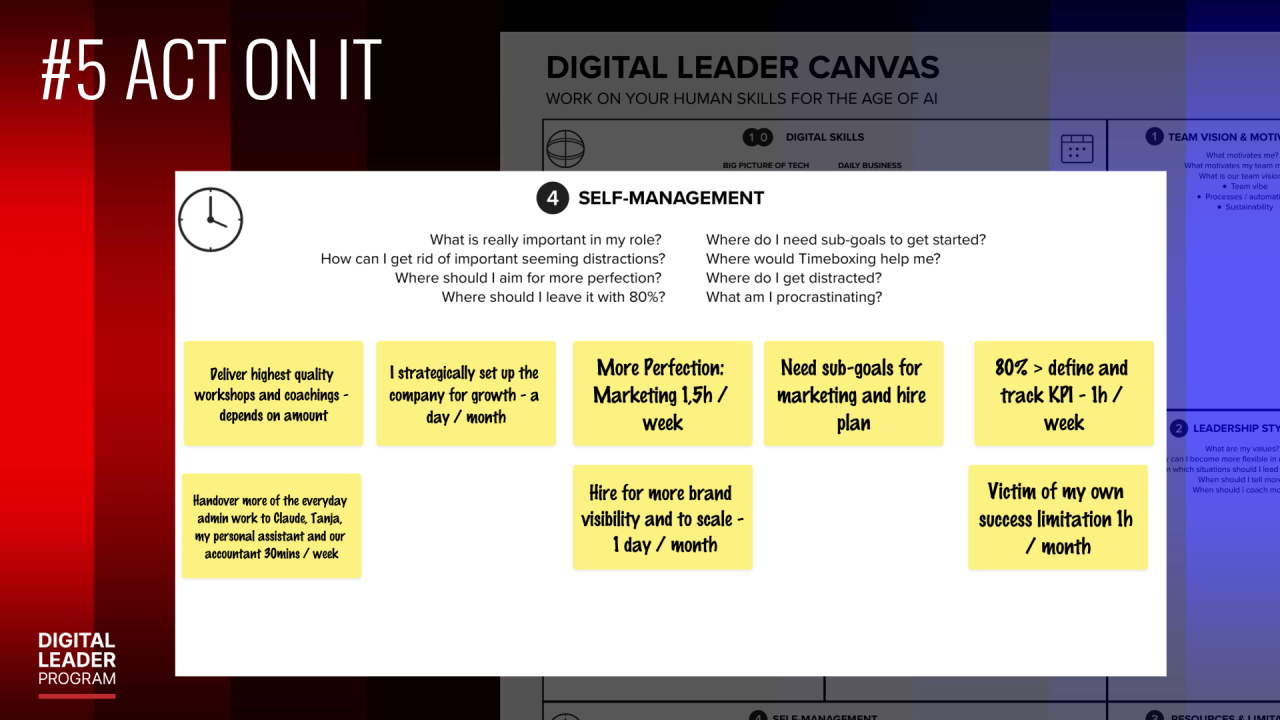
"Yeah, we've done that already."
That's what I hear every time I include a self-management module in a workshop series. And I get it. Self-management sounds basic. Everyone thinks they know how to manage their time.
But here's what I keep seeing: people who are very good at managing others and have real problems managing themselves. They can build a project plan for their team in an hour but haven't looked at their own priorities in months.
In a recent workshop, a team lead told me she had been timeboxing everything meticulously — except the one strategic project that would actually move her career forward. She'd been protecting time for everyone else's priorities and leaving none for her own. It took a 10-minute exercise with the Eisenhower matrix and honest feedback from her peers to see it. She could have read about Eisenhower a hundred times. But she needed someone to point at her board and say: "Where are you on this?"
That's Quadrant ④ on the Digital Leader Canvas — Self-Mana...
#4 Resources & Limitations — What's Actually Holding You Back?
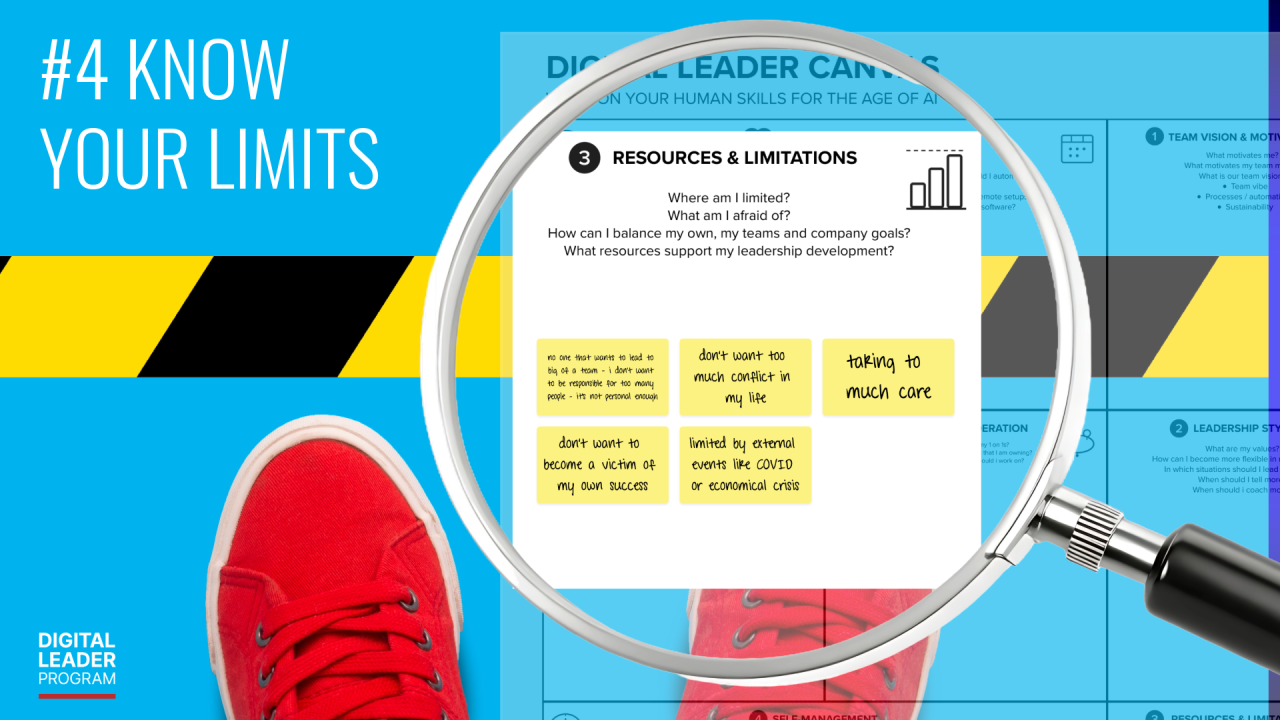
his is part four of my weekly series on the Digital Leader Canvas — a free self-assessment framework with 11 dimensions of leadership. If you're new here, you can download the canvas and catch up: https://www.digital-leader-program.de/en/digital-leader-program-digital-leader-canvas
This week we're looking at Quadrant ③ — Resources & Limitations. The canvas asks:
Where am I limited? What am I afraid of? How can I balance my own, my teams and company goals? What resources support my leadership development?
This is the most uncomfortable quadrant on the canvas. And that's exactly why it matters.
A leader who gave up on AI after one wrong answer
A client of mine recently tried out a Microsoft AI product. He asked it to run a calculation. The answer was wrong.
Worse: he discovered that some of his employees had been using the same tool, copying and pasting AI-generated calculations into their work — without checking them. They sent those wrong numbers up the chain.
He drew two conc...
#3 Leadership Style — When to Tell, When to Coach
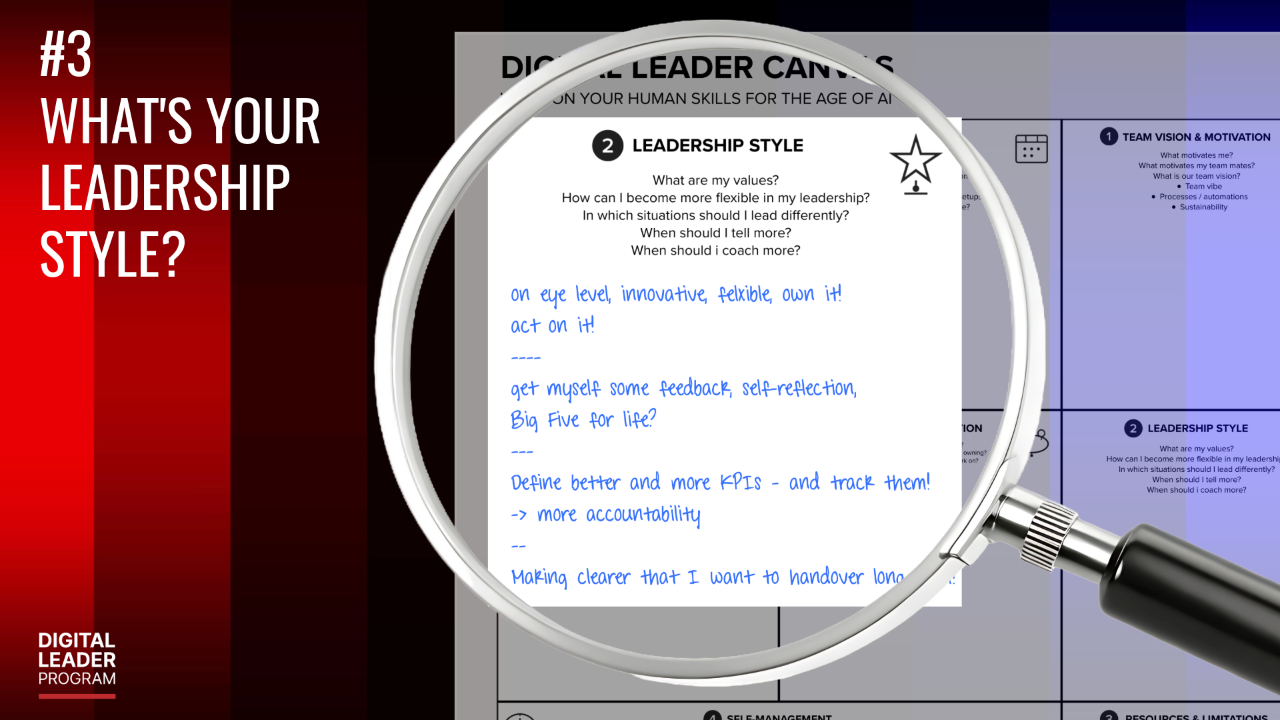
This is part three of my weekly series on the Digital Leader Canvas — a free self-assessment framework with 11 dimensions of leadership. If you're new here, you can download the canvas and catch up: https://www.digital-leader-program.de/en/digital-leader-program-digital-leader-canvas
This week we're looking at Quadrant ② — Leadership Style. The canvas asks:
What are my values? How can I become more flexible in my leadership? In which situations should I lead differently? When should I tell more? When should I coach more?
Let's get into it.
The two extremes
I think every leader moves between two extremes:
On one end: telling. Giving answers, making decisions, directing. Some people call it bossing — I'll use that word too, because that's how it often feels to the person on the receiving end.
On the other end: coaching. Asking questions, guiding, handing over responsibility. Trusting the other person to figure it out.
Most leadership advice today tells you to move towards coach...
#2 Team Vision & Motivation
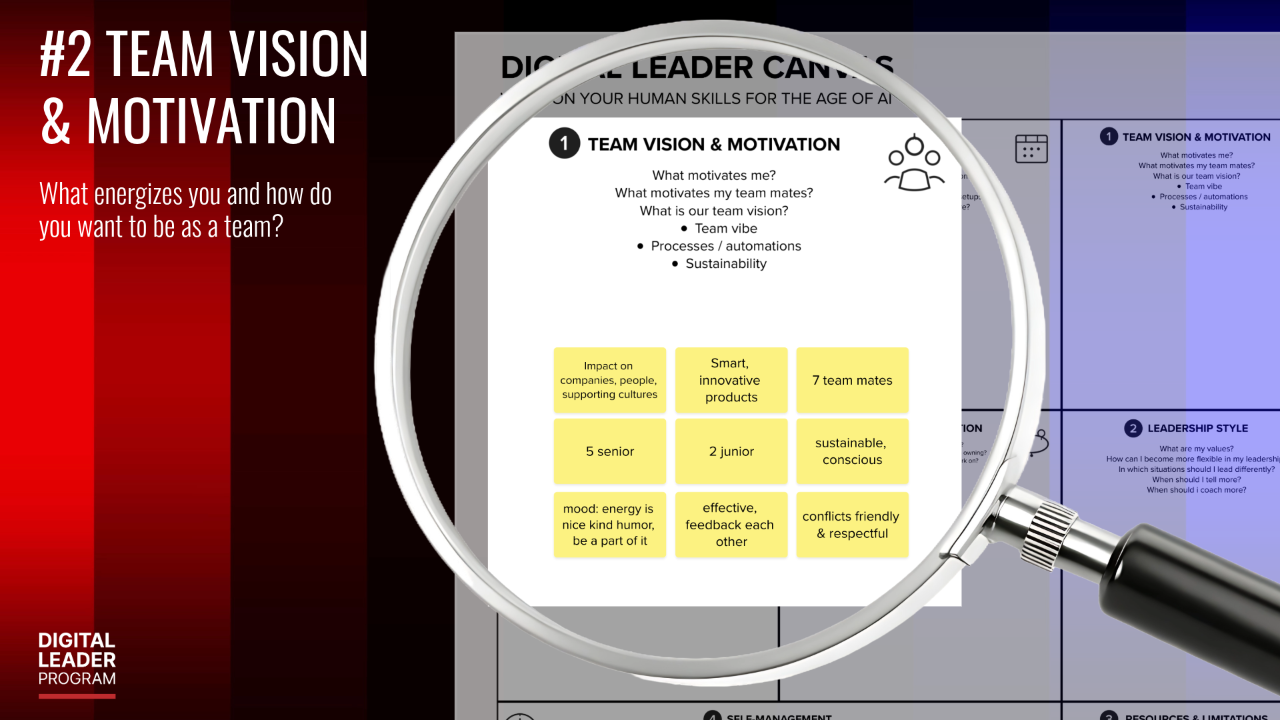
Last week I released the Digital Leader Canvas — a free self-assessment framework with 11 dimensions of leadership. If you missed it, you can download it here: https://www.digital-leader-program.de/en/digital-leader-program-digital-leader-canvas
This week, we're diving into the first quadrant: Team Vision & Motivation.
But first - let me give you some tips on how to work with the canvas.
You can print it and fill it out or use post-its, you can use the online whiteboard and fill it out digitally. You can work on it by yourself or with a colleague, friend or together with your team. OR you use some LLM to be your counterpart:

Happy to hear your thoughts and feedback on that!
Ok, let's get to work now: Team Vision & Motivation
The three questions
This field asks you to reflect on three things:
What motivates me? Not the polished answer you'd give in a job interview. The real one.
What motivates my teammates? Not what you assume. What actually drives them.
What i...
Linkedin Newsletter "Human Skills in the Age of AI" & Releasing the Digital Leader Canvas
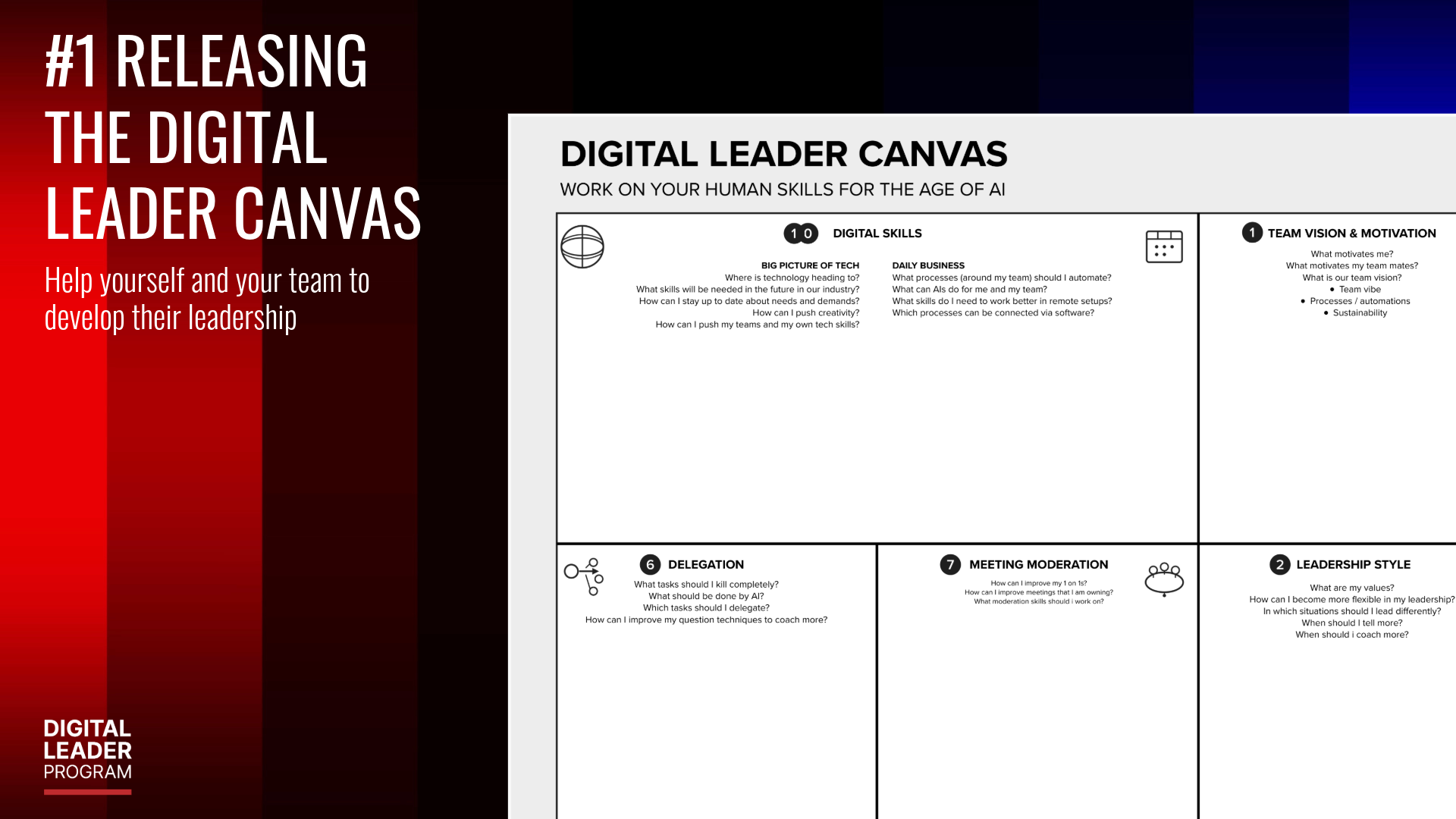
Big news today! Andre is launching his new Linkedin Newsletter called Human Skills in the Age of AI - feel free to subscribe here: https://www.linkedin.com/build-relation/newsletter-follow?entityUrn=7444678645496860672
AND we released our Digital Leader Canvas! (Which we will cover in detail and step by step in the next newsletters)
Why a canvas?
Over the years, I've seen leaders struggle with the same question again and again: "I know I should develop as a leader — but where do I actually start?"
Most leadership tools are either too abstract (personality tests that label you but don't guide you) or too rigid (competency checklists that miss the human side). I wanted something different.
Inspired by the logic of the Business Model Canvas, the Digital Leader Canvas breaks leadership down into eleven concrete dimensions — and gives you a structured way to reflect on each one.
It's not a personality test. It's not a scorecard. It's a thinking tool.
The 11 dimensions
The canva...
Certified Coach on LinkedIn, Command-and-Control on Monday

Why coaching skills don’t survive the inbox — and what actually helps.
Many leaders proudly add “Certified Coach” to their LinkedIn headline. On Monday morning, they still mostly tell people what to do.
I don’t say this with judgment. In hectic times, directing feels faster than coaching. When deadlines are tight and inboxes are full, giving a quick answer looks like the responsible thing to do. Coaching, especially at the beginning, feels slower and sometimes even inefficient.
It is important, but rarely urgent — and that is exactly why it loses against day-to-day business.
The Pattern I See Over and Over
I meet more and more leaders who have completed serious coaching programs. They know open questions, active listening, powerful silence. Many of them genuinely care about their people.
And then I observe them in their regular meetings:
- They start with a question — and then jump in with the solution.
- They ask “What do you think?” — and steer the conversation back to their ...
Recent Posts
Categories
All categories
KNOWLEDGE THAT WORKS IN PRACTICE
This is not a place for buzzwords. Or for theories that don't hold up in real life. Our blog is a space for leaders and professionals who are looking for genuine answers to genuine questions: How do I lead better in a hybrid environment? How do I communicate in a way that actually lands? How do I use AI meaningfully in my daily work? How do I build resilience in my team?
Every article in the Digital Leader Program blog is designed to be directly useful – with insights, methods and examples you can take straight into practice.
TOPICS THAT MATTER TODAY
Leadership in the digital age: How is leadership changing when teams work remotely or hybrid? What do new leaders need – and what do experienced managers need to relearn?
Human Skills under AI influence: Which human capabilities become more important as AI takes over routine tasks – and how do you develop them deliberately?
Hybrid work in practice: Concrete tips, rituals and tools for productive hybrid collaboration – what actually works, and what doesn't.
Culture Design and team dynamics: How do you build an organisational culture that attracts, retains and energises people?
Communication and feedback: The capabilities that separate average performance from real high performance.
FROM PEOPLE WHO WORK IN PRACTICE
Our articles are written by Andre Ottlik and our team – people who work in coaching sessions, workshops and training every single day. What you read here is not copy-pasted from academic studies, but knowledge drawn from lived practice.
And occasionally we feature contributions from external experts sharing insights from their own fields – such as the piece with Pascal Baumgartner on hybrid meeting optimisation.
FREQUENTLY ASKED QUESTIONS (FAQ)
How often are new articles published?
Regularly. Subscribe to our newsletter or follow us on LinkedIn to make sure you don't miss new content.
Are articles available in German too?
Yes. Many of our articles are also available in German – particularly on topics relevant to German-speaking leaders and organisations.
Can I suggest article topics?
Absolutely. Write to us or bring it up in a conversation – we welcome input from our community.
How can I go deeper than the blog?
Our workshops, coaching programmes and the podcast "3 minutes max." go further and support you systematically in your development. Browse our service pages or book an initial consultation.
Author
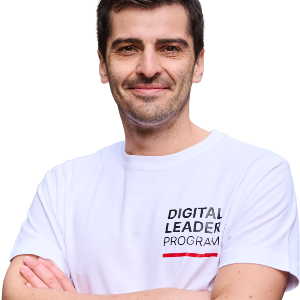
Andre Ottlik
Author
Andre and his Team are the authors of Digital Leader Programs Blog Posts
