
#21 Curiosity (Part 1 of 2) — The Mid-Career Dip
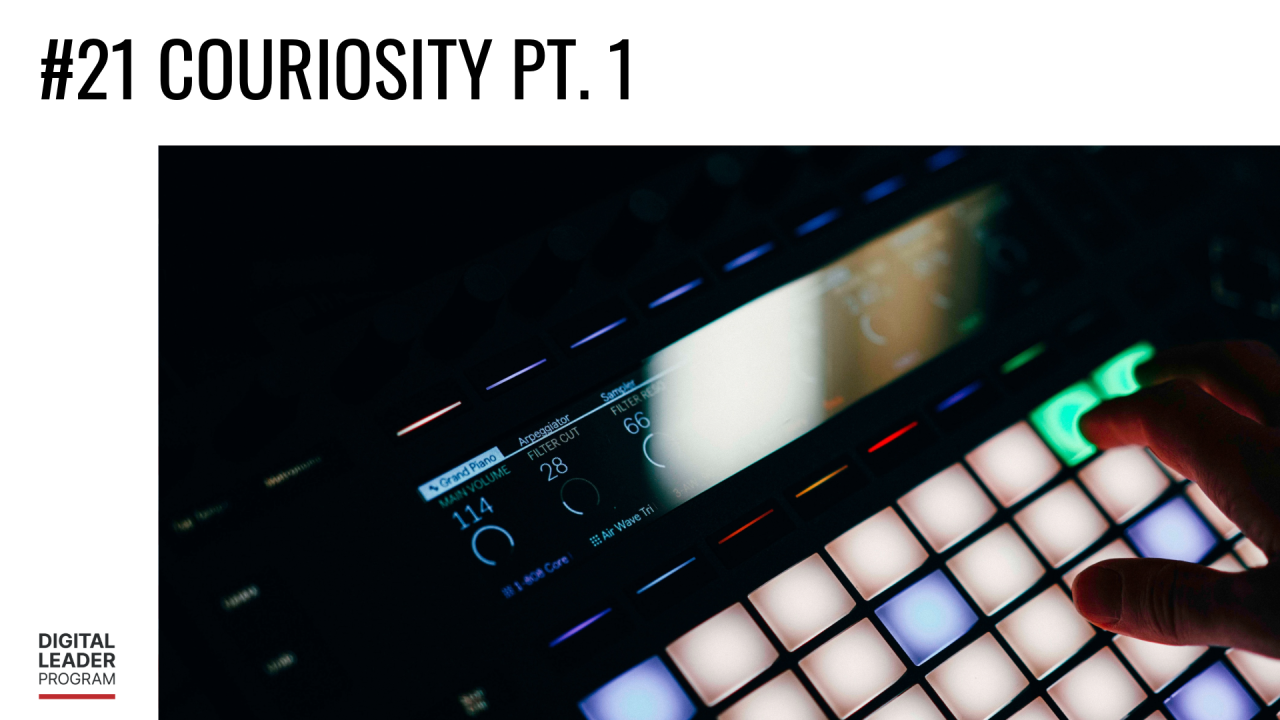
A child in front of a television is doing something clever. In twenty minutes it gets a jungle, a submarine, a city at night and a family that isn't its own, without leaving the sofa. More new things per minute than the house could ever offer. The brain, built to hunt for novelty, has found a shortcut.
For plenty of adults the shortcut survived childhood; only the screen changed. And somewhere between the sofa and the office, for many, the pleasure in the new goes missing. This edition is about whether that's true, what the shortcut leaves out, and why mid-career may be where it costs most.
(Second of Microsoft's 5Cs in this mini-series, after courage. Curiosity gets two editions as well, and this one is about the first of two dials: wanting the new at all.)
7 min read. If you take one thing from this: curiosity is a learning state, not a mood. It tends to dip in mid-career. And the grey feeling at the start of something new is real, not a weakness. Ahead: what novelty does in the brain; 1,218 adults: where curiosity goes with age; why the first weeks of something new can feel like work; what 47 seconds have to do with it. Part 2 next week: the second dial, the fear that stops interest turning into exploration.
Wired to look
The authors of Microsoft's 5Cs define curiosity through a question: "What if we tried something completely different?" Fair enough, but a question is the end of a process. The interesting part is what has to be true before anyone asks one.
In 2006, Nico Bunzeck and Emrah Düzel showed people a stream of images in a scanner, most of them repeated, a few of them novel. The midbrain's dopamine engine, the substantia nigra and ventral tegmental area, lit up for novelty as such: not for emotional pictures, not for ones that required a response, only for the fact that an image was new.
That is where the popular story stops: new thing, dopamine hit, curiosity. The authors were more careful. They read their result as fitting models that treat novelty "as a motivating bonus to explore an environment in the search for reward rather than being a reward itself". The signal doesn't say this is nice. It says go and look.
Eight years later, Matthias Gruber and Charan Ranganath at UC Davis ran a study on trivia and faces. People rated how curious they were about trivia questions, then waited fourteen seconds for each answer while an unrelated face flashed on screen. When curiosity was high, memory for the answer was better, as you'd expect. Less expected: memory for the faces was better too, a day later. Ranganath's summary: curiosity puts "the brain in a state in which you are more likely to learn and retain information, even if that information is not of particular interest or importance".
So curiosity is a state, and while it's on, you learn things you weren't trying to learn. The child on the sofa is in it. Whether the same person is still in it thirty years later, in a meeting about a new tool, is the question.
Where it goes
In 2025, Whatley, Murayama, Sakaki and Castel published data on 1,218 adults aged twenty to eighty-four. They measured two things: trait curiosity, the disposition you'd describe in a reference, and state curiosity, how much someone wanted the answer to the question in front of them.
Trait curiosity declined with age, modestly. State curiosity did the opposite. It rose, and in an exploratory analysis the curve was U-shaped: the lowest point sat in middle age, with older adults more curious about particular things than people in their twenties.
The usual qualifications apply: it's a snapshot rather than people followed over decades, the effects are small, and the state measure was trivia. Still, on this data, the people least drawn to something new put in front of them are neither the juniors nor the sixty-year-olds. They're the ones in the middle, and my guess at why: the most responsibility, the fullest calendars and the most to lose from looking like a beginner.
In the Profiling edition I noted in passing that the Big Five is the model academic psychology treats as best validated, and openness to experience is the Big Five trait closest to curiosity. Its "ideas" facet is intellectual curiosity by another name. Like the other four, it is substantially heritable, and it tends to decline in later adulthood. You will not train the trait in, and short of replacing the workforce, you won't hire it in either.
The state is another matter. It's situational, it responds to design, and it is the one that rose with age in that study. If you've been telling yourself the new tools are for the younger ones, the data disagrees. And the question for a leader is never "is this person curious?" but "what would have to be in front of them?"
A quick aside for HR and people-development leaders. If you're reading this and thinking that your culture, or your leadership, could take more curiosity than it currently gets, talk to me and we'll get you on the way. That is the work I do: over months rather than days, as coaching, workshops and longer programmes, or a culture offsite to start. If there's development budget left this year, this is the moment to decide whether it goes on another event your teams will have forgotten by February, or on getting one team moving. If you're planning next year, same conversation, only earlier and cheaper. I take on a few organisations at a time. Twenty minutes, and you'll leave with a clear next step whether or not you work with me: book a call.
The grey phase
Here is what I got wrong. Until recently I had "learning costs effort" filed under limiting beliefs, one more story people tell themselves. It isn't one.
In 2024, Louise David, Eliana Vassena and Erik Bijleveld at Radboud University pooled 170 studies with 4,670 participants across 29 countries. Across the populations and tasks in that pool, more mental effort went with more unpleasant feeling: frustration, stress, irritation. Bijleveld put it bluntly: "People choose mentally effortful activities despite the effort, not because of it."
Curiosity is not the absence of effort. It is the mechanism that makes the effort worth paying, and it needs something to work with.
George Loewenstein described that something in 1994. Curiosity, in his account, is an information gap: the itch between what you know and what you've just noticed you don't. You need to know a little before you can feel the gap. Know nothing, and there is no gap, just a wall.
About seven years ago I opened Ableton Live for the first time, wanting to make electronic music. For months it was a grey wall of grids and menus, and none of the effort felt like curiosity. It felt like work. The wanting came later, once I knew enough to notice what I didn't know: why one kick drum sits in a mix and another doesn't. And once it arrived, it compounded. Each part I understood produced questions about the next, and the questions started feeding each other. That is the far side of the wall, the part the grey phase hides from you: the effort is front-loaded, the curiosity is not.
The opposite of that wall is the child on the sofa: novelty on tap, and no wall at all. Swap the television for a feed and the shortcut is still there. Gloria Mark at UC Irvine has been logging how long knowledge workers stay on one screen before switching: about two and a half minutes in 2004, 75 seconds by 2012, and 47 seconds in her most recent studies. One qualification she insists on: social media is "not the full story", and we interrupt ourselves as often as anything interrupts us. Nor is it a story about the young; her participants were working adults, not teenagers.
Put that number next to the midbrain. The signal says go and look. A feed delivers the looking without the going, a fresh signal every 47 seconds with no wall behind it, while the new tool at work sits behind exactly the wall the feed lets you skip. What the feed cannot deliver is the far side: the point where the questions start feeding each other. That only exists behind effort, and it is, I think, the better deal by a distance.
Which is why the way back is smaller than it looks. Not a new discipline or a course. One thing, followed far enough to notice a single gap. From there the signal that says go and look has somewhere to point again, and the compounding can start. For a team, the same logic means the fix is rarely another demo, and never a poster.
Your turn
Your 1% this week. Pick one thing you've dismissed as not for you: an AI tool you've been forwarded three times, a colleague's way of working, a language.
- Give it fifteen minutes a day for five working days. Not to master it, but to get far enough in to hit the first thing you don't understand.
- When that first gap appears, write it down. That sentence is where curiosity finally has something to work with. It's also the point where quitting is most tempting, and a week too early.
If you lead a team, one more. Find the person who has opted out of the new tools and stop sending them demos. Give them one question instead, specific to their work, that the tool might answer. Curiosity needs a gap to work on, and a feature list has none.
If you develop people, one more still. Before the next AI session, collect one real question from each participant and build the session around those. Afterwards, ask what they want to find out next, not whether they liked it.
Next week: the second dial. Wanting the new doesn't get you across the wall on its own. What does is the willingness to be seen not knowing, and the environment that decides what that costs. It starts in 1992, with a games console and a word my mother and stepfather used a lot.
What did you dismiss as "not for you" that turned out to matter? Tell me in the comments, and if you've seen the mid-career dip in your own team, I'd like to read that one especially. I read every reply.
One favour before you close the tab. If you know a leader who decided years ago that they're "not a tech person", or an HR colleague trying to get one of them into the next AI session, forward this to them. Word of mouth is how most people find this newsletter, and a recommendation from you carries further than anything I can write.
If you're in HR or L&D and want to bring these themes into your organisation, here's that link again: book a 20-minute call. You can also explore the Leadership Essentials Workshop Series for teams.
Recent Posts
Categories
All categories
KNOWLEDGE THAT WORKS IN PRACTICE
This is not a place for buzzwords. Or for theories that don't hold up in real life. Our blog is a space for leaders and professionals who are looking for genuine answers to genuine questions: How do I lead better in a hybrid environment? How do I communicate in a way that actually lands? How do I use AI meaningfully in my daily work? How do I build resilience in my team?
Every article in the Digital Leader Program blog is designed to be directly useful – with insights, methods and examples you can take straight into practice.
TOPICS THAT MATTER TODAY
Leadership in the digital age: How is leadership changing when teams work remotely or hybrid? What do new leaders need – and what do experienced managers need to relearn?
Human Skills under AI influence: Which human capabilities become more important as AI takes over routine tasks – and how do you develop them deliberately?
Hybrid work in practice: Concrete tips, rituals and tools for productive hybrid collaboration – what actually works, and what doesn't.
Culture Design and team dynamics: How do you build an organisational culture that attracts, retains and energises people?
Communication and feedback: The capabilities that separate average performance from real high performance.
FROM PEOPLE WHO WORK IN PRACTICE
Our articles are written by Andre Ottlik and our team – people who work in coaching sessions, workshops and training every single day. What you read here is not copy-pasted from academic studies, but knowledge drawn from lived practice.
And occasionally we feature contributions from external experts sharing insights from their own fields – such as the piece with Pascal Baumgartner on hybrid meeting optimisation.
FREQUENTLY ASKED QUESTIONS (FAQ)
How often are new articles published?
Regularly. Subscribe to our newsletter or follow us on LinkedIn to make sure you don't miss new content.
Are articles available in German too?
Yes. Many of our articles are also available in German – particularly on topics relevant to German-speaking leaders and organisations.
Can I suggest article topics?
Absolutely. Write to us or bring it up in a conversation – we welcome input from our community.
How can I go deeper than the blog?
Our workshops, coaching programmes and the podcast "3 minutes max." go further and support you systematically in your development. Browse our service pages or book an initial consultation.
Author
Andre Ottlik
Author
Andre and his Team are the authors of Digital Leader Programs Blog Posts
