
#10 Profiling — Reading People Without Putting Them in a Box
You already know what profiling is. You've seen it on television.
A detective stares at a wall of photographs and works out who the culprit is — not by catching them in the act, but by reading the pattern. How they operate, what they choose, what they avoid. From that pattern, the profiler predicts the next move and gets there first.
Business profiling works on the same logic, minus the crime. You use a model to build a quick read of how someone ticks, then adapt how you work with them. Not to manipulate — to communicate better, reduce friction, and get further together. And once you can do it, you start to see your whole working life differently.
This is the tenth part of my weekly walk through the Digital Leader Canvas — Profiling, field ⑨ — and after last week's edition on reading a room, it's the natural next step: from sensing what's in front of you to making sense of it.
(New here? Download the canvas for free: https://www.digital-leader-program.de/en/digital-leader-program-digital-leader-canvas)
The canvas asks:
What profiling system works best for us? How should I keep cultural difference in mind?
Why bother profiling people at all?
Because almost everything that matters at work runs through other people — and people aren't all wired like you.
Once you have a language for how people differ, a surprising number of problems become solvable:
-
Hiring. You can name the profile your team is missing, write the job ad to attract it, and interview with a clearer idea of the fit you're actually looking for.
-
Team composition. You can see whether you're too homogeneous — everyone thinks alike, nobody challenges — or too scattered to align. Profiling makes the gap visible.
-
Self-reflection. This is the one people skip, and it might be the most valuable. Profiling shows you your own recurring patterns — and lets you ask whether you want to keep running them, or become more flexible and adaptable.
-
Conflict. When you understand both how you tick and how someone different ticks, those repeated clashes — the colleague you never quite click with — start to make sense. Often you're not in conflict over the issue. You're in conflict over wiring.
That last point is the quiet payoff. Profiling doesn't just help you read others. By forcing you to articulate how you yourself operate, it explains why some relationships flow and others grind — and gives you somewhere to start fixing it.
A quick aside for HR and people-development leaders: profiling tools are everywhere in your world — but the value rarely comes from the test itself. It comes from whether managers can actually apply it in daily work. That's what a short call is for. 20 minutes in which we map out together how to anchor the Digital Leader Canvas and the themes of this series in your organisation — as a workshop, a programme, or a small first step. Practical, with a clear next step at the end.
The systems — and what each is good for
There's no single correct model. Each is a different lens, and a good communicator learns to switch between them. The ones I come back to:
DISC. The simplest entry point — four colours, a handful of combinations. Thomas Erikson's bestseller Surrounded by Idiots popularised this version, and it's an easy read — but worth a warning: the book has been heavily criticised by psychologists for dressing up a century-old, unvalidated model as science, and Erikson has himself conceded "there are no facts in my book." Take it, then, as a gentle on-ramp to the idea that people differ in broad, recognisable ways — not as anything more rigorous than that.

Myers-Briggs (MBTI). The most widely known, which is its main practical advantage — lots of people already know their type, so it's a shared language. Use it as a conversation-starter, not a verdict.

The Culture Map by Erin Meyer. I treat this as a profiling system too — but for cultures rather than individuals, mapping how norms around communication, feedback, hierarchy, and trust differ across countries. More on why that matters below.
NLP meta programs. My personal favourite, because they're the most flexible. Rather than sorting someone into a fixed type, they describe patterns in how a person makes decisions and engages — and the same person can run different patterns in different contexts, which feels closer to how people actually are.
A few examples make it concrete. The detail sorter versus the big-picture sorter: does this person need to go deep into specifics before they're satisfied, or grasp the overview and lose interest the moment you drill down? The matcher versus the mismatcher: hearing a new idea, is their first instinct to agree and find common ground, or to hunt for the flaw? The optimist versus the pessimist: do they assume the best outcome, or brace for the worst?
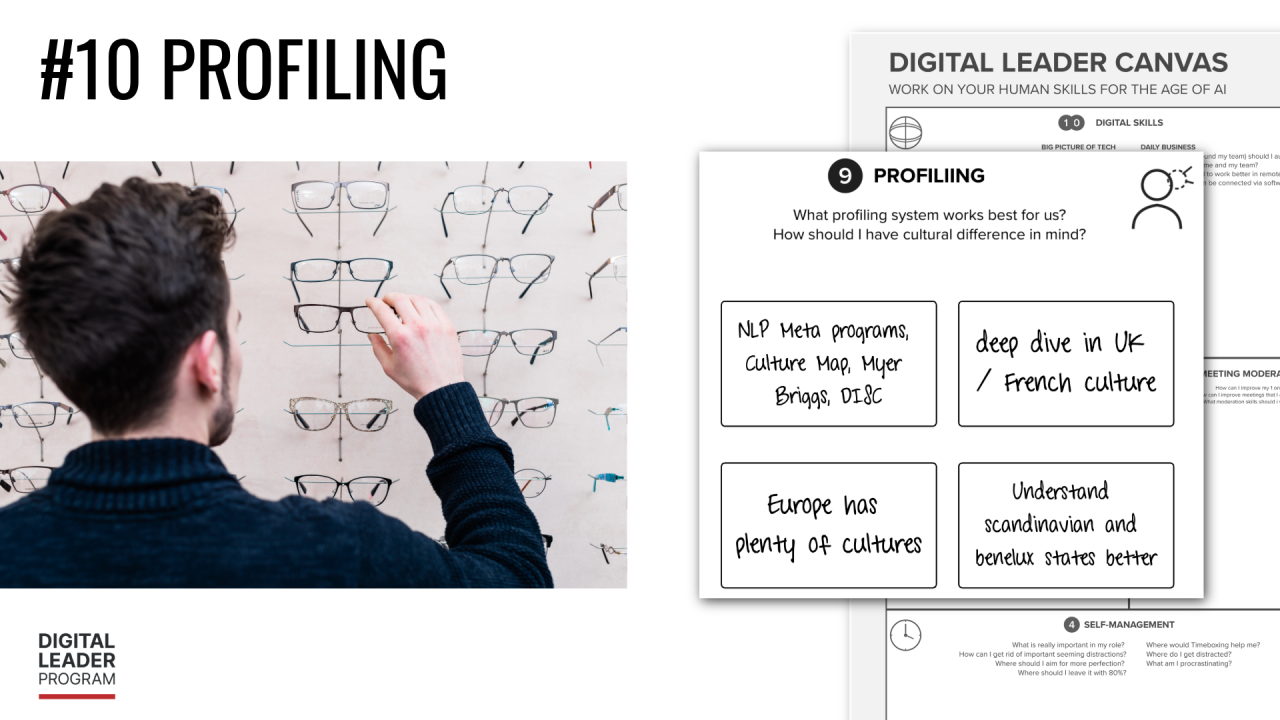
The useful way to picture it: each meta program is a different pair of glasses you put on to scan yourself, another person, or a whole room. One pair asks "matcher or mismatcher?" Another, "detail or big picture?" A profiling system hands you new filters — things to notice that you'd otherwise walk straight past — and from those you build your read of people, teams, and situations.
A necessary caveat, and I say it as someone who values these tools: most are contested in academic psychology. MBTI and DISC in particular take flak for weak test-retest reliability — take the test twice, get two different results — and the research consensus is that the Big Five model is the most scientifically validated. Most experts also warn against using any of them as a hiring filter, where structured interviews and skills assessments predict performance far better. So hold them lightly: a shared language and a mirror for reflection, not scientific truth about a human being.
The one trap to avoid
Here's the danger built into the whole exercise: the moment you profile someone, you make your world simpler by putting them in a box. That's the benefit. It's also the risk.
Put someone in the wrong box and you walk into every interaction biased — interpreting everything they do through a label that may not fit, and quietly refusing them the room to be different from your read. The model stops being a lens and becomes a blindfold.
The discipline, then, is to hold your profile of someone as a hypothesis, never a conclusion — a starting guess the next real interaction can confirm or overturn. Glasses, not a box: a lens you look through and can swap, not a container you seal someone into. The best profilers aren't the ones with the most confident labels. They're the ones most willing to be wrong about them.
Profiling as a deliberate tool: the Disney story
Profiling isn't only about reading people as they are. You can also invite people — or a whole team — to step into a profile on purpose, for a stretch of time.
Walt Disney is the classic example. When developing ideas, he separated three modes into three physical rooms: the Dreamer, who imagines without limit; the Realist, who works out how it could actually be done; and the Critic, who stress-tests it for flaws. Crucially, he kept them apart and ran them in sequence — nobody was allowed to criticise while the room was still dreaming. (The approach was later formalised by Robert Dilts in 1994.)
The lesson for any team: most meetings fail creatively because all three modes fire at once. The dreamer floats an idea and a critic shoots it down before it can breathe. By asking people to consciously adopt one mode at a time — "right now we're only dreaming; the critique comes later" — you use profiling not to label people, but to unlock a group. That's profiling as a leadership move, not just a diagnostic one.
Keep culture in the frame
A profile built entirely on individual personality misses half the picture, because people are also shaped by the culture they operate in — and Europe alone holds an enormous range of them.
This is where Erin Meyer's Culture Map earns its place. The composed restraint you might read as disengagement in one country is ordinary professionalism in another. Direct feedback that feels brutal to a British ear can be a sign of respect in the Netherlands. How a French meeting handles disagreement differs from how a Scandinavian one does. If your read on people was calibrated in a single culture, it will mislead you the moment you cross a border — and in a European team, you cross several without leaving the room.
The fix isn't to memorise national stereotypes; that's just boxing at a larger scale, with the same trap. It's to add a second axis to your reading — individual and cultural — and to stay curious about which one you're actually seeing. Sometimes the "introvert" is simply operating by a different cultural rule about when one speaks.
How AI can help — today
Profiling is a deeply human skill — but it's no longer true that AI can't do any of the reading. With access to real data, it already can.
-
Read patterns in real communication. The AI now built into Gmail (Gemini) and Outlook (Copilot) already reads whole threads, summarises them, and analyses tone and style — Copilot even has a "coaching" feature that tells you how your wording will land on the reader. None of them ships a one-click "personality profile" button, but you can point the assistant at a real exchange and ask: based on how this person writes, are they more detail-driven or big-picture, quick to agree or quick to challenge? It won't be definitive, but it's a genuine second read on patterns you might have missed — and the capability is only getting sharper.
-
Pressure-test your own read. Describe a colleague's behaviour and ask what patterns might explain it — and, just as usefully, what alternative reads you're missing. A fast way to check your bias before you act on a label.
-
Prep for a specific person. Before a difficult conversation, think it through with AI in the language of whichever model you use: if this person leans heavily toward detail and process, how should I frame the proposal differently than for a big-picture, options-driven type?
-
Translate across models. If a colleague knows their MBTI type but you think in DISC or meta programs, AI can bridge the vocabularies so you're not stuck in one system.
The thing AI still can't do is the live reading — the in-the-moment perception of the person in front of you, the things that never make it into an email. But the idea that profiling is purely human no longer holds. Increasingly, it's something you and a machine can do together.
How this changes long-term
Here's my bet. As AI takes over more of the analytical work, the human premium moves onto exactly this kind of relational skill — and profiling sits at its centre. Understanding what makes people different, adapting to it, composing teams that complement rather than clash: all of it depends on the live, contextual reading machines still can't fully do.
But a bigger shift is already starting. As more meetings get recorded and transcribed, the raw material for profiling explodes. Software can analyse who said what in a room — who dominates, who hedges, who builds on others, who goes silent — and infer the personalities around the table. That cuts two ways, and both are real.
The unsettling side: if a machine can profile a room from a transcript, all of us can be profiled at scale, often without realising — and a profile is exactly what you'd need to manipulate someone. Anyone serious about this skill has to sit with that risk, not wave it away.
The hopeful side: used openly and with consent, the same analysis can make teams genuinely better — showing how people actually behave in a group, what each person brings, where collaboration breaks down, who never gets the floor. The technology isn't good or bad in itself. What matters is whether it's done to people or with them.
So the skill of the future isn't handing the judgment of people to a machine. It's getting good enough at reading people yourself — and at understanding how these tools work — to tell when a machine's read is worth trusting, when it's just a confident box, and when it's quietly being used on you.
This is why I rate profiling among the most important soft skills there are — and the one that needs the most practice, because you can't learn it from a book. You learn it from people: reading them, getting it wrong, and adjusting, over and over.
Your turn
Profiling is a muscle, and here's a week's worth of reps.
Start with yourself. Pick any model — even just DISC's four colours — and honestly name your own pattern. Where do you default? What does that make easy, and what does it make hard?
Then read one relationship. Think of a colleague you repeatedly clash with. Don't label them to dismiss them — use the model to ask: how might they be wired differently from me, and what would it take to meet them halfway?
Then live it. The whole point is daily application, not a test result in a drawer. Running a brainstorm this week? Try the Disney move: dream first, critique later, and watch what changes.
You'll find my own answers in the cover image — the systems I lean on and the cultures I want to understand better. Pick one move. That's your 1%.
And before you go, I'd love to hear from you: which profiling system has actually helped you at work — and which left you cold? And what would you most like me to dig into next? Reply or drop a comment. The honest answers are usually the ones others are quietly weighing too.
👉 Download the canvas: https://www.digital-leader-program.de/en/digital-leader-program-digital-leader-canvas
Next week: Quadrant ⑩ — Digital Skills. Which tools actually matter, and how do you build real fluency rather than busywork?
See you then.
The Digital Leader Canvas is free for individual use. And if you're in HR or L&D and want to bring these themes into your organisation, here's that link again — book a 20-minute call. You can also explore the Leadership Essentials Workshop Series for teams.

Recent Posts
Categories
All categories
KNOWLEDGE THAT WORKS IN PRACTICE
This is not a place for buzzwords. Or for theories that don't hold up in real life. Our blog is a space for leaders and professionals who are looking for genuine answers to genuine questions: How do I lead better in a hybrid environment? How do I communicate in a way that actually lands? How do I use AI meaningfully in my daily work? How do I build resilience in my team?
Every article in the Digital Leader Program blog is designed to be directly useful – with insights, methods and examples you can take straight into practice.
TOPICS THAT MATTER TODAY
Leadership in the digital age: How is leadership changing when teams work remotely or hybrid? What do new leaders need – and what do experienced managers need to relearn?
Human Skills under AI influence: Which human capabilities become more important as AI takes over routine tasks – and how do you develop them deliberately?
Hybrid work in practice: Concrete tips, rituals and tools for productive hybrid collaboration – what actually works, and what doesn't.
Culture Design and team dynamics: How do you build an organisational culture that attracts, retains and energises people?
Communication and feedback: The capabilities that separate average performance from real high performance.
FROM PEOPLE WHO WORK IN PRACTICE
Our articles are written by Andre Ottlik and our team – people who work in coaching sessions, workshops and training every single day. What you read here is not copy-pasted from academic studies, but knowledge drawn from lived practice.
And occasionally we feature contributions from external experts sharing insights from their own fields – such as the piece with Pascal Baumgartner on hybrid meeting optimisation.
FREQUENTLY ASKED QUESTIONS (FAQ)
How often are new articles published?
Regularly. Subscribe to our newsletter or follow us on LinkedIn to make sure you don't miss new content.
Are articles available in German too?
Yes. Many of our articles are also available in German – particularly on topics relevant to German-speaking leaders and organisations.
Can I suggest article topics?
Absolutely. Write to us or bring it up in a conversation – we welcome input from our community.
How can I go deeper than the blog?
Our workshops, coaching programmes and the podcast "3 minutes max." go further and support you systematically in your development. Browse our service pages or book an initial consultation.
Author
Andre Ottlik
Author
Andre and his Team are the authors of Digital Leader Programs Blog Posts
