
#11 Digital Skills (Part 1 of 2) — Learning to Drive the Machine
When ChatGPT arrived at the end of 2022, my calendar started to empty.
The German economy was sliding — the energy shock after Russia's invasion of Ukraine had hit hard — and the first budgets cut were always the same: coaching, training, leadership development. Mine. When companies did keep spending, the money went into software and AI, not into people in a room with someone like me.
So I let myself ask the question I'd been circling for months: in a few years, will I still be needed at all?
I'd like to say I met that calmly. I didn't. For a while I told myself AI couldn't really do what I do — less a conviction than a way of not looking at the fear underneath. So I started a podcast on AI and human skills, mostly to force myself to understand the thing I feared. Even with a business-IT background, the climb was slow. But somewhere in it the fear drained away — not because the technology got weaker, but because I finally understood what it could do, what it couldn't, and, step by step, how to make it work for me.
That arc — from quiet dread to working fluency — is what this edition is about.
This is the eleventh part of my weekly walk through the Digital Leader Canvas — Digital Skills, field ⑩. There's more in this field than one edition can carry, so I've split it in two. Today is the big picture: where this is heading, and why no one gets to sit it out. Next time, the practical half — the tools, the automations, what to actually build.
(New here? Download the canvas for free: https://www.digital-leader-program.de/en/digital-leader-program-digital-leader-canvas)
The canvas asks:
Where is technology heading? What skills will my industry need? How do I stay up to date? And how do I push creativity — my team's and my own?
We have always been frightened of the tool
Every tool that ever mattered scared most of the people first.
A human took control of fire and could suddenly cook, stay warm, see in the dark. Then the engine, the car — alarming and unnatural when it first rattled down the street. Then the smartphone, which we now hand our children without a thought. Each arrived to a chorus of unease, and each ended up so woven into ordinary life that the unease is hard to recall.
A reflex hides in all of this: protecting hard, repetitive labour so that nobody has to change. It can feel like kindness. It can't be the answer to the future. Almost no one wants to spend a day filling in the same spreadsheet or queuing up the same posts — yet we've grown so used to those tasks that we mistake them for our jobs, when most of them are exactly the work we should be glad to hand away.
One caution before this tips into cheerleading. The same ingenuity that warmed our food and moved us around also burned enough fossil fuel to heat the planet to real consequence. Powerful tools cut both ways, and AI plainly needs guardrails — against surveillance, manipulation, the genuinely dystopian uses. But for an individual facing a new tool at work, the answer isn't to refuse it out of fear. The tool is here. The honest move is to learn to use it well.
A quick aside for HR and people-development leaders: most development budgets get spent in fragments — a workshop here, a coaching there, each booked, invoiced and forgotten before it changes anything. The alternative is continuity: a set number of days a month with one partner who already knows your people, used flexibly across coaching, consulting and workshops — soft skills, leadership, strategy, process, presentation, the lot. Less to administer, easier to plan, and usually lighter on the cost-per-employee than stitching the same support together piece by piece. I keep this to one organisation at a time, so the attention stays undivided — and that place opens up again from September. Give me defined bookings, or just a bigger goal to work towards — either works. A short call is the way in.
Work doesn't run out — but the skills do shift
Here is the part the fear gets wrong. Humans don't run out of things to do; we go looking for them. As long as the world has problems, there will be work. When routine work is taken off our hands, the appetite doesn't vanish — it moves: to products that don't exist yet, to caring better for our ageing and our sick, to problems we haven't named.
Why does automation tend to create more human work, not less? Dan Shipper, who runs the AI studio Every, has the sharpest explanation I've read. Today's models, he argues, are trained on the visible residue of past human competence, so they make that competence cheap and hand it to everyone at once. When anyone can produce a passable draft, design or line of code on demand, the result is a flood of sameness, and sameness becomes a commodity. What turns scarce — and valuable — is whatever is different: work that fits a specific person, company and moment. That judgment of what's right, here and now, is still ours. It's his argument, not a settled law, but it matches what I see, and it's the rigorous version of the "handmade premium" from the Delegation edition: the machine doesn't take the work, it raises the bar on the part only a human can do.
The flip side is just as real. Lean on AI uncritically — as plenty of teams already do, juniors especially — and you become the machine for it: same tool, same default, no judgment applied, churning out the very interchangeability we just described. Using these tools and interrogating what they hand back aren't two skills; they're one.
What doesn't move at that speed is people's skillsets — and that gap, not the technology, is what actually hurts. The World Economic Forum's Future of Jobs Report 2025 estimates employers expect 39% of workers' core skills to change by 2030 — though, tellingly, that's down from 44% two years earlier, as training catches up. The disruption is real and large; it isn't the apocalypse some headlines sell. It's a steep, manageable shift, and the people who treat it as manageable are the ones who'll manage it.
There's an old phrase for this pressure, almost always quoted wrongly. Survival of the fittest — coined by Herbert Spencer, only later taken up by Darwin — was never about the strongest or the most ruthless. The "fittest" is the best-fitted: the one most suited to an environment that has changed. That's the point for us. The advantage won't go to the cleverest in the room or the longest-serving, but to whoever adapts fastest while the ground keeps moving. To keep living and earning above the average, in other words, we'll have to be willing to adapt above it too.
A word on Europe — and then back to the work
I usually keep this newsletter clear of politics. This once, looking at where the technology leads, I can't quite avoid it — so take what follows as my own view, not a verdict.
I worry about Europe's footing. Some systems abroad deploy AI with no scruples — pooling data into a single pair of hands, which buys real technical momentum and, in the wrong hands, an unprecedented machinery of surveillance. Europe chose a different path: privacy, worker protection, a social contract. I believe in that path — but it comes with a bill, and the bill is competitiveness. If European companies want to keep their values and stay in the race with the US and China, the way through isn't to slow the technology down — it's to get our people fluent faster than the gap can open.
That's not abstract. I work with everyone from one-person ventures to 150-year-old firms of tens of thousands, and I feel the same fear of job losses in nearly all of them. Here's an uncomfortable thought, marked clearly as my own opinion: strong employment protection — the kind Germany is rightly proud of — is a genuine good, but it casts a shadow. In some large, established companies it lets people quietly opt out of change, secure that their seat is safe. If enough do, the company itself stops being competitive, and a firm that falls behind can't protect anyone's job for long. The safety becomes the very thing that hollows the place out.
That isn't fair to the people carrying the extra weight. A few who refuse to develop shouldn't get to drag the whole company down at everyone else's expense — least of all the colleagues who are adapting. My honest view is that employers today have too few options here, and that we'll need to think hard, as companies and as societies, about how we handle it. Not to strip away protection, but to stop it becoming a place to hide from change. The alternative is worse: the pressure arrives the hard way, through companies that fall behind and jobs that turn unsafe regardless. I'd rather we faced that question on purpose than waited for the market to force it.
Right now AI is mostly pointed at one question — where can we cut costs? — and I think that's a small use of a large thing. Its real promise is the opposite: more products, new business models, eventually more work, not less. Getting there takes time and a lot of retraining. The sooner we start, the shorter the painful middle.
What stays human — and what to feed it
If machines absorb the routine and the analytical, a professional's value shifts onto what they can't easily copy. On my own canvas, under the skills this field demands, I wrote three words: discretion, empathy, and an understanding of human complexity and emotion. Not because they sound noble — because they're the part a model can't stand in for. (That's the whole argument of the Senses & Emotions edition.)
The surprise is what actually develops those skills, and how little of it happens at a desk. My own note was to feed creativity from outside work entirely: time with children and artists, museums, an acting or singing class. The things that look least like professional development are often what keep the human edge sharp.
I've been living this through my daughter. Her school near Lisbon is closing, and choosing the next one forced the question open. We picked an active-learning school — practical, with its own garden — because I no longer believe education is about accumulating knowledge. Knowledge is the cheap part now. What lasts is the method: how you learn, work across cultures, handle yourself.
And as a leader, that learning isn't only yours to do — it's yours to make possible. Take the fear out of it, lead people in step by step, and make AI fluency part of the goals you set and the development you fund — with the resource it actually requires: time. Then point each person at the right medium for them: a newsletter, a podcast, a workshop, a coach. You can't order someone to become fluent. You can remove every excuse not to start.
How this changes over time
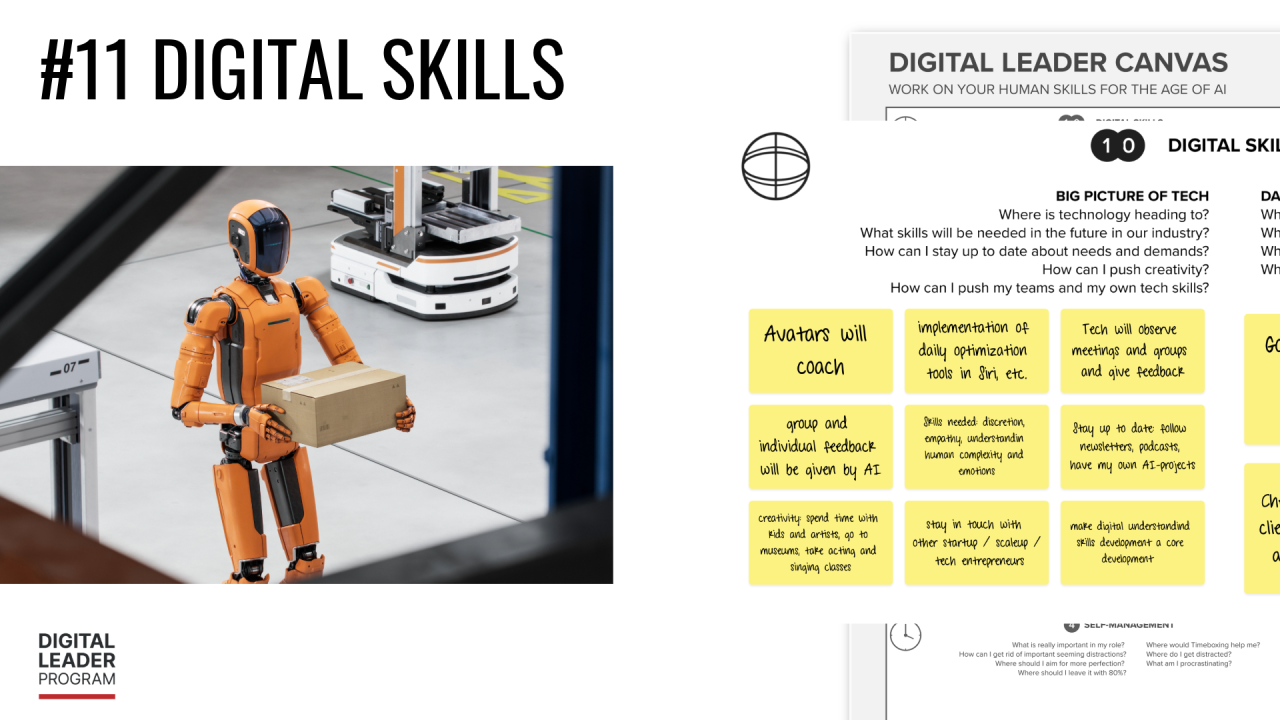
Here's my bet on the long arc. For now AI feels exotic and expensive — the data centres alone make computing power the currency of the moment. But it will become as unremarkable as the mobile network or the plate you heat dinner on: always there, barely noticed. On my canvas I sketched where that leads inside our work — avatars that coach, optimisation built quietly into the tools we already use, software that sits in on meetings and hands back honest feedback.
If you want to picture that endpoint, watch Her — Spike Jonze's 2013 film, where the main character talks to an AI as naturally as a colleague or partner, woven into the texture of his day. What looked like science fiction barely a decade ago now reads less like prediction than description.
When that day comes, the question won't be whether you can use AI — everyone will, the way everyone uses electricity. The question will be what you bring on top of it. And that, field by field across this whole canvas, keeps landing in the same place from a different angle: the machine handles the universal, and your value is whatever you make specific, human and yours.
Your turn
Think of AI as a Formula 1 car parked in your driveway. Frightening, fast, nothing like what you learned to drive on. You don't master it by reading about it — and you don't master it by flooring the accelerator and never steering, either. You climb in, you stall it, you go round again.
So this week, one honest lap — and which lap depends on where you actually are.
If AI still feels foreign, take a single task you'd normally dread — the recurring email, the first draft, the messy research — and do it with a tool instead of around it. Let it be clumsy; notice where it helps and where you still have to think.
If you or your team already lean on AI for everything, run the opposite lap: take one output you'd normally ship as-is and give it the second look. Where is it generic, where is it subtly wrong, and what would make it specific to this client and this moment — the part only you can add? That glance is the skill quietly going missing, and it matters more the more you automate.
Either way, that's your 1%, in the spirit of the one percent method we keep coming back to: not a transformation, just one honest lap that makes the next easier.
If you lead people, add one more: clear the time for the reluctant ones to try — and make that second look a visible standard for the ones who've stopped looking.
You'll find my own answers to this field in the cover image — the skills I'm betting on, the creative habits I'm feeding, the way I plan to stay current. Yours will look different. Pick one and start.
And before you go, I'd like to hear from you: what's the one task you'd hand to a machine tomorrow if you trusted it — and what's the fear that's stopping you? Reply or drop a comment. The honest answers are almost always the ones others are quietly sitting with too.
Next week: Digital Skills, Part 2 — the daily-business half. Which processes to automate, what to actually connect, and a real, build-it-yourself workflow rather than "just ask the AI."
See you then.
The Digital Leader Canvas is free for individual use. And if you're in HR or L&D and want to bring these themes into your organisation, here's that link again — book a 20-minute call. You can also explore the Leadership Essentials Workshop Series for teams.
Recent Posts
Categories
All categories
KNOWLEDGE THAT WORKS IN PRACTICE
This is not a place for buzzwords. Or for theories that don't hold up in real life. Our blog is a space for leaders and professionals who are looking for genuine answers to genuine questions: How do I lead better in a hybrid environment? How do I communicate in a way that actually lands? How do I use AI meaningfully in my daily work? How do I build resilience in my team?
Every article in the Digital Leader Program blog is designed to be directly useful – with insights, methods and examples you can take straight into practice.
TOPICS THAT MATTER TODAY
Leadership in the digital age: How is leadership changing when teams work remotely or hybrid? What do new leaders need – and what do experienced managers need to relearn?
Human Skills under AI influence: Which human capabilities become more important as AI takes over routine tasks – and how do you develop them deliberately?
Hybrid work in practice: Concrete tips, rituals and tools for productive hybrid collaboration – what actually works, and what doesn't.
Culture Design and team dynamics: How do you build an organisational culture that attracts, retains and energises people?
Communication and feedback: The capabilities that separate average performance from real high performance.
FROM PEOPLE WHO WORK IN PRACTICE
Our articles are written by Andre Ottlik and our team – people who work in coaching sessions, workshops and training every single day. What you read here is not copy-pasted from academic studies, but knowledge drawn from lived practice.
And occasionally we feature contributions from external experts sharing insights from their own fields – such as the piece with Pascal Baumgartner on hybrid meeting optimisation.
FREQUENTLY ASKED QUESTIONS (FAQ)
How often are new articles published?
Regularly. Subscribe to our newsletter or follow us on LinkedIn to make sure you don't miss new content.
Are articles available in German too?
Yes. Many of our articles are also available in German – particularly on topics relevant to German-speaking leaders and organisations.
Can I suggest article topics?
Absolutely. Write to us or bring it up in a conversation – we welcome input from our community.
How can I go deeper than the blog?
Our workshops, coaching programmes and the podcast "3 minutes max." go further and support you systematically in your development. Browse our service pages or book an initial consultation.
Author
Andre Ottlik
Author
Andre and his Team are the authors of Digital Leader Programs Blog Posts
