
#16 The AI-Native Organisation — When Culture Becomes Executable
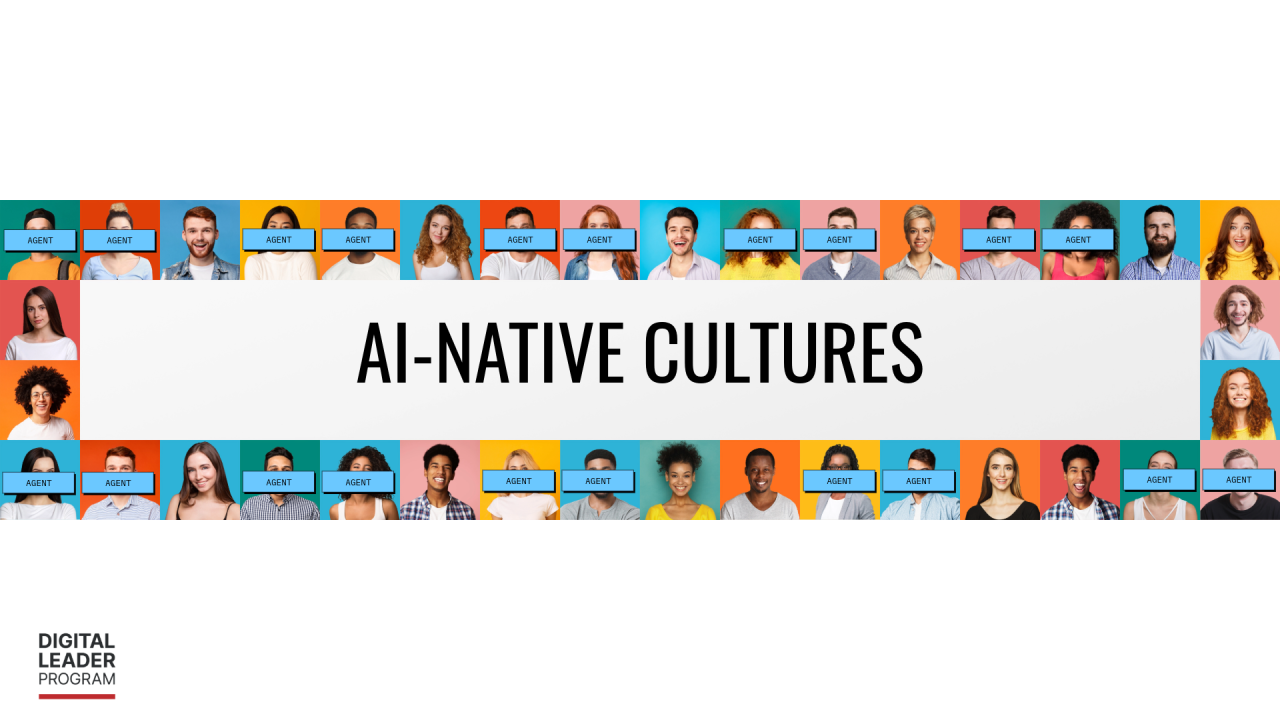
Imagine founding a company this year. Before you hire employee number three, you set up your first agents — for research, for reporting, for support. And to do that, you sit down and write their instructions: what they should optimise for, what they must never do, when they have to stop and ask a human.
Pause on that moment, because something remarkable just happened. You wrote your company's values down — precisely, or the agents misbehave. You defined your priorities as explicit trade-offs, or they optimise for the wrong thing. You set rules, or you get chaos. On day one, before the coffee machine arrives, you did the culture work most companies postpone for a decade.
That's the thought experiment for this edition, the one last week's walk through the Culture Design Canvas was building towards: if you built an organisation from scratch today, AI-native, what happens to each of the ten blocks on that canvas?
My short answer, from last time: culture stops being decoration and becomes specification. Here's the long one.
(New here? Start with last week's edition on the Culture Design Canvas — this one builds directly on it. And the Digital Leader Canvas, the individual-level companion, is a free download: https://www.digital-leader-program.de/en/digital-leader-program-digital-leader-canvas)
The core becomes executable
Take the canvas's heart first — Purpose and Values — plus Priorities, Norms and Decision-Making. In a classic organisation these live in slide decks and town halls, and their main enforcement mechanism is hope. In an AI-native organisation they become configuration.

Values turn into system prompts. Whatever you write into your agents' standing instructions is partly your culture, executed thousands of times a day without fatigue or interpretation drift. And here's the twist that should make every leadership team sit up: vague values produce vague agents. "We act with integrity" compiles to nothing. "We never state a number we can't source" compiles beautifully. For the first time in management history, wooliness has an immediate, visible cost.
Priorities become routing logic. Razzetti asks for your top three priorities as even-over statements — and an AI-native company doesn't hang them on the wall, it wires them in. "Quality even over speed" literally decides how long an agent may keep refining before it ships. The statement stops being an aspiration and starts being a parameter. If your even-overs are platitudes, you'll find out within a week, because your agents will make trade-offs you hate.
Norms and rules become guardrails. The canvas asks how to clarify expectations without hindering autonomy — for machines, that's solved in code: hard limits where it matters, freedom inside them. The interesting effect is on the humans: when the routine rules are enforced by the systems themselves, the human rulebook can finally shrink to the few norms that need judgment. Wikipedia's "assume good faith" was ahead of its time in more ways than one.
Decision-making gains a question the canvas never had to ask: what may an agent decide alone? Where the original block asks how authority is distributed among people, the AI-native version distributes it across people and systems — and has to draw the line explicitly: the agent decides refunds under fifty euros; a human decides anything touching a person's job. And one thing does not transfer with the authority. As I argued in the Delegation edition and it holds truer than ever: the machine can take the task, never the responsibility. Every automated decision still needs a human name against it. The upside: agents log everything, so "how did this decision happen?" — a question that dies in most organisations — gets answered by default. Radical transparency stops being a virtue and becomes a by-product.
A quick reminder for HR and L&D readers: if this thought experiment feels far from your daily reality, that gap is exactly what I work on with organisations — from culture offsites to twelve-month change programmes. A short call is the place to start: book 20 minutes.
The human remainder appreciates
Now the other half of the canvas — and here the thought experiment turns on its head. The blocks you can't compile don't shrink in an AI-native organisation. They become the scarce resource.
Meetings lose their oldest excuse. When agents keep a live, queryable picture of every project, the information-transfer meeting — most of the calendar, in most companies — simply dies, as I predicted in the Meeting Moderation edition. What's left to meet for is the part that was always the real point: connection, creative friction, conflict worth having in person. The AI-native company meets less, and for better reasons.
Feedback becomes half-continuous. Machines can tell you what happened — output, patterns, drift — cheaply and without embarrassment. But the feedback that changes a person still needs a person: the courage, the timing, the relationship. (Everything from the Communication editions applies, sharpened: when the data layer is automated, the human layer is the whole job.)
Rituals stop happening by accident. In a traditional office, belonging gets built in the corridor, at the coffee machine, in the small talk before the meeting. In an organisation where agents do the routine coordination, those accidental collisions largely disappear — so the rituals block shifts from "nice to have" to structural. An AI-native company has to design its human moments: the weekly gathering that exists purely for connection, the celebration nobody would automate. What was decoration becomes load-bearing.
And Psychological Safety becomes the bottleneck block of the whole canvas — with a dimension Razzetti couldn't have meant in 2016: safety about the machines themselves. Can someone admit they don't know how to use the tools, without fearing it marks them as replaceable? Do people know what's recorded, what's analysed, what feeds back into their evaluation? Is it safe to say "the agent is wrong" when the agent is management's favourite project? An organisation can deploy flawless technology and still fail here — because people who feel watched or threatened by the systems around them will work around them, quietly, and the whole executable culture runs on inputs nobody honest gave it. The Digital Skills editions made the individual case for taking fear out of the tools; at organisational scale, it's the difference between an AI-native culture and an AI-decorated one.
Which leaves the heart of the canvas. Purpose is the one block that cannot be automated even in principle. As Dan Shipper's argument from the Digital Skills editions goes: machines have autonomy, not agency — they execute goals, they don't have any. An AI-native organisation is, in the end, a purpose with an unusually efficient body. If the purpose is empty, you've built a very fast vehicle with nowhere to go.
The mirror for the rest of us
You're probably not founding from scratch. But here's why this experiment isn't academic: every agent your organisation deploys is a small from-scratch moment. Someone writes its instructions. Those instructions encode values, priorities and rules — deliberately or by accident, reviewed or unreviewed, aligned with your stated culture or quietly contradicting it.
Which means many companies are already running two cultures again — the one on the poster, and the one in the prompts. Last week's two-culture trap, back in new clothing. The difference: this second culture executes.
So the practical question for an existing organisation isn't "how do we become AI-native?" It's smaller and sharper: who writes our agents' instructions, and has anyone checked them against our canvas? If your stated value is transparency and your support agent is instructed to deflect complaints, your real culture is in production, and it isn't the one you wrote in the workshop.
Your turn
One experiment this week, straight from the thought experiment:
Take one of your organisation's stated values and try to write it as an instruction an agent could follow. Not a slogan — an instruction, with a testable behaviour in it. If it translates, you've learned your value is real. If it dissolves into vagueness under your pen, you've learned something more useful: it was wallpaper. That test costs ten minutes and tells you more about your culture than most surveys.
If your team already runs agents, go one step further: read their instructions as a culture document. Ask what values they actually encode — and whether anyone chose them.
Next time, something this newsletter has circled since the beginning without ever facing head-on: the Atlantic gap. Most of the business and leadership literature we all read is written from an American seat — and much of it quietly assumes a world of at-will employment, winner-take-all scale and relentless self-optimisation that simply isn't the world most European professionals work in. What does that gap mean for the human skills this newsletter is about, in the age of AI? That's the next edition.
And before you go: if you've ever read a bestselling leadership book and thought "this wouldn't survive contact with my workplace" — tell me which one, in the comments or by reply. I read every one.
See you next week.
The Digital Leader Canvas is free for individual use. And if you're in HR or L&D and want to bring these themes into your organisation, here's that link again — book a 20-minute call. You can also explore the Leadership Essentials Workshop Series for teams.
Recent Posts
Categories
All categories
KNOWLEDGE THAT WORKS IN PRACTICE
This is not a place for buzzwords. Or for theories that don't hold up in real life. Our blog is a space for leaders and professionals who are looking for genuine answers to genuine questions: How do I lead better in a hybrid environment? How do I communicate in a way that actually lands? How do I use AI meaningfully in my daily work? How do I build resilience in my team?
Every article in the Digital Leader Program blog is designed to be directly useful – with insights, methods and examples you can take straight into practice.
TOPICS THAT MATTER TODAY
Leadership in the digital age: How is leadership changing when teams work remotely or hybrid? What do new leaders need – and what do experienced managers need to relearn?
Human Skills under AI influence: Which human capabilities become more important as AI takes over routine tasks – and how do you develop them deliberately?
Hybrid work in practice: Concrete tips, rituals and tools for productive hybrid collaboration – what actually works, and what doesn't.
Culture Design and team dynamics: How do you build an organisational culture that attracts, retains and energises people?
Communication and feedback: The capabilities that separate average performance from real high performance.
FROM PEOPLE WHO WORK IN PRACTICE
Our articles are written by Andre Ottlik and our team – people who work in coaching sessions, workshops and training every single day. What you read here is not copy-pasted from academic studies, but knowledge drawn from lived practice.
And occasionally we feature contributions from external experts sharing insights from their own fields – such as the piece with Pascal Baumgartner on hybrid meeting optimisation.
FREQUENTLY ASKED QUESTIONS (FAQ)
How often are new articles published?
Regularly. Subscribe to our newsletter or follow us on LinkedIn to make sure you don't miss new content.
Are articles available in German too?
Yes. Many of our articles are also available in German – particularly on topics relevant to German-speaking leaders and organisations.
Can I suggest article topics?
Absolutely. Write to us or bring it up in a conversation – we welcome input from our community.
How can I go deeper than the blog?
Our workshops, coaching programmes and the podcast "3 minutes max." go further and support you systematically in your development. Browse our service pages or book an initial consultation.
Author

Andre Ottlik
Author
Andre and his Team are the authors of Digital Leader Programs Blog Posts
