
#17 The Atlantic Gap — What to Copy From America, and What Not To
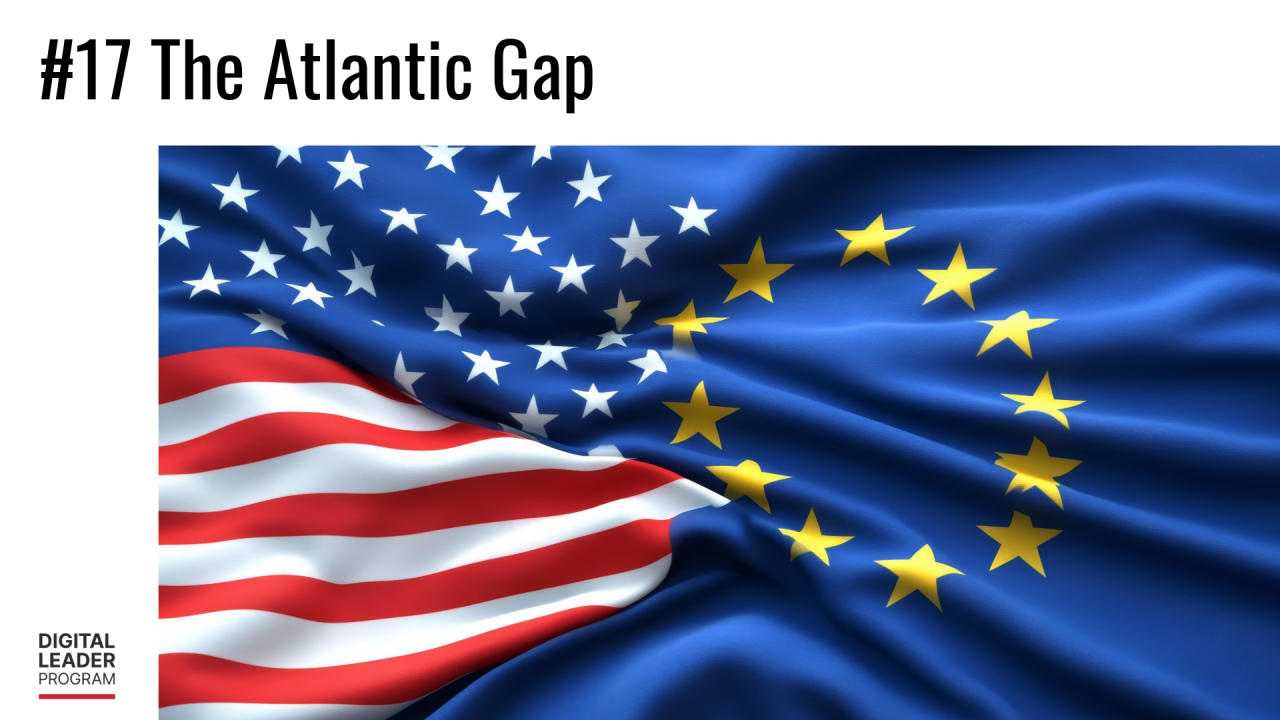
Walk through any European airport bookshop — Frankfurt, Lisbon, Amsterdam; my travel schedule gives me too many chances to test this — and look at the business shelf. Shelf after shelf, mostly American: the titles, the case studies, the advice. We fly between European cities reading playbooks largely written for a different continent, and then wonder why they don't quite fit when we land.
I promised this edition last time: the gap this newsletter has circled since the beginning without facing head-on. Europe watches America — its leadership trends, its development trends, its tools — and asks, almost reflexively, what do we need to do like they do? If that sounds overstated, run through the methods your own organisation has adopted: OKRs came from Intel and Google, the Agile Manifesto was written in Utah, Radical Candor and Lean Startup in Silicon Valley. Even the Culture Map — the standard work on European cultural difference, quoted throughout this series — was written by an American. There are European institutions and voices doing serious work on European realities. But the default gaze points across the Atlantic. So let's face the question properly: what's really different over there, where does looking across make sense, where doesn't it — and what does all of it mean for AI and for the human skills this newsletter is about?
One caveat before we start, in the spirit of this series: what follows mixes hard numbers with my own observations from two decades of working with European companies. I'll mark which is which.
What's different — beyond the clichés
Start with the observation that surprised me most when I finally said it out loud, because it cuts against a familiar cliché. The stock critique of American business is "quarterly capitalism" — everything sacrificed to the next earnings call — while Europe's family firms famously pride themselves on "thinking in generations." Look at how each side treats capital, though, and the picture flips. America funds companies that lose money for a decade because the bet is generational — the money is patient about scale. Europe's capital is cautious, but European careers are patient: people settle into secure employment and stay. My shorthand, and I'll hold it as an observation rather than a law: America is long-term about capital and short-term about jobs. Europe is long-term about jobs and short-term about capital.
The numbers behind that are not subtle. The Draghi report on European competitiveness — commissioned by the EU itself — found that only 5% of global venture capital is raised in the EU, against 52% in the United States. Only four of the world's fifty biggest tech companies are European. And the largest corporate R&D spenders tell the sharpest version of the story: in America they're software companies — Alphabet, Meta, Microsoft. In Europe they're carmakers.
Part of the gap is structural before it's psychological. America's considerable diversity runs on one operating system: one language, one integrated capital market, broadly one legal space, one founding narrative. Europe's diversity runs on twenty-seven — twenty-four official EU languages, separate labour laws, separate tax regimes, separate media markets. An American startup reaches 330 million consumers in one move; a European one crosses a border and meets a new language, new law, a new works council. The Draghi report names exactly this fragmentation as a core drag on European scale. Seen that way, the missing "10x mindset" isn't timidity. Betting everything on winner-take-all scale is rational on a unified continent and much less rational on a fragmented one.
Then there's personal posture, and here I'm firmly in observation territory. In the US, more people seem to want a stake — equity, shares, a piece of the upside — and accept the risk that comes with it. In much of Europe the preference runs the other way: a good salary, strong employment protection, predictability. That, too, is a sober answer to a different system: different tax treatment of equity, different bankruptcy consequences, different social safety nets, different cultural memory.
A deeper layer runs older than any policy: America is a country built on immigrants — at its founding, and in every generation since. And migration is a filter. The people who left for the US, then and now, were by definition the ones who believed in a future they could build, accepted hard work and risk as the price, and walked out of their comfort zone and across an ocean to pay it. That self-selection compounds into culture, and you can see its trace in the numbers: nearly half of today's Fortune 500 companies were founded by immigrants or their children, and more than half of America's billion-dollar startups have an immigrant founder. No continent chose its temperament; both inherited one. Which is one more reason to copy thoughtfully rather than wholesale — you can import a method, but not a migration history.
Neither posture is wrong. But they produce very different companies — and very different reactions when a technology like AI arrives.
A quick aside for HR and people-development leaders: most development programmes on this continent are built from imported playbooks. The work I do with organisations — workshops, coaching, longer-term programmes — starts from the opposite end: your people, your constraints, your regulatory and cultural reality, and only then the methods, wherever they come from. If that resonates, a short call is the place to start: book 20 minutes.
What it means for AI in your company
Back to the technology.
In the American setting, AI adoption has two powerful engines that Europe mostly lacks. The first is upside: when employees hold equity, automation that lifts the company lifts them, personally and directly. The second, harsher one is fear: in an at-will labour market, "adapt or be replaced" isn't a metaphor. Both engines are running at full throttle right now — and both are largely absent in a European company with strong employment protection and salary-based compensation.
Which leads to a conclusion I'd underline twice — consciously sharpened, but it matches what I see inside European companies: in the US, AI adoption can be pushed by fear and pulled by equity. In Europe, as a rule, it has to be led. Pressure exists on this side of the Atlantic too — restructurings happen, budgets tighten — but it tends to arrive slower and later, and day to day little structural force drags a protected, salaried workforce into new tools. When people here change how they work, it's usually because someone made the case, built the trust, created the safety to experiment, and gave them time — the whole human-skills repertoire this newsletter keeps returning to. I wrote in the Digital Skills editions about employment protection's shadow side, and it applies: where few can be forced, most must be convinced.
There's an uncomfortable irony in that, and I see it in my own pitch trainings, year after year: convincing is itself a skill Americans are, on the whole, trained in far earlier and far harder than we are. Selling — an idea, a change, yourself — is baked into American schooling and career culture from the first show-and-tell; in much of Europe it still carries a faint smell of showing off. So the one lever European leaders must rely on is the one their culture least prepared them for. Worth naming, because it's fixable: persuasion is learnable. And convincing, though harder than forcing, is more durable — change built on conviction survives the moment the pressure lifts; change built on fear doesn't.
So here's the reframe I'd offer every European leader who envies American adoption speed: the constraint you're operating under doesn't make the human skills optional. It makes them your strongest lever — often the only one that reliably works.
And there's an overlooked asset on our side of the Atlantic, hiding inside the fragmentation itself. Not because Americans can't work across cultures — the big US multinationals do it expertly, with global teams and decades of practice. The difference is when the skill becomes necessary, and for whom. An American company can grow enormous before anyone in it needs a second language; navigating difference is a specialist capability that arrives with international expansion. In Europe it's an entry condition: the mid-sized firm exports across three borders, the ordinary meeting holds three communication norms, the customer writes in a second language. I live a small version of it myself, a German working out of Portugal, switching registers several times before lunch. Difference here isn't a later chapter — it's page one, for nearly everyone. That constant, early translation is training in precisely the skills this newsletter argues will hold their value in the age of AI: reading a room, adapting a register, building trust across difference. We rarely count it as an advantage. We should.
The literature problem: reading translated futures
Which brings us back to that airport bookshelf, because the books are where the quiet import happens.
Most bestselling leadership and business literature carries invisible assumptions from the system it was written in: that employment is at-will, so teams can be rebuilt in a quarter. That equity is on the table, so motivation can be bought with upside. That scale is winner-take-all, so 10x beats 10%. That the individual optimises herself relentlessly, because the safety net is thin. And one more, subtler than the rest: that the audience is one audience — one language, one market, one culture of feedback and hierarchy. None of that is stated on the cover. All of it shapes the advice — and much of it dissolves on contact with a European workplace, where the team you have is the team you'll develop, works councils co-decide, and "we'll just replace the sceptics" is neither legal nor, I'd argue, wise.
That warning cuts against this very edition, by the way: "Europe" is not one context either. Advice that works in Amsterdam can land badly in Paris; a feedback norm that reads as respect in Munich reads as harsh in Madrid — the Culture Map territory this series keeps returning to. The translation work doesn't stop at the Atlantic. It continues at every border, sometimes at every office door.
None of this means look away. Some of what America exports is exactly what European organisations need more of: the ambition, the product obsession, the bias to experiment before the plan is perfect, the storytelling that makes people want to follow — and above all, the courage to commit to visions that are large and years away, and to keep walking towards them when this quarter offers no proof. I'd copy all of that tomorrow. The skill — and it is a human skill — is reading imported advice the way the Profiling edition taught us to read models: as a lens built in one context, held as a hypothesis in yours. What breaks in translation isn't the ambition. It's the mechanics: hire-fast-fire-fast, equity-as-motivation without equity, hustle as a default setting.
The real cost of all this looking west is that Europe under-reads itself. There are European thinkers, researchers and practitioners working from European realities — on codetermination, on social-market innovation, on leading within regulation rather than around it. They rarely make the airport shelf. Finding them takes effort. It's effort worth making, and — a note to myself as much as to you — worth featuring more in this newsletter.
How AI can help — today
Used deliberately, AI is well suited to exactly this translation problem.
- Run the assumption audit. Before rolling out advice from any book or framework, ask an AI: what does this assume about employment law, compensation, team stability, and culture — and which of those assumptions hold in my context? Ten minutes, and the invisible becomes visible. (It's the same wallpaper-test logic as last edition, pointed outward.)
- Translate, don't just adopt. Ask how a given practice would need to change for a works-council environment, a salaried team, a market where failure carries stigma. The answer is often a better practice than the original.
- Break the bookshelf bias. Ask specifically for European research, cases and voices on your topic. The material exists; the algorithms of attention just don't surface it. Being deliberate here is a small act of intellectual independence.
One warning, consistent with what I wrote in the Communication editions about the factual side of every message: today's models are trained disproportionately on American text. Ask naively and you'll get the Silicon Valley default back, fluently. The European framing only appears if you explicitly ask for it — which is, in miniature, the whole point of this edition.
Your turn
Your 1% this week: take the last American framework, book or practice your organisation rolled out — OKRs, radical candour, a hiring playbook, whatever it was. Write down three assumptions it makes about how employment, motivation and risk work. Then mark each one: holds here, or doesn't. If two out of three don't hold, you haven't been implementing a method — you've been performing one.
And if you lead people in Europe: reread the middle of this edition as a job description. Where fear and equity can't do the pushing, leadership does. It's a harder game. I think it's also the better one.
And tell me — which imported practice have you seen work brilliantly here, and which one dissolved on arrival? One sentence in the comments or by reply. I read every one.
See you next week.
The Digital Leader Canvas is free for individual use. And if you're in HR or L&D and want to bring these themes into your organisation, here's that link again — book a 20-minute call. You can also explore the Leadership Essentials Workshop Series for teams.

Recent Posts
Categories
All categories
KNOWLEDGE THAT WORKS IN PRACTICE
This is not a place for buzzwords. Or for theories that don't hold up in real life. Our blog is a space for leaders and professionals who are looking for genuine answers to genuine questions: How do I lead better in a hybrid environment? How do I communicate in a way that actually lands? How do I use AI meaningfully in my daily work? How do I build resilience in my team?
Every article in the Digital Leader Program blog is designed to be directly useful – with insights, methods and examples you can take straight into practice.
TOPICS THAT MATTER TODAY
Leadership in the digital age: How is leadership changing when teams work remotely or hybrid? What do new leaders need – and what do experienced managers need to relearn?
Human Skills under AI influence: Which human capabilities become more important as AI takes over routine tasks – and how do you develop them deliberately?
Hybrid work in practice: Concrete tips, rituals and tools for productive hybrid collaboration – what actually works, and what doesn't.
Culture Design and team dynamics: How do you build an organisational culture that attracts, retains and energises people?
Communication and feedback: The capabilities that separate average performance from real high performance.
FROM PEOPLE WHO WORK IN PRACTICE
Our articles are written by Andre Ottlik and our team – people who work in coaching sessions, workshops and training every single day. What you read here is not copy-pasted from academic studies, but knowledge drawn from lived practice.
And occasionally we feature contributions from external experts sharing insights from their own fields – such as the piece with Pascal Baumgartner on hybrid meeting optimisation.
FREQUENTLY ASKED QUESTIONS (FAQ)
How often are new articles published?
Regularly. Subscribe to our newsletter or follow us on LinkedIn to make sure you don't miss new content.
Are articles available in German too?
Yes. Many of our articles are also available in German – particularly on topics relevant to German-speaking leaders and organisations.
Can I suggest article topics?
Absolutely. Write to us or bring it up in a conversation – we welcome input from our community.
How can I go deeper than the blog?
Our workshops, coaching programmes and the podcast "3 minutes max." go further and support you systematically in your development. Browse our service pages or book an initial consultation.
Author

Andre Ottlik
Author
Andre and his Team are the authors of Digital Leader Programs Blog Posts
