
Certified Coach on LinkedIn, Command-and-Control on Monday

Why coaching skills don’t survive the inbox — and what actually helps.
Many leaders proudly add “Certified Coach” to their LinkedIn headline. On Monday morning, they still mostly tell people what to do.
I don’t say this with judgment. In hectic times, directing feels faster than coaching. When deadlines are tight and inboxes are full, giving a quick answer looks like the responsible thing to do. Coaching, especially at the beginning, feels slower and sometimes even inefficient.
It is important, but rarely urgent — and that is exactly why it loses against day-to-day business.
The Pattern I See Over and Over
I meet more and more leaders who have completed serious coaching programs. They know open questions, active listening, powerful silence. Many of them genuinely care about their people.
And then I observe them in their regular meetings:
- They start with a question — and then jump in with the solution.
- They ask “What do you think?” — and steer the conversation back to their original idea.
- They call 1:1s “coaching sessions” — but mostly check status and assign tasks.
On paper, they’ve moved from manager to leader to coach. In practice, they’re still in directive mode — with a modern label on top.
Why Leaders Fall Back Into Telling
1. Pressure makes us reach for the fastest tool
In intense phases — transformation, crisis, key projects — the brain goes into efficiency mode: “I already see the solution, I’ll just tell them.” The paradox: the more complex the environment becomes, the more we need people who think with us — and exactly in those moments we reach most strongly for instructions.
2. Coaching is important, but almost never urgent
Developing people, growing their judgment, building ownership — deeply important. But rarely does someone knock on the door and say: “Please coach me now.” What is urgent are deadlines, escalations, requests from above. So “important” loses against “urgent”. Every single day.
3. Identity and control
Many leaders became successful by being the ones who know and fix. Coaching asks for a different identity: less hero, more facilitator. In tough moments, we reach for the identity that feels safest — the expert who has answers, not the coach who sits in the question.
4. No translation into daily routines
Even good coaching programs often stay in the training room. Leaders return to overflowing inboxes without a plan: “Where exactly in my week will I use this?” Without that bridge, coaching skills remain theory.
|
KEY INSIGHT The problem is not “bad leaders.” It’s leaders in a system that rewards speed and control — and rarely protects the space that coaching needs. |
Not Everything Needs Coaching
One reason the “coach” label becomes confusing is that coaching gets treated as a universal answer. It isn’t. Situational leadership offers a more useful lens: adapt your style to the person and the task.
|
Development Level |
What They Need |
Your Style |
|
Low experience, low confidence |
Clear direction: what, how, by when |
Direct |
|
Some experience, mixed confidence |
Questions, exploration, guardrails |
Coach |
|
Good skills, rising confidence |
Listening, removing obstacles |
Support |
|
High competence, high commitment |
Trust, space, check-ins |
Delegate |
Coaching is not the opposite of leading. It is one part of a flexible repertoire. If leaders try to coach in every situation, they create insecurity. If they never coach, they keep their teams dependent.
The real skill is choosing in real time: For this person, in this task, right now — what will actually help?
Where AI Can Actually Help
Here is where it gets practical. AI won’t replace leadership judgment. But it can serve as a small brake on our automatic patterns — and as a mirror for our options.
A concrete example: the email inbox
A team member sends you a message with a problem. Instead of firing off your answer immediately, you paste it into an AI assistant with a simple prompt:
|
PROMPT EXAMPLE Here is a message from one of my team members. Based on situational leadership, suggest: 1. What development level does this person seem to be at for this task? 2. A coaching-style response (open questions that help them think). 3. A directive-style response (clear guidance and next steps). 4. Your recommendation: which style fits this situation better, and why? |
You get two draft responses and a rationale. Then you decide. The AI doesn’t lead for you — it creates a two-second pause between stimulus and reaction.
The same principle works for:
- Chat messages — “What three questions could I ask here instead of jumping straight to an answer?”
- Preparing 1:1s — “Which topics are development topics? Where should I coach, where decide quickly?”
- Debriefing your own day — “Where did I switch to solution mode too fast today?”
The point is not to outsource leadership to AI. The point is to interrupt the automatic pattern and make space for a deliberate choice.
Four Small Steps That Actually Work
1. Define 1–2 “coaching spots” in your week
For example: “In every weekly meeting, I choose one topic where I start with questions instead of answers.” Not everything. Just one.
2. Separate your 1:1 formats
Some 1:1s are for status and decisions. Others you explicitly frame as development conversations — with more time and more questions.
3. Use AI as a micro stop sign
Before replying to a complex message, ask: “What are my options here — coaching or directing?” Let AI draft both, then choose deliberately.
4. Make your experiment transparent
Tell your team: “I’m trying to ask more questions and give fewer instant answers. It might feel slower. If something is unclear, say so.”
|
THE BOTTOM LINE Coaching doesn’t need a heroic transformation. It needs a more honest view of the tension between pressure and development, a better understanding of when to coach and when to direct, and small, smart uses of AI that make the choice conscious rather than automatic. |

Recent Posts
Categories
All categories
KNOWLEDGE THAT WORKS IN PRACTICE
This is not a place for buzzwords. Or for theories that don't hold up in real life. Our blog is a space for leaders and professionals who are looking for genuine answers to genuine questions: How do I lead better in a hybrid environment? How do I communicate in a way that actually lands? How do I use AI meaningfully in my daily work? How do I build resilience in my team?
Every article in the Digital Leader Program blog is designed to be directly useful – with insights, methods and examples you can take straight into practice.
TOPICS THAT MATTER TODAY
Leadership in the digital age: How is leadership changing when teams work remotely or hybrid? What do new leaders need – and what do experienced managers need to relearn?
Human Skills under AI influence: Which human capabilities become more important as AI takes over routine tasks – and how do you develop them deliberately?
Hybrid work in practice: Concrete tips, rituals and tools for productive hybrid collaboration – what actually works, and what doesn't.
Culture Design and team dynamics: How do you build an organisational culture that attracts, retains and energises people?
Communication and feedback: The capabilities that separate average performance from real high performance.
FROM PEOPLE WHO WORK IN PRACTICE
Our articles are written by Andre Ottlik and our team – people who work in coaching sessions, workshops and training every single day. What you read here is not copy-pasted from academic studies, but knowledge drawn from lived practice.
And occasionally we feature contributions from external experts sharing insights from their own fields – such as the piece with Pascal Baumgartner on hybrid meeting optimisation.
FREQUENTLY ASKED QUESTIONS (FAQ)
How often are new articles published?
Regularly. Subscribe to our newsletter or follow us on LinkedIn to make sure you don't miss new content.
Are articles available in German too?
Yes. Many of our articles are also available in German – particularly on topics relevant to German-speaking leaders and organisations.
Can I suggest article topics?
Absolutely. Write to us or bring it up in a conversation – we welcome input from our community.
How can I go deeper than the blog?
Our workshops, coaching programmes and the podcast "3 minutes max." go further and support you systematically in your development. Browse our service pages or book an initial consultation.
Author
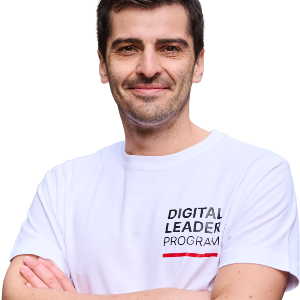
Andre Ottlik
Author
Andre and his Team are the authors of Digital Leader Programs Blog Posts
