
When Senior Leaders Block the Change They Ask For

On stage, they talk about AI, new work, and agility.
In their calendar, they still run leadership like it’s 2005.
I’ve sat in so many leadership meetings where the official story is bold transformation, but what actually happens in the room keeps the organization firmly in the past. Weekly leadership meetings and big transformation programs are usually the places where this contradiction becomes painfully visible. And very often, the bottleneck is not “the organization” or “the employees”. It’s the way senior leaders still work.
In this article, I want to talk about that gap. Why do senior leaders block the change they ask for? What does this look like in daily business? And what can HR and L&D leaders actually do when the leadership “operating system” is still stuck in the early 2000s?
I’m writing this based on my work with leadership teams and transformation programs across Europe.
The uncomfortable truth: senior leaders as bottleneck
Most companies today say they are “in transformation”. There are digital tools, new strategies, change campaigns, and transformation roadmaps. On the surface, senior leaders support all of this. They sponsor programs, record videos, give keynotes about “the future of work”.
But if you watch how they work from Monday to Thursday, you often see something else:
-
Long, presentation‑heavy weekly leadership meetings.
-
Information flowing via email and PowerPoint, not via shared, transparent systems.
-
Experiments that are “allowed”, but failure still feels dangerous.
-
Data in slides, but very little real‑time, data‑driven decision making.
From the outside, this looks like “resistance in the organization”. From the inside, it’s often simpler: leaders still running on an outdated operating system, while asking everybody else to upgrade.
At the same time, I want to be fair. Most senior leaders are not the bad guys in this story. They are under huge pressure, they care about results, and many honestly try to do a good job with what they know. They don’t need judgement. They need honest feedback and support to work differently.
Why top leaders don’t change (even when they know they should)
In my experience, most senior leaders do see the need for change. They read the same reports, hear the same warnings, feel the same market pressure. Still, their own behavior hardly changes.
Two things are especially strong here.
1. Fear of change
The higher someone is in the hierarchy, the more their identity is tied to “how we’ve always done it”. Being in control. Having answers. Making the final call in the room. New ways of working threaten that image. Letting go of control, saying “I don’t know”, experimenting in front of others – that’s risky for people who’ve built a whole career on being the expert.
2. Overload
Most senior leaders spend their days putting out fires that simply didn’t exist ten or fifteen years ago. Crises, new regulations, tech shocks, talent shortages – on top of normal business. Under that level of pressure, our brains go back to what feels safe. For leaders, that means familiar habits: more meetings, more slides, more control, more escalation. They know these habits don’t create the future, but they feel they have no time or mental space to try something else.
So they talk about completely new challenges – and respond with exactly the same behaviors that created today’s problems.
If we want them to change, we have to take this seriously. They are afraid, overloaded, and still want to do the right thing. Real change needs both: a clear mirror and real appreciation.
The operating system mismatch: 2026 strategy, 2005 habits
The real issue is not the strategy deck. It’s the leadership operating system: how decisions are made, how meetings run, how information flows, and what is rewarded.
On the strategy level, most top teams say things like:
-
“We want more autonomy and ownership in the teams.”
-
“We want to become more data‑driven and experiment faster.”
-
“We need to break silos and work across functions.”
On the everyday level, their weekly leadership meetings often look like this:
-
Agenda full of status updates from each function.
-
Long discussions about what went wrong last week, ending in micro‑management.
-
Very few clear decisions, but lots of “take this offline”.
-
The CEO or a very small core group decides most important topics.
In transformation programs, it’s similar. Big initiatives, lots of activity, nice slides. But senior leaders stay in a sponsor role. They talk about culture change, but their own routines don’t move.
In other words: the organization is asked to install a new app, but leadership keeps running on an old operating system.
The hidden leverage: role models and resources
Senior leaders are not just one stakeholder group. They are the strongest culture signal in the company – and they control the resources that real change needs.
They are role models – whether they want to be or not.
If a senior leader spends the week in slide‑driven status meetings, people learn: “This is what leadership looks like here.” If they never touch an online whiteboard, never join a breakout, never share how they use AI, the message is: “These are nice tools, but not real leadership work.”
Their working style moves down the hierarchy. How they run the top meeting shapes how their direct reports run theirs, and so on. Very quickly, the whole organization copies patterns nobody ever chose on purpose.
They control the resources for new ways of working.
New practices don’t appear for free. They cost time, budget, attention and political capital. Someone has to protect experiments, give space for learning, and accept that things might be slower at first.
If senior leaders don’t actively invest in new ways of working, nothing really changes. A few pilots appear and disappear. Workshops happen, and then everything goes back to normal.
This is why the leadership operating system is not a “soft” topic. It defines what has power inside the company.
The skills nobody talks about: basic digital leadership literacy
One thing people rarely say directly: many senior leaders simply lack hands‑on experience with the tools they talk about in their strategy slides.
They talk about “hybrid collaboration” and “AI”. Some of them even love to show AI slide decks. But in real collaboration situations, they quickly fall back into old habits.
For example:
-
Online whiteboards: Tools like Miro or Mural are liked in theory, but many leaders don’t know how to set them up, structure a board, or actually facilitate a session. So someone else does it – and the leader stays in a passive “commenting” mode.
-
Breakout rooms: Almost every tool offers them. Almost nobody at the top uses them. In many leadership meetings, the idea of letting people work in smaller groups still feels scary or inefficient. So we stay in huge groups where only a few voices are heard.
-
AI: Many leaders “use AI” in the sense that they have typed a few prompts. But using AI to prepare decisions, create scenarios, stress‑test ideas, or simulate stakeholder reactions is almost never part of their practice.
People don’t watch the strategy. They watch their leaders’ fingers and calendars. If senior leaders never personally use modern tools in a visible way, everyone understands: this is optional.
Case 1: the leadership team that “had no time” to change
A while ago, I worked with a leadership team in the middle of a big transformation. Officially, the goal was clear: more cross‑functional work, faster decisions, better use of digital tools.
HR and L&D told me: “The teams are open. The bottleneck is the leadership level.”
We started with their weekly leadership meeting.
What I saw was familiar:
-
10–15 minute status reports from each leader.
-
Long dives into details and problems.
-
Almost no real decisions.
-
No shared board or overview, just slides.
When I suggested a new structure – less status, more decisions, visible priorities, some small‑group work – the first answer was: “We don’t have time to change the meeting. We must get through the topics.”
In other words: “We are so busy fighting fires that we can’t change how we use water.”
So we used a small, 1% approach. We didn’t flip the table. We changed a few things:
-
A simple online board with the top 5–7 decisions for the quarter.
-
Clear outcomes for each agenda point.
-
One 20‑minute block with small groups working cross‑functionally.
After three weeks, the feedback was different. More clarity. Fewer offline follow‑ups. Conflicts a bit earlier, but more honest. The transformation felt less like a story and more like real work.
The strategy hadn’t changed. The meeting had.
Case 2: the transformation program that forgot leadership practice
In another company, I came into a transformation program that was already “live”. Workstreams, steering committees, timelines – all there.
Teams told me:
-
“We hear a lot, but our day‑to‑day is the same.”
-
“They say they want more autonomy, but decisions still go up.”
-
“Workshops are nice, and then it’s business as usual.”
In the steering committee, the focus was mostly on reports and risks. The leaders cared. But they treated the program like a project “out there”, not as a change in how they led.
Together with HR and the transformation office, we added “Leadership Practice Labs”:
-
Short sessions around concrete behaviors: running meetings differently, using whiteboards, trying AI in prep, giving feedback in a new way.
-
Real cases from their context, no generic exercises.
-
One small experiment to try between labs.
Slowly, the tone changed. The program stopped being something “for the organization”. It became something leaders were visibly doing themselves.
The 1% method: change in small, real steps
There is a strong urge to look for big solutions: big offsites, big programs, big declarations. In my work, the most reliable changes come from something different: small steps, done consistently.
Use the 1% method. Instead of asking: “How can I reinvent my leadership?”, I ask leaders: “What is one small behavior you can change this week?”
For example:
-
In the next leadership meeting, remove one status slot and use the time to solve one real cross‑functional problem together.
-
Once a week, you personally open and use an online whiteboard in a meeting. No one else does it for you.
-
Once a week, you explicitly say: “I don’t know yet, let’s think together,” so people see that learning at the top is allowed.
-
Once a month, you use AI visibly to prepare a topic and share what it changed in your thinking.
These are low‑hanging fruits. They don’t need a big program. But they are visible, and they add up. After a while, you look back and realize: the way you lead has actually shifted.
What HR and L&D can actually do
If you are in HR, L&D or transformation, you see all this – and you’re often not in the room where decisions are made. That’s not an easy position.
A few things help:
-
Make the operating system visible
Map the routines: meetings, decision paths, communication channels. Show how they contradict the transformation story. Don’t attack people. Make the system visible. -
Talk about practice, not only about programs
Invite leaders to look at their own practice: “What would it look like if your weekly meeting already looked like the culture you want?” Combine that with appreciation: “We know you’re under pressure. Let’s look for 1% changes that are realistic.” -
Start with one important meeting
The weekly leadership meeting is a good place to begin. Redesign it as a pilot. Try a few small changes. Review them. Iterate. -
Create safe spaces to learn tools
Offer low‑risk spaces where senior leaders can practice things like whiteboards, breakouts and AI without losing face. Let them ask “basic” questions. That humility is already a culture signal. -
Bridge strategy and daily work
Don’t stop at vision and values. Help design concrete rituals, formats and decision rules that make the desired culture visible in everyday life.
How I work with leadership teams on this
When I work with organizations on culture and transformation, I rarely start with a big concept presentation. I usually start with what is already there: existing leadership routines.
Typical elements of my work are:
-
Culture design for leadership rituals
Together with HR, transformation and senior leaders, we redesign “the critical few” moments – weekly meetings, quarterly reviews, offsites – so they match the culture you actually want. Simple, clear, and doable. -
Hands‑on support in real meetings
I join real leadership meetings, observe, facilitate, and adjust with the team. We experiment with structure, tools (whiteboards, breakouts, AI support) and involvement. The meeting itself becomes the training ground. -
Leadership practice labs
In focused labs, we work on specific behaviors and turn them into small experiments in the calendar. Less theory, more practice.
The goal is always the same: your leadership operating system and your transformation story start to match.
If this resonates, let’s talk
If you’re responsible for culture, HR, or transformation and you recognize your organization in this article, you’re not alone. Many companies are stuck between a very modern strategy and very old leadership habits.
If you want help in changing the way leadership actually works – in your leadership meetings, your transformation program, and your everyday culture – I’d be happy to support you.
Our work focuses on culture design and hands‑on support for leadership teams in transformation. If you want to explore what that could look like in your context, let’s talk.

Recent Posts
Categories
All categories
KNOWLEDGE THAT WORKS IN PRACTICE
This is not a place for buzzwords. Or for theories that don't hold up in real life. Our blog is a space for leaders and professionals who are looking for genuine answers to genuine questions: How do I lead better in a hybrid environment? How do I communicate in a way that actually lands? How do I use AI meaningfully in my daily work? How do I build resilience in my team?
Every article in the Digital Leader Program blog is designed to be directly useful – with insights, methods and examples you can take straight into practice.
TOPICS THAT MATTER TODAY
Leadership in the digital age: How is leadership changing when teams work remotely or hybrid? What do new leaders need – and what do experienced managers need to relearn?
Human Skills under AI influence: Which human capabilities become more important as AI takes over routine tasks – and how do you develop them deliberately?
Hybrid work in practice: Concrete tips, rituals and tools for productive hybrid collaboration – what actually works, and what doesn't.
Culture Design and team dynamics: How do you build an organisational culture that attracts, retains and energises people?
Communication and feedback: The capabilities that separate average performance from real high performance.
FROM PEOPLE WHO WORK IN PRACTICE
Our articles are written by Andre Ottlik and our team – people who work in coaching sessions, workshops and training every single day. What you read here is not copy-pasted from academic studies, but knowledge drawn from lived practice.
And occasionally we feature contributions from external experts sharing insights from their own fields – such as the piece with Pascal Baumgartner on hybrid meeting optimisation.
FREQUENTLY ASKED QUESTIONS (FAQ)
How often are new articles published?
Regularly. Subscribe to our newsletter or follow us on LinkedIn to make sure you don't miss new content.
Are articles available in German too?
Yes. Many of our articles are also available in German – particularly on topics relevant to German-speaking leaders and organisations.
Can I suggest article topics?
Absolutely. Write to us or bring it up in a conversation – we welcome input from our community.
How can I go deeper than the blog?
Our workshops, coaching programmes and the podcast "3 minutes max." go further and support you systematically in your development. Browse our service pages or book an initial consultation.
Author
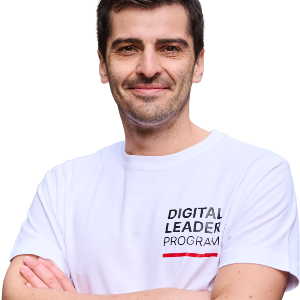
Andre Ottlik
Author
Andre and his Team are the authors of Digital Leader Programs Blog Posts
