
#13 Communication (Part 1 of 2) — The Only Tool You Never Put Down
As a child, I trained as a classical singer. Three years of it — learning to place my voice, and, more than that, to hear: the small nuances in someone else's singing, the half-tones in a piece of music. Around the same time, I helped train one of our dogs for hunting. Animals don't read your slide deck. They read your body, your face, and above all your tone.
Two very different apprenticeships, one lesson: long before the words land, the message is already on its way — in the pitch of the voice, the set of the shoulders, the look on the face.
I start here because of a question I'd like you to sit with: where in your life are you already a better communicator than you are at work? In more than fifteen years of giving presentation and pitch trainings, this is the pattern that stands out most: we fall into a narrow "work voice" we quietly believe is the only one permitted — while outside the office we're warmer, sharper, funnier, more direct. The range is already in you. Too often it's left at the door.
This is the thirteenth part of my weekly walk through the Digital Leader Canvas — Communication, field ⑪, the last one. There's more here than a single edition can hold, so I've split it in two. Today: rapport, tonality and presentation — the sending half. Next time: feedback, conflict, and the close of the walk through the canvas.
(New here? Download the canvas for free: https://www.digital-leader-program.de/en/digital-leader-program-digital-leader-canvas)
The canvas asks:
How can I get better at establishing rapport? When should I adapt my tonality more? How can I improve my presentation skills?
One claim I'll make good on before the end: everything you're about to read about models is now the cheap half of this skill. The expensive half is the one that just became reachable.
The tool that's always in your hands
For anyone doing knowledge work, communication isn't a skill among many. It's the tool you have your hands on all day — with the team around you, with clients, and with yourself, ordering the noise in your head into something you can actually work with. Take it seriously as the instrument it is, and almost everything else in this canvas gets easier.
There's an old line from Paul Watzlawick worth keeping close: you cannot not communicate. Stay silent in a meeting and you've still said something. Your dress, your posture, your tone, your timing — all of it transmits, whether you meant it to or not. The question is never whether you're communicating. It's whether you're doing it on purpose.
And it works on two layers at once. The first is the obvious one: information — people and systems exchanging what they know to align and move. The second is quieter and more powerful: emotion. The same sentence can leave someone energised or deflated, trusted or managed. Optimise only for the information and you'll wonder why clean messages keep failing. (The Meeting Moderation and Senses & Emotions editions both circled this; here it's the whole foundation.)
Underneath both sits rapport. It's the precondition for information to flow at all — the thin layer of trust and attunement that lets a message be received rather than defended against. Without it, the clearest brief bounces off. With it, even a clumsy one gets a generous hearing. Rapport isn't the soft extra at the start of the call; it's the channel everything else travels down. Reading whether it's there — sensory acuity, the deliberate attention I made the case for in the Senses & Emotions edition — is the first move of any good communicator.
A quick aside for HR and people-development leaders: communication is the one skill every role in your organisation runs on — and the hardest to shift with a single workshop, because it only changes through practice and feedback over time. That's exactly what a continuous partnership is for: a set number of flexible days a month with one partner who already knows your people, used across coaching, consulting and workshops — soft skills, leadership, strategy, presentation, the lot. Less to administer, easier to plan, and usually lighter on the cost-per-employee than stitching the same support together piece by piece. I keep this to one organisation at a time, so the attention stays undivided — and that place opens up again from September. A short call is the way in: book 20 minutes.
Every message has four sides — and AI sits on each differently
If there's one model to take from this edition, it's this one — it explains most of the "communication problems" you've ever had. It's also over forty years old and widely taught, so the fresh part isn't the model; it's what happens when you hold it against AI.
In 1981 Friedemann Schulz von Thun, building on Watzlawick, showed that every message — however plain — carries four things at once. Here they are, each with where the machine now helps, or can't:
-
The fact — the data, the content, what's literally said. AI's home turf: it cleans the factual layer, orders the argument, catches the error. But that strength is borrowed. A model repeats what it was trained on and tuned towards, so the factual layer can be bent by whoever built it — training choices, commercial pressure, in some markets outright censorship — and it states the wrong thing with perfect confidence. The side where AI feels most reliable is precisely the side you'll check least. Verify anything that matters.
-
The self-revelation — what the message gives away about you: your mood, your values, what you don't know. AI's most underused use is as a mirror with no ego in the room — paste a draft and ask what it reveals, where it reads anxious or defensive, and it names the tell you can't see in yourself.
-
The relationship — what it signals about how you regard the other person, carried mostly in tone. Today AI works almost entirely on text, so it can flag where warmth or respect has gone missing from a draft. That's about to change: microphones are the obvious next step — systems that listen to how you speak, your pace, your interruptions, the warmth or its absence, and coach you on habits no colleague will ever point out. Useful — and worth watching with both eyes, because a machine that listens to every conversation is also a machine that records one. What it still can't touch is the live relationship: the face across the table, right now.
-
The appeal — what you actually want them to do, think or feel. Ask AI to find your real ask: is the one thing you want clear, or buried under everything else? It surfaces the muddled or missing appeal — and increasingly, an agent can carry it out once you've decided it.
You know the catch: the listener has four ears, and may not hear the one you spoke from — that gap is where most workplace arguments start. The only reminder worth keeping is the working question it gives you: not "why are they being difficult?" but "which ear did that land on?"
Step back and the AI pattern is the tell: the machine is strong where a message is text on a page — the facts, the structure, the wording — and weak where it's a person in a room. As that polish gets cheap for everyone, it stops being a differentiator; what appreciates is the part it keeps handing back to you: the live read, the room, the meaning behind the words. Prepare all four sides with it — then put it down and be present for what only happens live.
Tonality, and the art of meeting people where they are
When should you adapt your tonality? More often than feels natural. A detail-driven, rational colleague wants precision, evidence, no theatrics; a room you're trying to move at a kickoff wants energy, a clear arc, something to feel. Adapting isn't inauthenticity — it's respect for how the other person receives. (The practical face of the Profiling edition: read the wiring, then choose the register.)
My own canvas note was to put more energy into my tonality when presenting or selling — to stop under-playing the relationship and appeal sides when the facts are strong. Yours might be the opposite. The skill is the same: knowing which dial to turn, for whom.
Presentation: sending to the many
Presentation is just communication aimed at a group — the kickoff, the town hall, the keynote. It's the four sides at scale, and the one most people drop under pressure is the relationship: they talk at the room instead of with it. Keep that alive, hold the facts clean and the ask clear, and the room moves with you.
Two things from my own canvas. First, a living "standard" deck — not a fixed script, but a base presentation I keep refining, so I'm improving one thing rather than rebuilding from scratch each time. Second, deliberately seeking bigger stages again, because presentation, like the singing, only sharpens in front of real audiences.
And one advanced tip, for those already strong on stage: what helps most isn't more slides — it's improv. I've taken three improvisation-theatre courses, and I'd call it the best masterclass there is for anyone who has to present in the moment: think on your feet, field the unexpected question, stay composed when the plan falls apart.
There's a reason you have to go looking for this rather than pick it up at work. The people around you usually can't give you feedback on how you communicate — they're not trained to see it, they haven't the time, and most don't feel it's their place. Hold that thought; it's about to matter.
Nobody needs another model
Here's the uncomfortable part, and it comes from someone who makes a living doing this.
Every model in this edition — the four sides, the four ears, situational tonality — is now one prompt away. AI will explain Schulz von Thun to you more patiently than most trainers will, at two in the morning, for nothing. The knowledge half of communication training is finished as a product. It was always the cheap half. Now it's free.
What was never cheap is the other half: reps under observation, and specific feedback on how you actually come across. That's the part almost nobody gets at work, for the reasons just above — and it's the only part that has ever changed anyone's behaviour. Reading about rapport has never once made a person warmer in a room.
So if you're deciding what to invest in, for yourself or for your people, the shift is blunt: stop buying content, start buying repetition. A workshop teaches a model; only reps change a habit. Fewer one-off events, more of what works — practice, observation and feedback spread over months, with someone whose job it is to see what you can't.
And this is where the tech earns its place. AI can't be in the room. But between the sessions that matter, it's an endlessly patient sparring partner: run the difficult conversation three times before you have it once, ask which ear your line lands on, hear what a draft gives away about you. Human coaching for the live room; AI for the thousand small reps in between.
That combination is what human-skills training has to become. Neither one alone gets you there.
And one more thing, addressed to you specifically. If you read a newsletter like this one, none of these models are new to you. You've known about the four sides, about listening and rapport, for years — that isn't your gap. Your gap is the one nobody names: getting everyone else in your organisation to treat communication as a serious business question rather than a soft one.
Because that is what it now is. When the routine work gets automated, what's left running through a company is people talking to each other — and the quality of that shows up in hard places: how quickly decisions get made, how much rework comes out of a single misunderstanding, whether the people you can't afford to lose stay. Communication training has always been among the first budgets cut. That was survivable when the machines couldn't talk. It isn't any more.
So don't underestimate your role in this. The person who can see it is usually the person who has to make the case for it — and you may be the only one in the building positioned to make it. Say it in the language your leadership actually answers to: competitiveness, speed, retention. And say it before the next budget round, not after.
Your turn
Two options for your 1% this week — pick one, and treat it as a rep, not a resolution. Run it past the machine twice before you do it once for real.
If it's rapport and range: name one place outside work where you're a better communicator — with friends, on a stage, coaching a kids' team — and bring one ounce of that voice into a work conversation. Notice what changes.
If it's the four ears: before you send the next message that matters, read it back four times — once for each side. Is the appeal clear? Could the relationship ear mishear it? Fix the one that's most likely to go wrong.
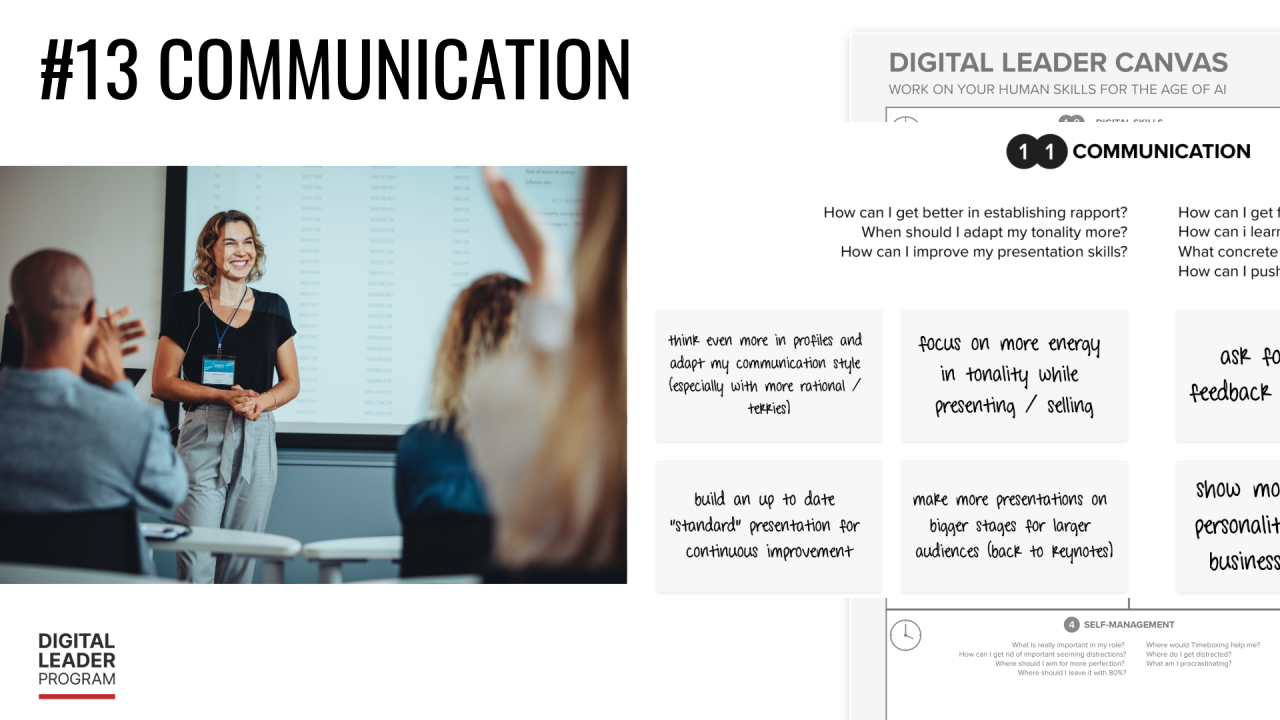
You'll find my own answers in the cover image — thinking more in profiles, more energy in my tonality, a standard deck I keep sharpening, and getting back onto bigger stages. Yours will look different. Pick one and start.
And before you go: where are you a noticeably different communicator outside work than in it — and what would it take to bring that version to the office? Reply or drop a comment. The honest answers are usually the ones others are quietly wrestling with too.
Next week: Communication, Part 2 — giving and receiving feedback, going into conflict, and the end of this walk through the canvas.
See you then.
The Digital Leader Canvas is free for individual use. And if you're in HR or L&D and want to bring these themes into your organisation, here's that link again — book a 20-minute call. You can also explore the Leadership Essentials Workshop Series for teams.
Recent Posts
Categories
All categories
KNOWLEDGE THAT WORKS IN PRACTICE
This is not a place for buzzwords. Or for theories that don't hold up in real life. Our blog is a space for leaders and professionals who are looking for genuine answers to genuine questions: How do I lead better in a hybrid environment? How do I communicate in a way that actually lands? How do I use AI meaningfully in my daily work? How do I build resilience in my team?
Every article in the Digital Leader Program blog is designed to be directly useful – with insights, methods and examples you can take straight into practice.
TOPICS THAT MATTER TODAY
Leadership in the digital age: How is leadership changing when teams work remotely or hybrid? What do new leaders need – and what do experienced managers need to relearn?
Human Skills under AI influence: Which human capabilities become more important as AI takes over routine tasks – and how do you develop them deliberately?
Hybrid work in practice: Concrete tips, rituals and tools for productive hybrid collaboration – what actually works, and what doesn't.
Culture Design and team dynamics: How do you build an organisational culture that attracts, retains and energises people?
Communication and feedback: The capabilities that separate average performance from real high performance.
FROM PEOPLE WHO WORK IN PRACTICE
Our articles are written by Andre Ottlik and our team – people who work in coaching sessions, workshops and training every single day. What you read here is not copy-pasted from academic studies, but knowledge drawn from lived practice.
And occasionally we feature contributions from external experts sharing insights from their own fields – such as the piece with Pascal Baumgartner on hybrid meeting optimisation.
FREQUENTLY ASKED QUESTIONS (FAQ)
How often are new articles published?
Regularly. Subscribe to our newsletter or follow us on LinkedIn to make sure you don't miss new content.
Are articles available in German too?
Yes. Many of our articles are also available in German – particularly on topics relevant to German-speaking leaders and organisations.
Can I suggest article topics?
Absolutely. Write to us or bring it up in a conversation – we welcome input from our community.
How can I go deeper than the blog?
Our workshops, coaching programmes and the podcast "3 minutes max." go further and support you systematically in your development. Browse our service pages or book an initial consultation.
Author

Andre Ottlik
Author
Andre and his Team are the authors of Digital Leader Programs Blog Posts
