
#14 Communication (Part 2 of 2) — Feedback, Conflict, and the End of the Walk
"Feedback is a gift." "Feedback is the breakfast of champions." You've met both, probably on a poster.
They're half true. Champions do take feedback and work on themselves. But I've also watched people ignore almost all of it to build something no committee would have approved — and I've watched "feedback" arrive not as a gift at all, but as a demand: one person requiring something of another, wrapped in a friendly word. Treat every piece as a present you must gratefully accept and you'll end up sanded down to the average of everyone else's preferences.
So let's take down the poster and look at what feedback and conflict actually are — and how to get better at both.
This is the fourteenth part of my walk through the Digital Leader Canvas — Communication, field ⑪, part two. It also closes the walk: field by field, we've now done all eleven. That's not the end of this newsletter, though — more on where it goes next at the end.
(New here? Download the canvas for free: https://www.digital-leader-program.de/en/digital-leader-program-digital-leader-canvas)
The canvas asks:
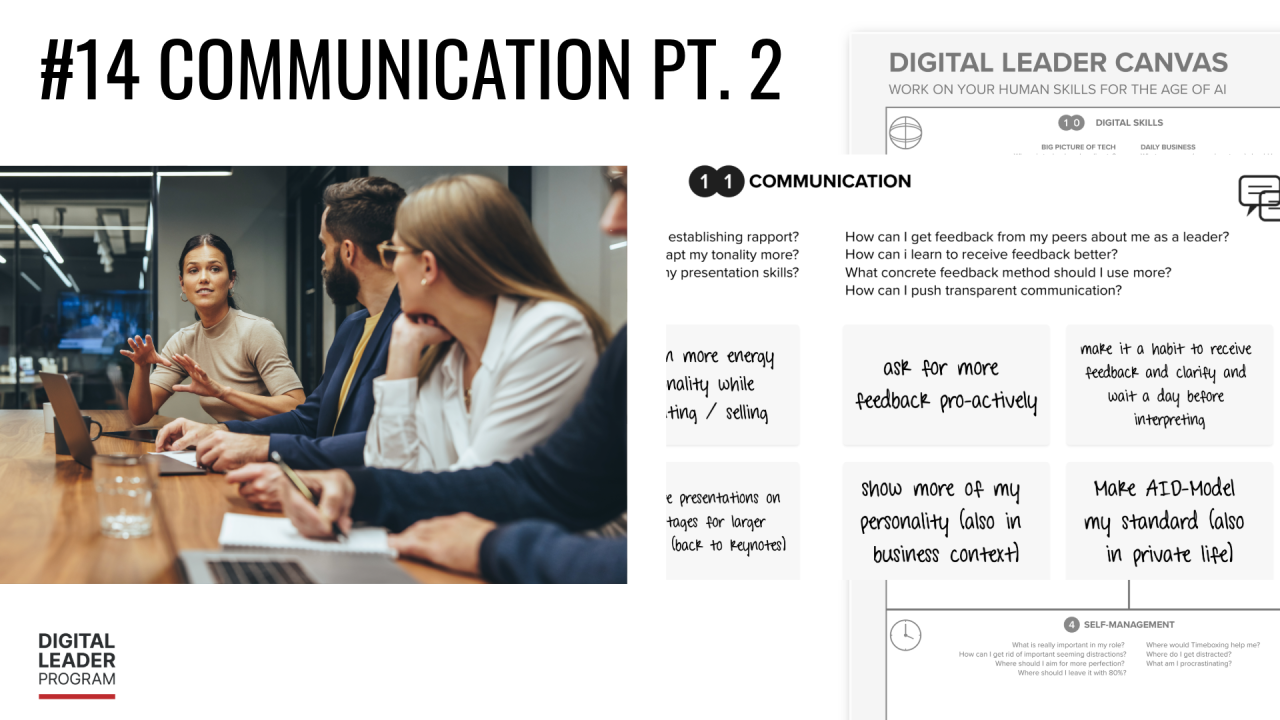
How do I get honest feedback from peers about me as a leader? How do I learn to receive feedback better? What concrete method should I use more? How do I push transparent communication?
Before we get into it — an edition about feedback is a poor place for me to stay quiet about wanting yours. So, up front: if a line here lands, or rubs you the wrong way, tell me in the comments or hit reply. One sentence is plenty. I read every one — and now that the canvas is complete, what you send genuinely steers where this newsletter goes from here.
Conflict isn't the failure — it's the normal
As work gets more complex, people end up with different interests, different data, and different amounts of context. Conflict isn't a sign something has gone wrong; it's the ordinary result of capable people seeing different slices of the same picture. Communication is how you walk through the misunderstanding together and come out, with luck, aligned.
That reframe matters because how you handle this was largely decided long before the meeting. Many of us were socialised into a fixed setting — taught how much room we're allowed to take, whether we may disagree out loud, how conflict is supposed to go. (The Resources & Limitations edition called these the limitations we mistake for personality.) Worth knowing your own default before you try to change anyone else's.
The hard half: receiving it
Most advice is about giving feedback. The harder skill is taking it.
My own note on the canvas was a small discipline that changes everything: ask for feedback proactively — then clarify, and wait a day before interpreting. The waiting is the trick. In the moment, feedback hits the relationship ear first (they think I'm not good enough), and you defend. Give it a night and the same words arrive on the factual ear, where you can actually use them. Hearing and reacting don't have to happen at the same time.
Getting honest feedback about yourself as a leader is harder still, because power distorts it — people manage upward, and tell you a smoother version. You don't fix that by demanding candour. You earn it: by asking specific questions rather than "any feedback for me?", by visibly acting on what you're told, and by not punishing the first person brave enough to be straight. Do that a few times and the real feedback starts to arrive.
The giving half: make it AID
When you do give feedback, structure beats instinct — and the model I'd make your standard is AID: Action, Impact, Desired outcome.
-
Action — the observable thing, stated as fact, not interpretation. "In Tuesday's review you cut in twice while Maria was presenting." Not "you were dismissive."
-
Impact — what it caused. "She stopped offering ideas, and we lost the thread she was building."
-
Desired outcome — where to go next. "Hold your points to the end, and ask her to finish — I think you'll get more from her, not less."
It works for praise as much as correction, and it works because it keeps the message on the factual and appeal sides of Schulz von Thun's four — last week's model — and off the relationship ear, where "you were dismissive" lands as an attack and the shutters come down. Action, impact, outcome: clarity, dignity, a way forward.
Questioning sits underneath all of it; I've made the case twice, so I'll only point (the Delegation and Meeting Moderation editions go deeper). A sharp question, asked at the right level of detail, does more than the cleverest statement.
A quick aside for HR and people-development leaders: feedback culture is the thing every organisation says it wants and few actually build — because it isn't a policy, it's a hundred small conversations done well, repeatedly. That's what a continuous partnership is for: a set number of flexible days a month with one partner who knows your people, across coaching, consulting and workshops — feedback, leadership, communication, the lot. Less to administer, easier to plan, and usually lighter on the cost-per-employee than one-off sessions. I keep this to one organisation at a time, so the attention stays undivided — and that place opens up again from September. A short call is the way in: book 20 minutes.
Feedback is the supreme discipline
I rate feedback as the hardest thing in all of communication, because the aim is three things at once: to move someone toward a change in behaviour; to leave them motivated to make it, if it genuinely fits them; and to come out with the relationship intact — better, even. Hit all three and you've done something rare.
It needs most of the skills this whole canvas has covered, because there's no universal way to give feedback. Each person takes it differently — and the same person takes it differently on a Monday than a Thursday. It even depends on who's speaking: I'll absorb a hard truth from a colleague I respect in that field and bristle at the identical words from someone else. So the craft isn't tailoring feedback to eight billion people — it's tailoring it to this person, in this moment. That takes the in-the-moment attention the Senses & Emotions edition was about.
And there's a tension inside it: I want to give enough that the person can actually move, which means pushing toward the edge of what they can hear — and sometimes overshooting. When that happens, one rule saves you: don't generalise from one exchange to all the rest. A conversation that landed badly is data about that conversation, not a verdict on the person, the relationship, or feedback itself.
Reading the room — and the culture it's in
Two more variables decide how feedback lands, and both sit outside the words themselves.
The first is setting. The standard rule — praise in public, correct in private — quietly kills timely feedback: the one-to-one slot never opens, and the moment passes. So a correction in a group isn't a no-go for me, provided the team shares a clear sense of how feedback is meant here. But watch the ripple: I once gave one person feedback in front of the group; they took it well and thanked me — while someone else in the room sat deeply uncomfortable, certain I'd treat them the same way. The individual gained; part of the group flinched. Even aimed at one person, feedback is a message to everyone watching, heard on the relationship ear.
The second is culture. What counts as good feedback shifts the moment you cross a border — Erin Meyer's Culture Map (a recurring companion in this series) maps how directly criticism is given, how openly people disagree, how much meaning hides in the unsaid. Direct feedback that reads as respect in the Netherlands can sound brutal to a British ear; restraint that's professional in Japan can read as disengagement elsewhere. In an international team you cross several of these lines without leaving the room — so treat "that was too blunt" as a hypothesis about your own upbringing, not a fact about them. Ask more, assume less, the humility the Profiling and Senses & Emotions editions kept insisting on.
Transparency, and showing up as yourself
Two of my own canvas notes pull in the same direction: push more transparent communication, and show more of my personality — in business, not only outside it. They're connected. Transparency without personality is just disclosure; it's the willingness to be a real person, with a real voice, that makes openness land as trust rather than procedure. Which loops straight back to last week: the "work voice" we shrink into is often the enemy of exactly the rapport we're trying to build.
How AI can help — today
For feedback and conflict, the most useful thing AI does is let you practise the conversation before it costs anything.
-
Rehearse the hard talk. Have it play the other person — defensive, quiet, upset — so you feel your own reaction rise in a low-stakes setting and steady it before it counts. (The Senses & Emotions edition made this its core AI use; it matters most here.)
-
Draft it in AID. Describe what happened and ask for an Action–Impact–Desired outcome version — then check it against the four ears: would any line land as a relationship-attack?
-
Translate across styles. If you're giving feedback across cultures, ask how your wording might read to a more direct, or more indirect, audience.
What AI can't do is supply the courage. Feedback and conflict are acts of nerve as much as wording, and the nerve is yours.
How this changes over time
Two futures pull against each other. The risk: feedback gets outsourced and over-sanitised — AI-smoothed messages that never quite say the hard thing, honesty mediated into mush. The opportunity: the barrier to giving good feedback drops, and teams that record and analyse their own communication (openly, with consent — the line the Profiling edition drew) can finally see how they actually talk to each other.
Which future you get isn't decided by the tool. It's decided by whether people still choose to be honest when a machine would let them avoid it.
Your turn
Your 1% this week, pick one.
If it's receiving: ask one person a specific question about how you show up — and then do nothing with the answer for 24 hours. Just let it sit on the factual ear.
If it's giving: take one piece of feedback you've been sitting on and write it in AID — action, impact, desired outcome — before you say it.
You'll find my own answers in the cover image — asking for feedback more proactively, waiting a day before I interpret it, showing more personality at work, and making AID my default. Pick one. That's the start.
The canvas is finished. This newsletter isn't.
Fourteen editions ago, we started with a blank canvas and a promise to go through it field by field.
We mapped what a team is for and what drives the people in it; when to tell and when to coach; the limitations we carry without naming them; how to manage ourselves before we manage others; the body that runs our leadership; what to delegate, automate, or kill; how to run a room; how to read one; how to read the people in it without boxing them in; which digital skills actually matter; and, these last two weeks, how we communicate it all.
The canvas was never a test to finish. It's a tool to come back to — a different field each time something in your work starts to ache. Print it out again next quarter; you'll fill it in differently, because you'll be different.
And the thread running through every field was the same one. As machines take more of the routine and the analytical, the durable advantage moves to the things this whole canvas is about: judgment, presence, taste, the ability to connect, to read a room, to mean what you say. Not because machines can't do anything — they can do a staggering amount — but because what stays scarce, and therefore valuable, is the human on either end of the work.
So the walk through the canvas ends here — but Human Skills in the Age of AI carries on. The canvas was the map for this first stretch; from here I follow the same question into new terrain, beyond the eleven fields, wherever the work of staying human in an AI world leads. Same newsletter, new ground.
And I know the first stop. For fourteen editions we've worked on the individual leader; next, we pull back to the team. I'll take you through the Culture Design Canvas by Gustavo Razzetti — the organisational counterpart to the one we just finished: a one-page way to design the culture a team actually lives in, rather than the one printed on the wall. If the Digital Leader Canvas was the mirror, this is the room.
Thank you for reading, for replying, for the honest answers you sent back week after week — they shaped these editions more than you know, and they'll shape what comes next. So, before you go, one last question from this chapter: of the eleven fields, which one will you act on first?
Tell me. I read every reply.
The Digital Leader Canvas is free for individual use. And if you're in HR or L&D and want to bring these themes into your organisation, here's that link again — book a 20-minute call. You can also explore the Leadership Essentials Workshop Series for teams.

Recent Posts
Categories
All categories
KNOWLEDGE THAT WORKS IN PRACTICE
This is not a place for buzzwords. Or for theories that don't hold up in real life. Our blog is a space for leaders and professionals who are looking for genuine answers to genuine questions: How do I lead better in a hybrid environment? How do I communicate in a way that actually lands? How do I use AI meaningfully in my daily work? How do I build resilience in my team?
Every article in the Digital Leader Program blog is designed to be directly useful – with insights, methods and examples you can take straight into practice.
TOPICS THAT MATTER TODAY
Leadership in the digital age: How is leadership changing when teams work remotely or hybrid? What do new leaders need – and what do experienced managers need to relearn?
Human Skills under AI influence: Which human capabilities become more important as AI takes over routine tasks – and how do you develop them deliberately?
Hybrid work in practice: Concrete tips, rituals and tools for productive hybrid collaboration – what actually works, and what doesn't.
Culture Design and team dynamics: How do you build an organisational culture that attracts, retains and energises people?
Communication and feedback: The capabilities that separate average performance from real high performance.
FROM PEOPLE WHO WORK IN PRACTICE
Our articles are written by Andre Ottlik and our team – people who work in coaching sessions, workshops and training every single day. What you read here is not copy-pasted from academic studies, but knowledge drawn from lived practice.
And occasionally we feature contributions from external experts sharing insights from their own fields – such as the piece with Pascal Baumgartner on hybrid meeting optimisation.
FREQUENTLY ASKED QUESTIONS (FAQ)
How often are new articles published?
Regularly. Subscribe to our newsletter or follow us on LinkedIn to make sure you don't miss new content.
Are articles available in German too?
Yes. Many of our articles are also available in German – particularly on topics relevant to German-speaking leaders and organisations.
Can I suggest article topics?
Absolutely. Write to us or bring it up in a conversation – we welcome input from our community.
How can I go deeper than the blog?
Our workshops, coaching programmes and the podcast "3 minutes max." go further and support you systematically in your development. Browse our service pages or book an initial consultation.
Author
Andre Ottlik
Author
Andre and his Team are the authors of Digital Leader Programs Blog Posts
