
#27 Presenting with AI (3): Stage — What the Tool Cannot Hear
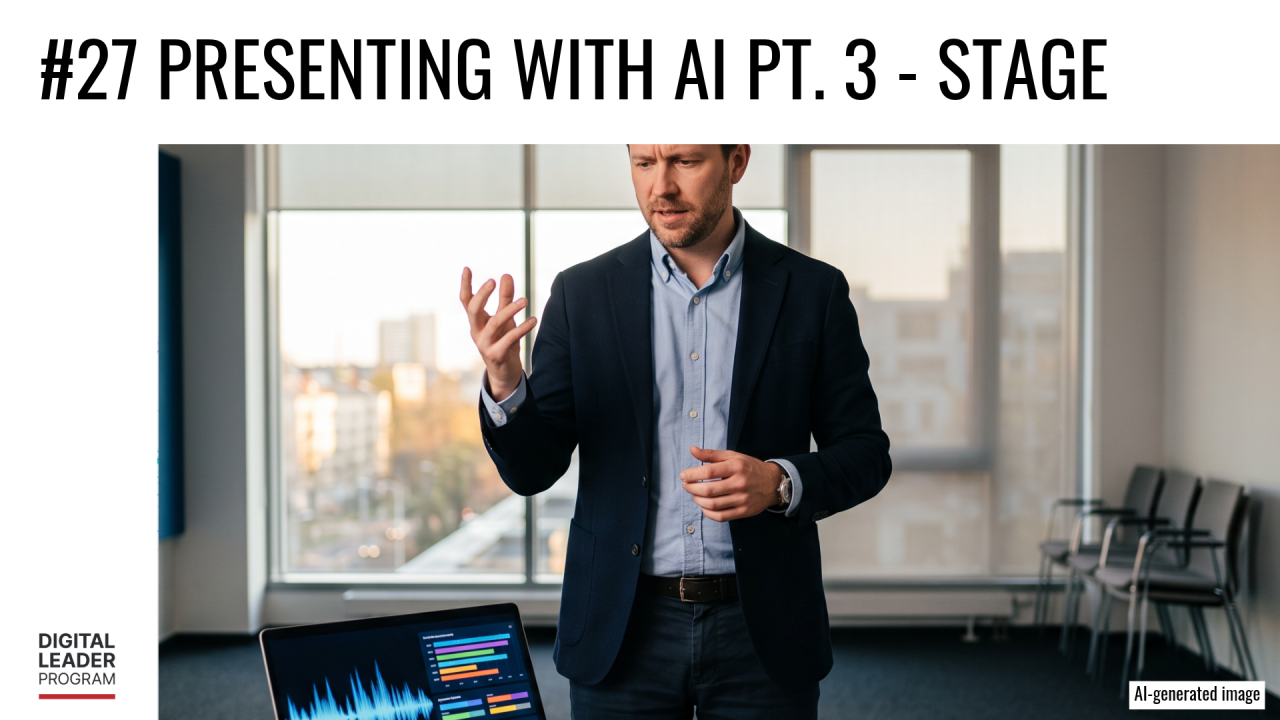
In my presentation trainings, the third step is the one that divides the room: some dread it, some love it. The content is right, the slides are clean, and now someone stands up and presents to the others, on camera. When all of that is in place, about one in ten gets the energy right. The rest, at least in Germany, give too little: too little power towards the audience, too little conviction in the voice. Rarely, someone gives too much. A few months ago I wrote in my own Digital Leader Canvas that I wanted "to put more energy into my tonality when presenting or selling". After years of reflection it can still be hard to find the right energy, and the motivation to use it.
If you run a company, this is your problem first. The tools that promise to fix it now listen to voices and read faces, and some of them score "confidence" or "energy" and report to managers. Since February 2025, the EU AI Act prohibits AI that infers emotions from the faces or voices of people at work, except for medical or safety reasons. A tool that counts filler words on someone's own laptop is one thing; a tool that tells you which of your people sounded unsure is another. Whether your company buys the first or the second is decided at the top, or by nobody.
(The last of three editions on presenting with AI: story, slides, and now the person in front of the room.)
8 min read. If you take one thing from this: AI can count what you do on stage, pace, filler words, where you look; it cannot hear whether you meant it. Ahead: what the room reacts to, hands, eyes, voice; what Speaker Coach measures, and the one study that tested such tools properly; why nobody tells you how you come across; energy across cultures, plus one rule for whoever signs.
What the room reacts to
Start with what listeners respond to, not with what feels right on stage.
Hands. Nicole Dargue and colleagues at Macquarie University combined 83 samples in 2019: people understand speech better when they can see the speaker's gestures. But not all gestures. Gestures that show a shape, a movement or an idea helped a lot; the small rhythmic hand beats many speakers make while talking had no measurable effect. So "use your hands more" is half right. Use them to show something, and on video make sure they are in the picture at all: in many remote setups the camera never sees them.
Eyes. On video, the camera is the audience. A Gothenburg and Stanford team had about 3,900 people rate screenshots from video calls: speakers who looked away from the screen seemed less likeable and less present. That is the person with two monitors and the call window on the wrong one, seen from the side for a whole hour. Looking into the camera and looking at the faces on screen did equally well, with a small edge in presence for the camera. Bielefeld researchers found in two small experiments that a direct gaze reads within about four degrees around the lens. So put the face you talk to directly under the camera, and don't look away.
Voice. In studies of speech judged as charismatic, from Columbia University's speech lab to Oliver Niebuhr's group in Denmark, ratings rise with a wider, more variable pitch range and, in most samples, with more varied loudness and a faster pace; filled pauses lower them, and some effects reverse across cultures. All of that can be measured, which is where the tools come in.
What the tools can hear
PowerPoint's Speaker Coach listens to a rehearsal and reports pace (it recommends 100 to 165 words a minute), filler words, monotone pitch, repeated phrases, and whether you are reading your slides aloud. The Teams version does the same in live meetings and shows the result only to you: not your manager, not your IT admin, in Microsoft's own words. Both work in English only. Poised, which sold a "confidence" score, shut down this month. Gemini will take a five-minute video of a rehearsal and describe it.
I have not used Speaker Coach myself yet. But I know what seeing yourself does, because I recorded e-learning videos over several years. I watched myself, and repeated a take until the point landed the way I wanted. It was one of the best lessons I had in how I come across and how strongly to say something, and it took away some of the shame of watching myself.
The research is more modest than the product pages. The only randomised trial over a whole course, by Xavier Ochoa, now at New York University, gave 180 students a system that scored gaze, posture, volume and filled pauses after every rehearsal. Their gaze improved, as measured by the tool. When a human expert later rated a new presentation, the difference to the control group was so small that the authors call it negligible. A team at the University of Southern California compared three ways of giving feedback to 45 speakers: live numbers on the screen came last, behind a simulated audience that visibly lost interest, and even behind no feedback. And when researchers in France and Glasgow worked with sixteen professional speaking coaches, in a 2025 study not yet reviewed, one of them said of AI feedback: "I'm missing something of the enthusiasm, of the commitment", and: "We choose to be silent because there is meaning in silence, and [AI feedback] does not say this."
So use the tools for what they count well: pace, "ums", repeated sentences, slides read aloud, on the thousand small repetitions nobody else will sit through. In the communication edition I put it this way: "Human coaching for the live room; AI for the thousand small reps in between." Two years of tools later, I would not change a word.
If you sign budgets and the presentations in your leadership team get the content right and nobody remembers them, one thing is enough. Forward this edition to whoever runs people development for you, with one line: "I want us to work on this over months, not in an event. Find me something like it." What to look for: a programme that starts with the leadership team, runs over months rather than days, and treats human skills and AI as one subject. If you run people development and just received that line, or still have budget for this year: that is the work I do, since 2010 with organisations from start-ups to adidas and Fraunhofer (references). Twenty minutes, and you'll leave with a clear next step whether or not you work with me: book a call.
Why nobody tells you
The tools are tempting for a reason: people will not tell you. In 1970, Sidney Rosen and Abraham Tesser gave participants good or bad news to pass on to a stranger, in a small lab study. The good news was passed on by 82 percent, the bad by 26. They called it the MUM effect. In the communication edition I wrote: "The people around you usually can't give you feedback on how you communicate." They can. They do not.
And the machines cannot read what people think they can. Lisa Feldman Barrett, author of How Emotions Are Made, reviewed with four colleagues the research on facial expressions: the same movement means different things across cultures, situations and people; a scowl "often communicates something other than an emotional state". That is the science behind the AI Act's ban. A system that tells your manager you looked unsure is guessing.
What works instead is older than both: a group that has agreed to tell you. In my trainings, every rehearsal is filmed, and the video stays untouched; each person takes it home with the feedback from the group and from me recorded on it. Energy and tone I work on from the start, as soon as someone feels safe enough at the front, and people often hear within five minutes how much more convincing they have become. It only works if they know what they want to say; without a rehearsed story there is nothing to put power behind. That is why this is step three.
Energy, and where it comes from
Energy is not one thing everywhere. In my work with teams from the United States there was far more power in a presentation than I know from Germany; in Poland, Estonia and the Czech Republic less again, also in the words chosen. Within Germany, east and west, north and south expect different amounts of it. My observation, not a study. The studies draw a different map. Jeanne Tsai at Stanford found that European Americans value excited, high-energy positive states more than Hong Kong Chinese do, who value calm ones more; a 2025 meta-analysis of more than 31,000 people confirmed the gap on excitement. Kuba Krys of the Polish Academy of Sciences showed with data from 44 cultures that where people see the future as unpredictable, a smiling face is rated less intelligent; where predictability is prized, a smile helps. And, as always with the Culture Map, about eighty percent of the variation lies within countries, not between them. The person in front of you beats the passport, and a tool trained on English speakers has met neither.
Where does energy come from when it is missing? For me, from two places outside work. Three years of singing as a child left something I still use: I hear myself, and I have a reasonable sense of pitch, pace and volume, also relative to others in the room. And improv, three courses so far, did more for my confidence on stage than any technique. It forces you to trust what comes out of you on the spot, and teaches you that it is usually half as bad as you feared. I recommend it to presenters who are already good and want the next step.
That is where the series ends. The deck is built, the slides are designed, and the last step cannot be handed to a tool. Someone has to stand up in front of people who will notice whether it is real.
Your turn
If you sign budgets. Do not buy a tool that scores your people's energy or confidence and reports to managers; in the EU it is prohibited, and it would not help right now. Let people count their own filler words. Then send this edition to whoever runs people development, with the line from the middle of this page.
If you lead a team. Before the next presentation that matters, one filmed rehearsal in front of two colleagues. Their feedback goes on the recording, and the presenter keeps it.
If you develop people. Before booking another slide-design training, book rehearsal time: a human in the room, a tool on the laptop, and the deck that is due. If you need the mandate, forward this upward; the opening is written for the person who signs.
Your 1% this week, whoever you are. Record two minutes of your next presentation on your phone. Watch it with the sound off, then listen with the screen off.
That closes the three on presenting. Next time: what using AI all day asks of our brains, and how to keep an overview across all those chats. Until then: who was the last person who told you honestly how you come across? Tell me in the comments. I read every reply.
If you want to bring these themes into your organisation, here's that link again: book a 20-minute call. You can also explore the Leadership Essentials Workshop Series for teams.
Recent Posts
Categories
All categories
KNOWLEDGE THAT WORKS IN PRACTICE
This is not a place for buzzwords. Or for theories that don't hold up in real life. Our blog is a space for leaders and professionals who are looking for genuine answers to genuine questions: How do I lead better in a hybrid environment? How do I communicate in a way that actually lands? How do I use AI meaningfully in my daily work? How do I build resilience in my team?
Every article in the Digital Leader Program blog is designed to be directly useful – with insights, methods and examples you can take straight into practice.
TOPICS THAT MATTER TODAY
Leadership in the digital age: How is leadership changing when teams work remotely or hybrid? What do new leaders need – and what do experienced managers need to relearn?
Human Skills under AI influence: Which human capabilities become more important as AI takes over routine tasks – and how do you develop them deliberately?
Hybrid work in practice: Concrete tips, rituals and tools for productive hybrid collaboration – what actually works, and what doesn't.
Culture Design and team dynamics: How do you build an organisational culture that attracts, retains and energises people?
Communication and feedback: The capabilities that separate average performance from real high performance.
FROM PEOPLE WHO WORK IN PRACTICE
Our articles are written by Andre Ottlik and our team – people who work in coaching sessions, workshops and training every single day. What you read here is not copy-pasted from academic studies, but knowledge drawn from lived practice.
And occasionally we feature contributions from external experts sharing insights from their own fields – such as the piece with Pascal Baumgartner on hybrid meeting optimisation.
FREQUENTLY ASKED QUESTIONS (FAQ)
How often are new articles published?
Regularly. Subscribe to our newsletter or follow us on LinkedIn to make sure you don't miss new content.
Are articles available in German too?
Yes. Many of our articles are also available in German – particularly on topics relevant to German-speaking leaders and organisations.
Can I suggest article topics?
Absolutely. Write to us or bring it up in a conversation – we welcome input from our community.
How can I go deeper than the blog?
Our workshops, coaching programmes and the podcast "3 minutes max." go further and support you systematically in your development. Browse our service pages or book an initial consultation.
Author
Andre Ottlik
Author
Andre and his Team are the authors of Digital Leader Programs Blog Posts
