
#3 Leadership Style — When to Tell, When to Coach
This is part three of my weekly series on the Digital Leader Canvas — a free self-assessment framework with 11 dimensions of leadership. If you're new here, you can download the canvas and catch up: https://www.digital-leader-program.de/en/digital-leader-program-digital-leader-canvas
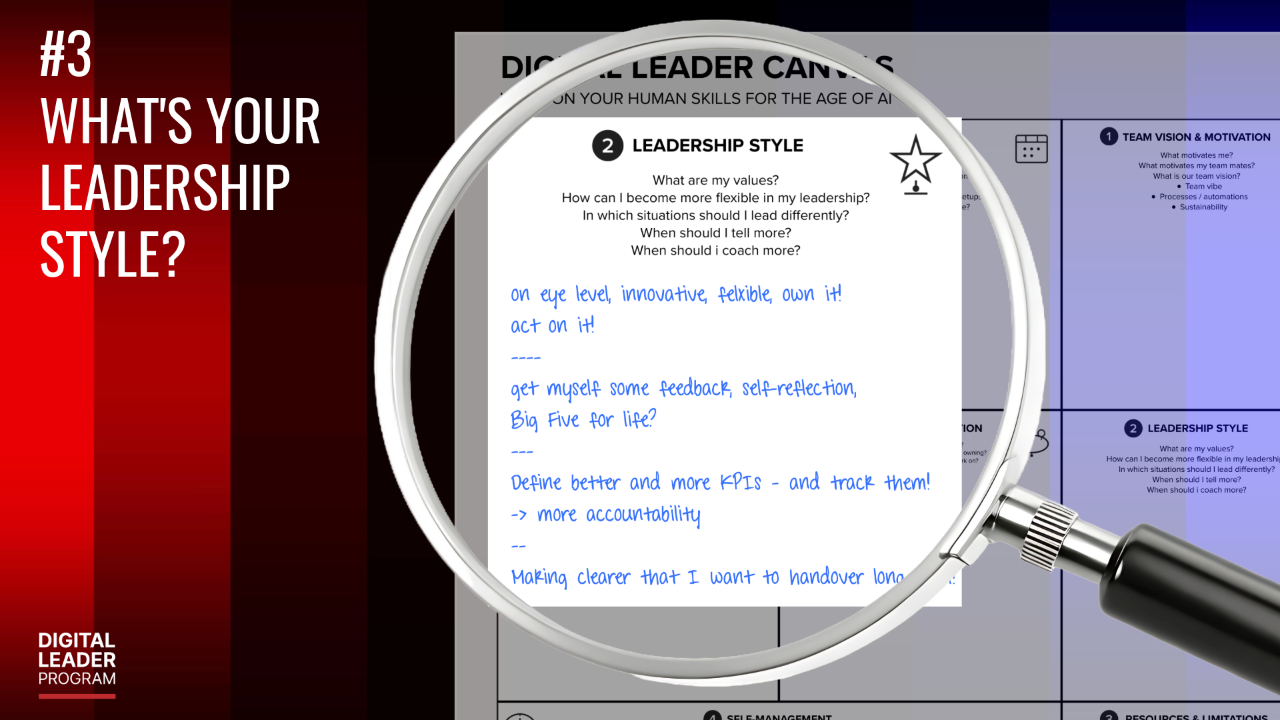
This week we're looking at Quadrant ② — Leadership Style. The canvas asks:
What are my values? How can I become more flexible in my leadership? In which situations should I lead differently? When should I tell more? When should I coach more?
Let's get into it.
The two extremes
I think every leader moves between two extremes:
On one end: telling. Giving answers, making decisions, directing. Some people call it bossing — I'll use that word too, because that's how it often feels to the person on the receiving end.
On the other end: coaching. Asking questions, guiding, handing over responsibility. Trusting the other person to figure it out.
Most leadership advice today tells you to move towards coaching. And I agree — that should be the direction. But here's the thing most people don't say out loud: you can't just coach everyone all the time. And if you try, you'll confuse people, lose trust, and slow things down.
The real skill is knowing when to do what.
Why most leadership principles fail
Before we go deeper, a quick detour. Many companies write down leadership principles. Values. Behaviours. They present them at an all-hands meeting, put them in a PDF, maybe mention them in the onboarding.
And then nothing happens.
Leadership principles only work if the organisation lives them — top down. If the senior leaders act as role models, pick them up in everyday conversations, and hold each other accountable. Writing them down because "it needs to be done in a modern culture" is not enough. If your leadership team doesn't embody the principles, don't expect anyone else to.
Situational leadership — my updated version
I'm a big fan of situational leadership, originally developed by Blanchard and Hersey. The core idea is simple: different people need different leadership approaches depending on their competence and confidence.
But I've updated the model for how I actually use it. Here's my version:

Q1 — Telling (Decide). Low competency, low relationship intensity. The person is new or unfamiliar with the task. You give clear instructions. You decide.
Q2 — Selling (Convince). The person is growing but still needs guidance. You explain the why, not just the what. You consult them, but ultimately you still steer.
Q3 — Participating (Consensus). The person is competent and the relationship is strong. You involve them in decisions. You seek consensus. You co-create.
Q4 — Handover (Autonomy). High competency, high trust. You hand over completely. The person owns the task, the process, and the outcome.
The goal — following the logic of Kenneth Blanchard's One Minute Manager — is that the person at the lowest level in the hierarchy who is capable of doing the job should do the job. And you should be actively working to hand over as many topics as possible to get there.
The handover problem
In theory, every leader agrees with this. In practice, especially in growing companies, it rarely happens.
Why? Because managers feel they don't have time. There's so much going on that preparing a proper handover — training the person, setting up the process, building trust — feels like a luxury. So they keep telling. Keep doing things themselves. Keep being the bottleneck.
In Eisenhower's terms: handovers are important but not urgent. And that's exactly why they never get done.
The difference between single task delegation and a real handover is significant. When you delegate a task, you stay in the middle — the specialist comes to you with questions, you go to the client, you control the outcome. When you hand over properly, the specialist works directly with the client. You step back into setting standards, processes, and development. Your role shifts from doing to enabling.

That shift is what frees you up to think strategically instead of firefighting every day.
But what about trust?
Here's where it gets personal. Even if your colleague is perfectly prepared — skilled, experienced, ready — none of it matters if you can't let go.
If you have trust issues as a leader, the other person might be the best employee you've ever had. But as long as you cannot give up control, they'll never be able to truly help you. And they'll never grow.
So when you're filling in this quadrant on the canvas, be honest: is the bottleneck really your team's competence? Or is it your ability to trust?
The cultural dimension
Now, here's something that doesn't get enough attention in leadership discussions: culture shapes what people expect from their leaders.

Erin Meyer's Culture Map shows two relevant scales. On the Deciding scale, some cultures lean towards consensual decision-making (like Sweden, Japan, the Netherlands, Germany), while others lean towards top-down decisions (like India, Nigeria, China). On the Leading scale, some cultures are deeply egalitarian (Denmark, Netherlands, Sweden), while others are hierarchical (Japan, Korea, Nigeria).
And here's the practical implication: in some cultures, if you switch to a coaching style and only ask questions instead of giving answers, people won't think you're empowering them. They'll think you're incompetent. They expect their leader to have the answer. They want clarity, not another question.
So if you're leading a diverse or international team, you need to make your leadership approach explicit. If you lean towards coaching, explain why. Don't assume everyone will appreciate it. Some people need to understand your reasoning before they can trust the method.
When telling is exactly right
Modern leadership culture has made "telling" almost a dirty word. But there are situations where it's not just acceptable — it's necessary.
Crisis situations. A server goes down. A key client is about to leave. COVID hits and you need to decide in hours whether to send everyone home. In moments like these, gathering input from the crowd is a luxury you don't have. Leaders need to make bold decisions quickly and tell people what to do.
Urgent + important. In the Eisenhower matrix, when something is both urgent and important, that's telling territory. You don't coach someone through a burning building.
Certain industries and roles. Firefighters. Military. Emergency medicine. There are jobs where the nature of the work requires instant, clear direction. Discussion comes after.
A modern leader should lean towards coaching as the default — but needs the flexibility and the situational awareness to understand when telling is the right call.
One more thing: it depends on the task, not just the person
This is a nuance that most situational leadership models miss.
Let's say you have a social media manager who has been with you for two years. She's in Q4 — full autonomy on her core job. You've handed over. She's excellent.
Now you ask her to organise the company Christmas party.
Can you treat her the same way? No. Because she might be a Q4 in social media but a Q1 when it comes to event planning. Situational leadership isn't just about the person — it's about the person in relation to the specific task.
Every time you assign something outside someone's core area, recalibrate. Don't assume that someone who is autonomous in one domain is autonomous in all of them.
A real example: how I filled in this field
Let me show you how I reflected on this quadrant for my own team.
My values:
Working on eye level with each other. Being forward-oriented and innovative. Understanding when perfection is needed — and when 80/20 is enough. And reliability: if someone says they'll take care of something, I expect them to own it and come back to me proactively if something is going wrong. Not when it's too late.
How can I become more flexible?
By actively asking my team to give me feedback — in the right way, continuously, not just once a year. That means training my colleagues on understanding when I'm open to receiving feedback, so it actually lands. I also want to build a ritual of self-reflection: regularly stepping back and asking myself — what's the rapport with each of my team members? Who needs more of my time? Who needs more questions instead of answers? And for each person: is there a match between their personal goals — their "Big Five for Life" — and what our company and organisation can offer them for their medium and long-term development?
Where should I lead differently?
I'm very good at leading on an emotional basis — building energy, creating connection, motivating people. But I need to get better at tracking results. Handing over bigger projects is one thing. Defining the KPIs I want back, actually following up on them, managing by data — that's where I have room to grow. Both sides matter: the human side and the accountability side.
Telling vs. coaching:
Honestly, I'm quite aware of what I'm doing here. But I could be even more explicit about it — making clear from the very beginning of a work relationship that my aim is handover. Not because I don't want to help, but because I believe that's where both the person and the team grow the most. If people know that's the trajectory from day one, they can lean into it instead of being surprised by it.
Your turn
Grab the canvas and reflect on your leadership style:
Where do you naturally sit on the telling-coaching spectrum? Are there team members where you're stuck in Q1 or Q2 — and it's not because of their competence, but because of your trust? If you lead an international team: have you made your leadership approach explicit? Think about one task you could hand over properly this month — not just delegate, but truly hand over.
👉 Download the canvas: https://www.digital-leader-program.de/en/digital-leader-program-digital-leader-canvas
Next week: Quadrant ③ — Resources & Limitations. Where are you limited, and what are you afraid of?
See you then.

Recent Posts
Categories
All categories
KNOWLEDGE THAT WORKS IN PRACTICE
This is not a place for buzzwords. Or for theories that don't hold up in real life. Our blog is a space for leaders and professionals who are looking for genuine answers to genuine questions: How do I lead better in a hybrid environment? How do I communicate in a way that actually lands? How do I use AI meaningfully in my daily work? How do I build resilience in my team?
Every article in the Digital Leader Program blog is designed to be directly useful – with insights, methods and examples you can take straight into practice.
TOPICS THAT MATTER TODAY
Leadership in the digital age: How is leadership changing when teams work remotely or hybrid? What do new leaders need – and what do experienced managers need to relearn?
Human Skills under AI influence: Which human capabilities become more important as AI takes over routine tasks – and how do you develop them deliberately?
Hybrid work in practice: Concrete tips, rituals and tools for productive hybrid collaboration – what actually works, and what doesn't.
Culture Design and team dynamics: How do you build an organisational culture that attracts, retains and energises people?
Communication and feedback: The capabilities that separate average performance from real high performance.
FROM PEOPLE WHO WORK IN PRACTICE
Our articles are written by Andre Ottlik and our team – people who work in coaching sessions, workshops and training every single day. What you read here is not copy-pasted from academic studies, but knowledge drawn from lived practice.
And occasionally we feature contributions from external experts sharing insights from their own fields – such as the piece with Pascal Baumgartner on hybrid meeting optimisation.
FREQUENTLY ASKED QUESTIONS (FAQ)
How often are new articles published?
Regularly. Subscribe to our newsletter or follow us on LinkedIn to make sure you don't miss new content.
Are articles available in German too?
Yes. Many of our articles are also available in German – particularly on topics relevant to German-speaking leaders and organisations.
Can I suggest article topics?
Absolutely. Write to us or bring it up in a conversation – we welcome input from our community.
How can I go deeper than the blog?
Our workshops, coaching programmes and the podcast "3 minutes max." go further and support you systematically in your development. Browse our service pages or book an initial consultation.
Author
Andre Ottlik
Author
Andre and his Team are the authors of Digital Leader Programs Blog Posts
