
#4 Resources & Limitations — What's Actually Holding You Back?
his is part four of my weekly series on the Digital Leader Canvas — a free self-assessment framework with 11 dimensions of leadership. If you're new here, you can download the canvas and catch up: https://www.digital-leader-program.de/en/digital-leader-program-digital-leader-canvas
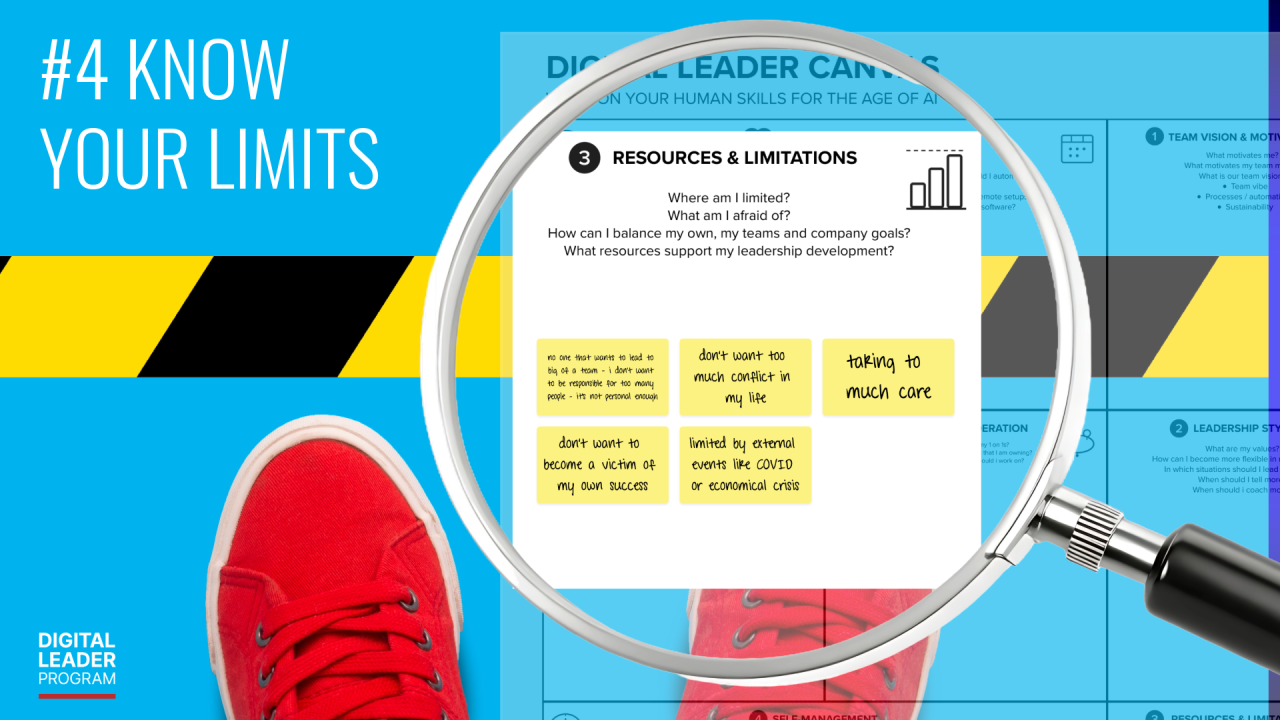
This week we're looking at Quadrant ③ — Resources & Limitations. The canvas asks:
Where am I limited? What am I afraid of? How can I balance my own, my teams and company goals? What resources support my leadership development?
This is the most uncomfortable quadrant on the canvas. And that's exactly why it matters.
A leader who gave up on AI after one wrong answer
A client of mine recently tried out a Microsoft AI product. He asked it to run a calculation. The answer was wrong.
Worse: he discovered that some of his employees had been using the same tool, copying and pasting AI-generated calculations into their work — without checking them. They sent those wrong numbers up the chain.
He drew two conclusions. First, that AI can't do proper calculations — and that this is the state of the art across all AI tools. Second, that his people had stopped thinking for themselves.
So he pulled back. Less AI, less automation, more caution.
I understand the reaction. But I think it's a mistake — because out of one bad experience, he created a limitation for his entire company. The truth is, AI outputs depend massively on the prompt, on the context you give the system, and on the tool you choose. One wrong answer from one product doesn't mean the technology is useless. It means you need to learn how to use it better.
This is what limitations do. They start with one experience and become a belief that shapes every decision after it. And when a leader adopts that belief, it doesn't just limit them — it limits everyone around them.
Where limitations come from
Some limitations are practical. You don't have enough budget. You don't have enough people. Your company only offers one career path — management — and there's no expert track for people who want to grow without leading teams.
But the most powerful limitations aren't practical. They're personal.
They come from how we grew up. From what we were praised for and what we were punished for. From that moment as a child when you took the stage and someone told you that you were taking too much attention. Or from the moment you learned that being visible means being a target.
These kinds of limitations are sneaky. You carry them for years — sometimes forever — without even knowing where they came from. They show up as preferences: "I just don't like being in the spotlight." They feel like personality. But often, they're old patterns that were never examined.
I'm not saying every limitation needs to be overcome. Some you can work around. Some you can accept and build a life that fits them. But as a leader, it's an advantage to at least know which ones you're carrying — because they're shaping your decisions whether you're aware of them or not.
The limitations leaders don't talk about
There are a few limitations I see again and again in my work with leaders, and they rarely come up in leadership books.
Control. If you want to grow as a leader, you need to delegate. You need to hand over. And that means trusting someone else to do the job — maybe only at 80% of your standard. If you can't give up control, you'll stay the bottleneck forever. And the person who could help you will never get the chance to grow.
Which leads to Perfectionism. The enemy of delegation. If everything needs to be perfect tight away, nobody else will ever be good enough. You need to decide: do I want perfection on this task, or do I want to grow? Because most of the time, you can't have both - and some tasks really don't need the 100%.
Power. Closely connected to control. When you hand over, you also lose power. The person who now owns the client relationship, the project, the decision — they gain influence that used to be yours. If your identity as a leader is built on being needed, that handover will feel like a threat.
Fear of success. This one surprises people. But I've seen it many times — leaders who are excellent at what they do, who could scale, who could build something bigger, but who hold back because they're afraid of what success would bring. More visibility. More opinions. More conflict. More risk of burnout. The success itself becomes the threat.
The resource gap
The canvas also asks: What resources support my leadership development?
In theory, everything is available. There's more leadership content than ever — books, courses, frameworks, newsletters like this one. The knowledge is there.
But knowledge isn't the bottleneck. The bottleneck is usually one of three things: time, energy, or someone to walk beside you.
Most leaders I work with know what they should be doing differently. They've read the books. They've been to the workshops. What's missing is someone who takes them by the hand — a coach, a mentor, a peer group — and helps them actually apply what they know. Someone who gives them feedback, holds up a mirror, and pushes them forward when they get stuck.
Self-reflection is essential. But self-reflection alone has a ceiling. At some point, you need an outside perspective.
A real example: how I filled in this field
Let me be honest about my own limitations.
Where am I limited?
I don't want to lead a very large team. Fifty to a hundred people — maybe. But I can't imagine being responsible for thousands of people in a big corporation, not really knowing them. That might be a limitation. It might also be a deliberate choice. I'm still figuring out which one it is.
I also take too much care. When people share their opinions about my work, I don't just hear them — I take time to reflect them. I might sometimes self-reflect too much on what individuals think. On one hand, that makes me a good coach. On the other hand, it makes me vulnerable to noise. And it makes me want to avoid being too much in the centre of attention, because the more visible you are, the more opinions come at you.
What am I afraid of?
Honestly? Too much success. That might sound strange, but I've seen what happens when things grow fast and the balance tips. I love 95% of my work — working with clients, with groups, with individuals. But the downsides — the overwhelm, the constant demands, the risk of burnout — those could become too much if I'm not careful.
I'm also limited by my own experiences. Before COVID hit, I thought I can reach everything I want as long as I just try hard enough. But the virus changed my whole industry (in the bigger picture for the better) and with following economical criseses the business didn't flourish the way I'd planned. That leaves a mark. It creates a kind of caution — a reluctance to go all in on scaling — that might be wisdom, or might be a limitation dressed up as wisdom.
How do I balance my own, my teams and company goals?
This is my biggest challenge. I want a fulfilled life — health, family, social connections. But I also don't want to become a victim of my own success, where the business grows faster than my ability to sustain it.
What resources do I have?
Time. Energy. Knowledge. Methodologies. Years of experience. Access to literature and networks. I'm lucky — I know that not every leader has these on the table. Many of my clients struggle with exactly this: they know what they need to develop, but they don't have the time, the energy, or the budget to do it.
Your turn
This quadrant isn't about fixing everything. It's about seeing clearly.
Grab the canvas and sit with these questions for ten minutes. Don't judge your answers — just write them down. Where are you limited? What are you afraid of? Be specific. Not "I'm afraid of failure" — but what kind of failure, in what situation? What resources do you actually have available — and which ones are you missing? Is there a limitation you've been treating as a personality trait that might actually be an old pattern worth examining?
And here's a harder question: are any of your limitations also limiting the people around you — the way my client's one AI experience limited his entire company?
👉 Download the canvas: https://www.digital-leader-program.de/en/digital-leader-program-digital-leader-canvas
Next week: Quadrant ④ — Self-Management. Where do you get distracted, and where should you leave it at 80%?
See you then.

Recent Posts
Categories
All categories
KNOWLEDGE THAT WORKS IN PRACTICE
This is not a place for buzzwords. Or for theories that don't hold up in real life. Our blog is a space for leaders and professionals who are looking for genuine answers to genuine questions: How do I lead better in a hybrid environment? How do I communicate in a way that actually lands? How do I use AI meaningfully in my daily work? How do I build resilience in my team?
Every article in the Digital Leader Program blog is designed to be directly useful – with insights, methods and examples you can take straight into practice.
TOPICS THAT MATTER TODAY
Leadership in the digital age: How is leadership changing when teams work remotely or hybrid? What do new leaders need – and what do experienced managers need to relearn?
Human Skills under AI influence: Which human capabilities become more important as AI takes over routine tasks – and how do you develop them deliberately?
Hybrid work in practice: Concrete tips, rituals and tools for productive hybrid collaboration – what actually works, and what doesn't.
Culture Design and team dynamics: How do you build an organisational culture that attracts, retains and energises people?
Communication and feedback: The capabilities that separate average performance from real high performance.
FROM PEOPLE WHO WORK IN PRACTICE
Our articles are written by Andre Ottlik and our team – people who work in coaching sessions, workshops and training every single day. What you read here is not copy-pasted from academic studies, but knowledge drawn from lived practice.
And occasionally we feature contributions from external experts sharing insights from their own fields – such as the piece with Pascal Baumgartner on hybrid meeting optimisation.
FREQUENTLY ASKED QUESTIONS (FAQ)
How often are new articles published?
Regularly. Subscribe to our newsletter or follow us on LinkedIn to make sure you don't miss new content.
Are articles available in German too?
Yes. Many of our articles are also available in German – particularly on topics relevant to German-speaking leaders and organisations.
Can I suggest article topics?
Absolutely. Write to us or bring it up in a conversation – we welcome input from our community.
How can I go deeper than the blog?
Our workshops, coaching programmes and the podcast "3 minutes max." go further and support you systematically in your development. Browse our service pages or book an initial consultation.
Author
Andre Ottlik
Author
Andre and his Team are the authors of Digital Leader Programs Blog Posts
