
#8 Meeting Moderation — The Most Underrated Skill in Your Calendar
A team gathers. There's no agenda. Nobody said why. Halfway in, two people are checking email under the table, one has gone silent, and the most senior person is doing most of the talking. An hour disappears. Nothing is decided. Everyone files out and books a follow-up.
You've sat in that meeting. You've probably run it.
Executives spend an average of nearly 23 hours a week in meetings, and meetings still rank as the number one barrier to workplace productivity. Yet the skill that determines whether all those hours are useful or wasted — moderation — is, in my experience, one of the most underrated skill sets in business. Almost nobody is trained in it. And since COVID turned remote and hybrid meetings into the norm, the people who own meetings have fallen even further behind the demands of the format.
This is the eighth part of my weekly walk through the Digital Leader Canvas — Meeting Moderation, field ⑦ on the canvas.
(New here? Download the canvas for free: https://www.digital-leader-program.de/en/digital-leader-program-digital-leader-canvas)
The canvas asks:
How can I improve my 1-on-1s? How can I improve the meetings I own? What moderation skills should I work on?
When is a meeting actually a meeting?
Start with a question that sounds trivial and isn't: when does a meeting begin? Only when there's a calendar invite — or also when two people run into each other in the kitchen and the conversation turns to work?
It matters, because you can't have rules for something you haven't defined. And rules are exactly what most meeting cultures lack. Many organisations — including very successful ones — never set a shared standard for what a meeting is or how one should run. They make appointments, and things happen. No agenda, no stated outcome, sometimes no clear reason at all. That vacuum is where meetings go to die: without a frame, people can't focus, can't tell whether they should be there, and — especially on a remote call — quietly drift off to do something else.
So the real work here isn't moderating better in the moment. It's agreeing, as a team, on a few basic structures: what counts as a meeting worth calling, what every meeting needs before it starts, and who actually belongs in the room. Get those right and half of moderation takes care of itself.
That last one — who belongs in the room — is where I'd start, because it's the rule people break most. My rule of thumb: if an attendee can't contribute to at least 60% of the agenda, ask whether they need to be there at all — or whether a document, a message, or a recorded update would do the job.
There's a human complication worth naming, though. Sometimes people are invited not because the content needs them, but because the organiser doesn't want them to feel left out. The instinct is kind. It's also how you end up with twelve people in a meeting that needed four. A good meeting culture finds a way to invite the right people and protect everyone else's time — usually through documentation trustworthy enough that the uninvited can catch up without sitting through the hour.
A quick aside for HR and people-development leaders: you know your managers should be growing in exactly these areas — but how do you get it moving without setting up yet another programme nobody uses? That's what a short call is for. 20 minutes in which we map out together how to anchor the Digital Leader Canvas and the themes of this series in your organisation — as a workshop, a programme, or a small first step. Practical, no obligation, with a clear next step at the end.
Two reasons to meet — and one of them gets neglected
A meeting is a moment of synchronisation: people aligning at one point in time, whether in a room together or scattered across time zones. For that to be worth it, the meeting has to make sense on two levels.
The first is content. Do we all need to be here to brainstorm this, or to reach this decision quickly? If the content doesn't demand the gathering, the gathering shouldn't happen.
The second is emotional — and it's not that leaders can't see it. Most can. They feel the tension in the room, they notice the conflict, they sense when someone has checked out. The trap is treating that emotional layer as noise to push through rather than the actual work. People meet to feel part of a team, to stay connected, to align not just on tasks but on belonging. A weekly sync can be inefficient on paper and still be the thing that holds a remote team together. Optimise purely for content and you can accidentally starve a team of the connection that keeps it a team.
So the skill isn't seeing the emotion — it's reading it accurately and steering with it. Understanding what people actually feel beneath what they say. Knowing when to let a conflict surface because it needs to, and when to defuse it. Both kinds of meeting — content and emotional — are legitimate. What makes a meeting feel like a waste is pretending an emotional one is about information, or barrelling through the feelings to get to the agenda.
A field guide to running the room
Over years of workshops, I've boiled meeting moderation down to a sequence. Not theory — a checklist you can actually run.
Before the meeting:
- Send the agenda and expected outcomes in advance, and set expectations for participants.
- Clarify the type of meeting — brainstorm, decision, or jour fixe — because each one behaves differently.
- Invite only who's needed. Prepare the room, or the whiteboard.
- Prepare yourself: clear your head, get emotionally relaxed, and switch on what I call sensory acuity — the deliberate attention you pay to whether what people say matches how they say it. When someone says "yes" but their body says "no," that incongruence is information.
During the meeting:
- Open with rapport — a little small talk to set a good vibe, between you and the group and among the participants.
- Frame it explicitly: who's moderating, what outcomes you're after, how much time you have, how things get documented.
- Keep the outcomes visible the whole time — on a flip chart or in the live doc.
- When you reach a decision, ask each person to confirm it out loud. This single move prevents the silent dissent and hidden agendas that quietly derail follow-through.
- When someone drifts, challenge the relevance — "how does this connect to where we're heading?" — in the right tone. The secret is to challenge the information, never the person. Eventually you barely need words; you just point at the outcomes.
After the meeting:
- Write down the next steps and decisions, each with an owner and a date.
- Then be the role model: chase what you said you'd chase, and deliver your own commitments on time.
A meeting culture is built less by rules than by the moderator visibly living them.
What if you're not the one holding the pen?
All of that assumes the meeting is yours. For a lot of readers, it isn't.
You're the junior in a room full of seniors — maybe your own bosses — watching them run the meeting into the ground, and the gap between what you see and what you're allowed to say feels unbridgeable. Or you're on the client project, sitting through a workshop someone else is mangling, where taking the wheel isn't your place. The research is blunt about why people stay quiet here: employees rate most meetings as ineffective, but without real psychological safety, almost no one says so — and the most junior voice says least of all.
You're not powerless. You're just holding the wrong tool. Authority isn't the only thing that moves a room. Here are three moves that work from any seat.
Ask the question you're not allowed to state. You can't say "this meeting is a mess." But anyone can ask, with honest curiosity, "Just so I'm tracking — what are we trying to walk out with?" Harvard Business School researchers call this the helpful workaround: you don't name the problem, you ask the question that dissolves it. Said in the right tone, it never reads as a challenge — it reads as someone trying to keep up. And it does the moderator's job for them without taking their chair.
Volunteer for the pen. Offer to capture the notes — on the shared screen, the flip chart, the online board. It sounds like you're being helpful, and you are. But the person writing "Decision:" and "Next step:" where everyone can see them is quietly steering a rambling conversation toward an outcome, with no title required. Taking the notes is the most accepted way there is to shape a meeting you don't lead.
Have the real conversation outside the room. The feedback that actually changes a senior's or a client's behaviour almost never lands in the meeting. It lands afterward, one-on-one, framed as your curiosity rather than their failure: "Got two minutes? I had a thought about our project syncs." Then keep it simple — what you noticed, why it matters, what might help. "When we open with the full status review, we tend to run out of time for the decisions — what if we flipped the order next time?" You're not grading them. You're handing them a small upgrade to a goal you both share.
One honest caveat: sometimes you'll try all three and nothing moves, and you'll choose to live with the meeting as it is. That's a legitimate choice. But far too many capable people sit in silence through broken hours, certain it isn't their place to speak — when a single well-aimed question would have rescued the room for everyone in it.
How AI can help you moderate — today
Here's where the format has genuinely changed. A few years ago, an "AI meeting assistant" was a transcription bot that dumped a wall of text in your inbox. In 2026, the good ones target exactly the weak points in the sequence above.
Documentation. The obvious win. AI transcribes the meeting, separates decisions from discussion, extracts action items with owners, and pushes them into your project tools. The protocol that never used to get written now writes itself — which means you can genuinely invite fewer people, because the absent can read a reliable record instead of attending defensively.
Timeboxing and focus. Newer tools (AgendaPilot, Read AI) track talk time and can flag — without you having to be the bad guy — when the conversation has wandered from the agenda. The relevance challenge is easier to make when something neutral, not you, points out you're eight minutes into a tangent.
The catch — and it's a big one. None of this is culturally neutral. Whether you can record at all depends on where you are. Under US federal law and in most states, one party can consent to recording a conversation. In the EU the bar is far higher: GDPR requires a lawful basis and genuine transparency, and Germany's §201 makes unauthorised recording of private speech a crime. In Germany, France, and Austria, works councils often demand explicit consent regardless — and regulators note that in an employer-employee setting, "consent" is questionable anyway, because the power imbalance means people can't freely refuse.
Beneath the legal point is a human one. When people know they're being recorded, they don't show themselves fully — they self-censor, weighing every sentence against how it might be used later. In my own coaching and workshops, I don't record unless the team asks for it, and even then I tell them plainly: some people stop speaking openly the moment the recorder is on. The transcript you gain can cost you the honesty you came for. That trade-off looks very different in Berlin than in San Francisco — and a digital leader has to read both the room and the jurisdiction before switching anything on.
How AI will change meetings long-term
Here's my bet on where this goes.
Think about why most meetings exist today. A huge share — the recurring status syncs, the project updates, the "let's make sure everyone's on the same page" sessions — exist to keep humans informed about where things stand. They are, fundamentally, information-transfer meetings.
That's exactly the work AI is best positioned to absorb. As AI agents increasingly track project status, surface blockers, and keep a shared, queryable picture of where everything stands, the informational reason to meet erodes. You won't need a Monday sync to learn what happened last week if you can simply ask. The industry consensus already leans this way: AI won't eliminate meetings, but it will thin out the routine ones.
So what survives? The meetings AI can't hold for you. Personal development. Team building. Staying genuinely in touch. Vision, creativity, strategy. The emotional and generative work — the second of the two reasons to meet — becomes the main reason to meet.
If that's right, it changes what a moderator needs to be good at. Less keeping-everyone-updated, more creating the conditions for connection, honest conversation, and creative thinking — the human skills this whole series is about. The administrator of meetings fades. The host of meaningful gatherings rises.
Your turn
Look at the meetings you own. Pick the next one on your calendar and run three checks before it starts.
Why are we meeting — content, emotion, or both? Name it honestly. Who actually needs to be here — would anyone pass the 60% test, or are some people invited just so they don't feel left out? What's the outcome — and is it written down where everyone can see it?
Then run the sequence: frame it at the start, keep the outcome visible, challenge the information not the person, and capture next steps with owners. One meeting, done with intention. That's your 1%.
And if the broken meeting in your week isn't yours to fix? Pick one of the three moves — ask the question, take the pen, or have the quiet conversation afterward — and try it once. You may be surprised how far a single question travels.
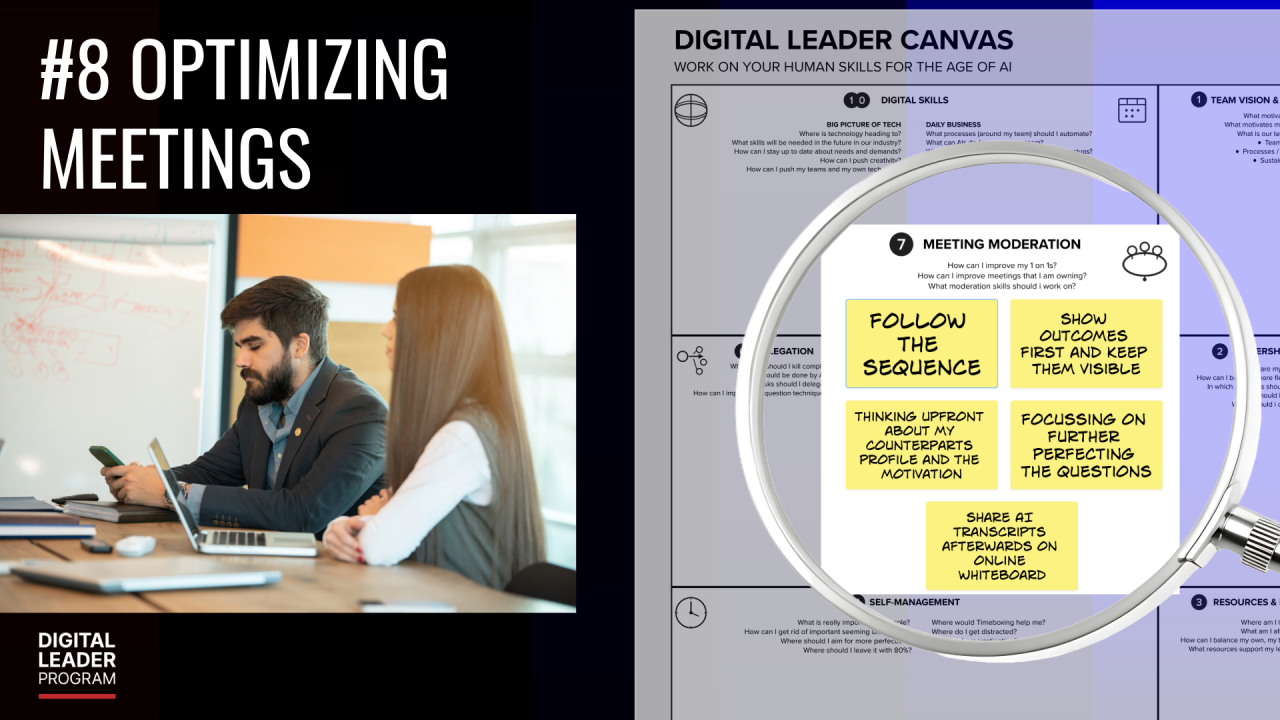
You'll find my own answers for this quadrant in the cover image — the handful of moderation habits I'm working on myself, from following the sequence to perfecting my questions. Yours will look different. The point is to write them down.
And before you go, I'd genuinely like to hear from you: what's the most broken thing about meetings in your world — too many, too vague, too dominated by one voice? And what would you most like me to dig into next? Reply or drop a comment. The frustrations you name are almost always shared by people sitting quietly in the same meetings.
👉 Download the canvas: https://www.digital-leader-program.de/en/digital-leader-program-digital-leader-canvas
Next week: Quadrant ⑧ — Senses & Emotions. How do you read the room, sharpen your listening, and shift your own emotional state?
See you then.
The Digital Leader Canvas is free for individual use. And if you're in HR or L&D and want to bring these themes into your organisation, here's that link again — 20 minutes, no obligation. You can also explore the Leadership Essentials Workshop Series for teams.
Recent Posts
Categories
All categories
KNOWLEDGE THAT WORKS IN PRACTICE
This is not a place for buzzwords. Or for theories that don't hold up in real life. Our blog is a space for leaders and professionals who are looking for genuine answers to genuine questions: How do I lead better in a hybrid environment? How do I communicate in a way that actually lands? How do I use AI meaningfully in my daily work? How do I build resilience in my team?
Every article in the Digital Leader Program blog is designed to be directly useful – with insights, methods and examples you can take straight into practice.
TOPICS THAT MATTER TODAY
Leadership in the digital age: How is leadership changing when teams work remotely or hybrid? What do new leaders need – and what do experienced managers need to relearn?
Human Skills under AI influence: Which human capabilities become more important as AI takes over routine tasks – and how do you develop them deliberately?
Hybrid work in practice: Concrete tips, rituals and tools for productive hybrid collaboration – what actually works, and what doesn't.
Culture Design and team dynamics: How do you build an organisational culture that attracts, retains and energises people?
Communication and feedback: The capabilities that separate average performance from real high performance.
FROM PEOPLE WHO WORK IN PRACTICE
Our articles are written by Andre Ottlik and our team – people who work in coaching sessions, workshops and training every single day. What you read here is not copy-pasted from academic studies, but knowledge drawn from lived practice.
And occasionally we feature contributions from external experts sharing insights from their own fields – such as the piece with Pascal Baumgartner on hybrid meeting optimisation.
FREQUENTLY ASKED QUESTIONS (FAQ)
How often are new articles published?
Regularly. Subscribe to our newsletter or follow us on LinkedIn to make sure you don't miss new content.
Are articles available in German too?
Yes. Many of our articles are also available in German – particularly on topics relevant to German-speaking leaders and organisations.
Can I suggest article topics?
Absolutely. Write to us or bring it up in a conversation – we welcome input from our community.
How can I go deeper than the blog?
Our workshops, coaching programmes and the podcast "3 minutes max." go further and support you systematically in your development. Browse our service pages or book an initial consultation.
Author
Andre Ottlik
Author
Andre and his Team are the authors of Digital Leader Programs Blog Posts
