
#9 Senses & Emotions — The Leadership Edge No Machine Can Copy (Yet)
Walk into the office on a Monday morning and, within seconds, you know things no status report will ever tell you. Who's stressed before they've said a word. Which two colleagues aren't speaking. Whether the team that shipped on Friday is quietly proud or quietly burnt out. The mood of the meeting before the meeting starts. You haven't asked a single question, and you already have a read on the room.
That flood of signal — thousands of impressions absorbed and made sense of in an instant — is one of the last clear advantages humans hold over machines. And I think it'll stay that way for a while.
This is the ninth part of my weekly walk through the Digital Leader Canvas — Senses & Emotions, field ⑧ — and of all eleven, it might be the one most worth investing in to stay valuable in an AI world.
(New here? Download the canvas for free: https://www.digital-leader-program.de/en/digital-leader-program-digital-leader-canvas)
The canvas asks:
How can I heighten my senses? How can I improve my listening skills? How can I improve reading the room? How can I learn to change my emotional state faster?
Why this is the quadrant to bet on
Most advice about work treats the senses as background equipment — something that simply runs while the "real" thinking happens. I'd argue the opposite. Anyone whose work involves other people is, before anything else, a communicator. And your senses are the instruments you use to perceive the world as accurately as possible — to read what's actually happening in a room, not what you assume is happening.
That matters more, not less, as machines get better. A current AI can already out-analyse you on most structured problems. What it can't do is walk into a tense meeting and feel the tension. In principle you could wire a room with enough cameras and microphones, strip away every privacy protection, and let software infer the mood — but we don't live in that world, and most of us don't want to. A room under total surveillance is a room where no one is honest anyway. So the human ability to take in a thousand signals at once and place them in context remains a genuine edge — one of the few quadrants where the gap between you and the machine is widening in your favour, if you train it.
A quick aside for HR and people-development leaders: you can feel when your managers aren't reading their teams well — but how do you build that skill across an organisation without another workshop nobody applies? That's what a short call is for. 20 minutes in which we map out together how to anchor the Digital Leader Canvas and the themes of this series in your organisation — as a workshop, a programme, or a small first step. Practical, no obligation, with a clear next step at the end.
Your senses are a skill, not a setting
Here's the uncomfortable truth: most of us perceive far less than we could. We're in our heads, on our phones, rehearsing what we'll say next instead of noticing what's in front of us. Sensory acuity — the deliberate, trainable attention to what's actually happening — is a muscle, and most of us never train it. In practice it shows up in three places:
Reading the room. In any meeting, the most useful information rarely comes through words. It's the person who goes quiet, the one who wants to speak but won't, the flicker of disagreement someone swallows. High sensory acuity lets you catch the "yes" that's really a "no" — and address it before it becomes a problem after the meeting.
Listening. Not waiting for your turn. Actually hearing the thing beneath the thing — the hesitation, the word someone chose carefully, the question behind the question. It's the rarest skill in most rooms, and the most felt when it's present.
Holding rapport. A group constantly signals energy rising, attention drifting, trust building or fraying. Someone who can sense that in real time can steer with it. Someone who can't just keeps pushing the agenda while the room quietly checks out.
This is the part I'd underline above all the others: reading the room — and reading the individuals in it — is the thing that decides how far you can go as a communicator. You can master structure, preparation, and technique, but without working on your senses and emotions you hit a ceiling. At some point you simply stop getting better at building real rapport, with individuals or with a group, and you plateau there. Everything else in communication is built on this foundation. Neglect it and the rest can only take you so far.
The good news: senses sharpen with use. Slow down. Look before you talk. Spend the first thirty seconds of a meeting observing instead of performing. It feels unnatural at first — then it becomes the most valuable thing you do.
The other half: your emotions
If the senses are how you read the world, your emotions are how you respond to it — and they cut in two directions.
On the rational side, this is where a machine has the advantage. AI has no emotions to manage (unless we build them in), so it can stay coolly rational under pressure. That's a real reason the management parts of any role — the analysis, the tracking, the dispassionate calls — are the parts most likely to be automated. What stays human is the leadership part, in the broadest sense: emotion, presence, the ability to move a room. Those will never be reproduced one-to-one by a machine, because they're not a calculation.
But emotion is only an asset if you can work with it. I'd break that into two steps most people never separate.
Step one: notice what you actually feel. For some people, the inner emotional world has two settings — good and bad. For others it's richly differentiated. The more precisely you can name what's happening in your own body, the better. And there's reasonable evidence this isn't just self-indulgence: people with sharper interoception — the ability to sense internal bodily signals — tend to recognise emotions in others more readily, which suggests reading yourself and reading others may share the same machinery. (The evidence isn't unanimous, so hold it as a strong working idea, not a settled law.) You build this awareness the same way you build bodily awareness generally — meditation, movement, deliberate attention to physical sensation. Some people also have to clear a quieter barrier: they've learned, often from their upbringing or culture, that certain emotions simply aren't allowed. Recognising that block is part of the work.
Step two: decide what to do with the emotion. Feeling it is not the same as being driven by it. Sometimes the move is to let it pass — breathe, sleep on it, give it a night. Sometimes the move is to share it, openly, in a meeting or a difficult conversation, because naming an emotion in the room can dissolve a tension that pretending-it's-not-there would only harden. And sometimes — this is the subtle one — people deliberately step into an emotion, because it fuels them, signals conviction, and moves those around them. None of these is right or wrong in the abstract. The skill is choosing, rather than being chosen for.
This is also where conflict lives. If you're aware of what's happening in your body the moment a conflict ignites — the tightening, the heat, the urge to win — you can dissolve the tension instead of being swept into it. One caveat on the popular "gut feeling" idea: the gut does hold a vast network of neurons, the enteric nervous system, but neuroscientists at Stanford and Johns Hopkins are clear its main job is digestion, not decision-making. Intuition lives in the brain — a prediction machine drawing on everything you've experienced. What the gut does do is shape your mood through the gut-brain axis, which is why stress registers physically there. So the body gives you real signal worth heeding — just not because your stomach is doing the thinking. The people who handle conflict best aren't the ones who feel nothing. They feel it early and clearly, and choose their response.
The same emotion, read differently in every culture
There's a layer to all of this that catches even experienced professionals off guard: emotion isn't expressed or read the same way everywhere. If you work with an international team or across borders, the room you're trying to read is partly written in a code you may not share.
The research here is well established. Psychologists distinguish cultures along lines like individualist versus collectivist, and high- versus low-context communication. Broadly, more individualist cultures — the US, UK, Australia — tend to endorse open emotional expression as a sign of authenticity. More collectivist cultures, many in East Asia for example, more often regulate the outward show of emotion to protect group harmony — a pattern researchers call "display rules." In one classic study, Japanese and American participants reacted almost identically to a disturbing film when alone, but with someone else in the room the Japanese participants masked their negative emotions far more. Same feeling, different rule about showing it.
The practical danger is obvious. If your instinct for reading the room was calibrated in one culture, it can mislead you in another. A quiet, composed response you'd read as disengagement might be appropriate restraint. An emotion that looks "missing" might be one the other person was taught not to display. Even which emotions count as desirable shifts — pride reads as achievement in one setting, a breach of humility in another.
The lesson isn't to memorise a table of national stereotypes — individuals vary enormously within any culture. The lesson is humility about your own read. Across cultures, treat your first interpretation as a hypothesis, not a fact. Ask more, assume less. The sensory acuity that makes you a strong reader at home is exactly what has to stay switched on — and stay modest — when the cultural code changes.
A small map worth keeping in mind
There's a useful model from neuro-linguistic programming — and a quick caveat: NLP as a whole is contested, and I'd treat its grander promises with healthy skepticism. But this one diagram is a genuinely helpful way to think about perception, so take it as a map, not a law.

It goes like this. An external event hits your senses — sights, sounds, feelings, tastes, smells. But you don't experience it raw. Before it reaches your awareness, your mind deletes most of it (you can't process everything), distorts some of it, and generalises the rest — filtered through your memories, language, values, and beliefs. What's left becomes your internal representation of the event. That representation drives your emotional state, your state shapes your physiology, and the two together drive your behaviour.
Why does this matter at work? Two reasons. First, it explains why two people sit in the same meeting and walk out with completely different accounts of what happened — you're not seeing reality, you're seeing your filtered map of it. Humility about that gap is the start of reading a room accurately. Second, it shows you have leverage: change what you focus on and you change your state; change your state and you change how you show up. That's not positive-thinking fluff — it's the mechanism behind shifting your own emotional state on purpose, exactly what the canvas asks.
How AI can help — today
You can't outsource your senses to a machine. But you can use AI to train them and to handle the parts that don't need a human nervous system.
Debrief your perception. After a charged meeting, talk it through with an AI: what did I notice, what did I miss, what might that silence have meant? As a reflection partner it sharpens the habit of reviewing what your senses picked up — and surfaces what you filtered out in the moment.
Rehearse the hard conversation. Before a conflict talk, have AI play the other person — pushing back, going quiet, getting defensive. You feel your own reaction rise in a low-stakes setting and practise regulating it before it counts.
Name the emotion faster. An AI can act as a neutral mirror — you describe what's going on in your body, it helps you put a more precise word to it. Over time you need the crutch less, because you've built the vocabulary yourself.
What AI can't do is be in the room for you. The signal lives in the physical space, in the micro-expressions and the silences — and that channel is still yours alone.
How this changes long-term
Here's my bet. As AI absorbs more of the analytical, rational, management-shaped work, the human premium shifts almost entirely onto the sensing-and-feeling layer. The professional of the near future is valued less for what they can calculate — the machine wins that — and more for what they can perceive and evoke: reading a room, sensing what's unsaid, regulating their own state and moving other people's.
That's a strange inversion for a culture that spent decades prizing the rational and treating emotion as a workplace inconvenience. But if the rational is exactly what gets automated first, the "soft" skills become the hard currency. The senses you were never taught to train, and the emotions you were taught to suppress, become the core of what makes you irreplaceable — which is why this quadrant is quietly one of the most important on the whole canvas.
Go deeper: the podcast
I've covered each piece of this — reading a room, listening well, spotting and shifting your own emotions, and what the gut-brain connection really does — in short episodes of my podcast "3 minutes max. — Human Skills in the Age of AI." Each is capped at three minutes: one idea, straight into your work.
🎧 Listen here: https://www.digital-leader-program.de/podcasts/3-minutes-max-human-skills-in-the-age-of-ai-english-version-2
Your turn
Pick one of the canvas questions and turn it into a single experiment this week.
If it's reading the room: in your next meeting, spend the first thirty seconds just observing — who's energised, who's withdrawn, who wants to speak. Say nothing. Just notice.
If it's changing your state: take one minute to breathe before you walk into your next important conversation. Notice whether you show up differently.
If it's noticing your emotions: once a day, stop and ask what you're actually feeling — and try to name it more precisely than "fine."
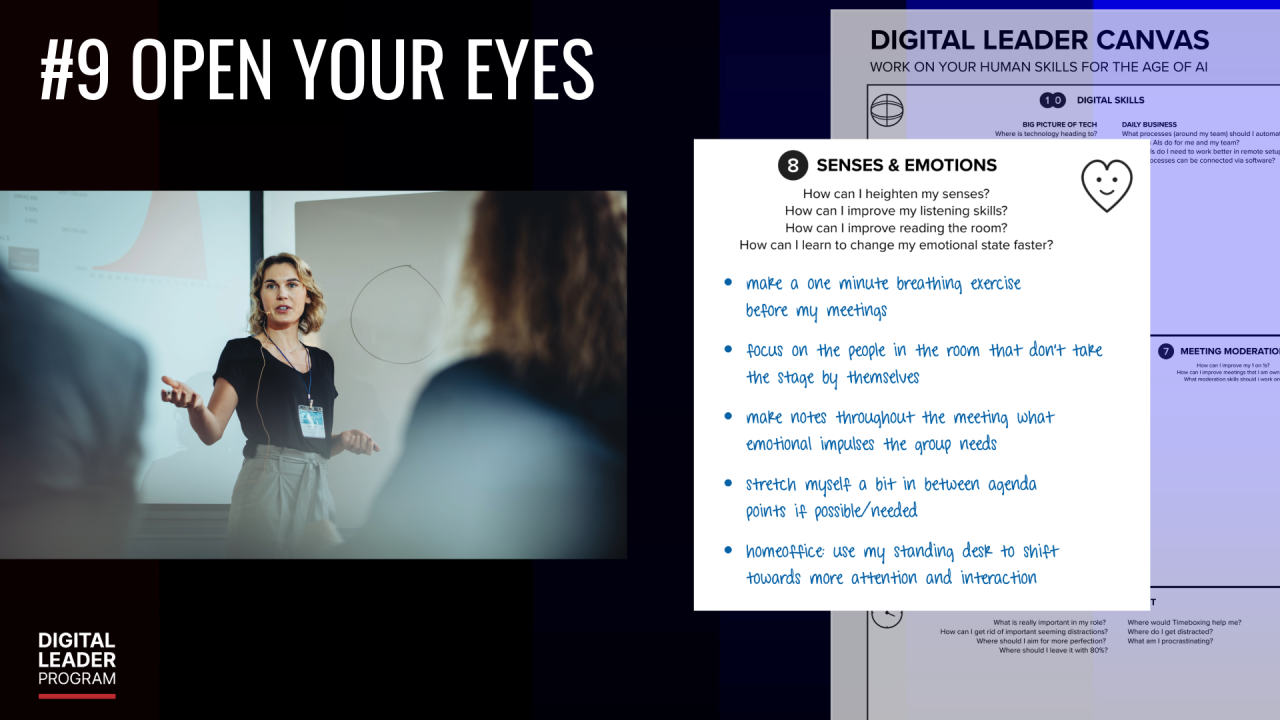
You'll find my own answers in the cover image — small, concrete things like a one-minute breathing exercise before meetings, deliberately watching the people who don't take the stage, and noting what emotional impulse the group needs. Yours will look different. Pick one. That's your 1%.
And before you go, I'd genuinely like to hear from you: which is harder for you — reading other people, or managing your own emotional state under pressure? And what would you most like me to dig into next? Reply or drop a comment. The honest answers are almost always the ones others are quietly wrestling with too.
Next week: Quadrant ⑨ — Profiling. What personality system actually helps your team, and how do you account for cultural difference?
See you then.
The Digital Leader Canvas is free for individual use. And if you're in HR or L&D and want to bring these themes into your organisation, here's that link again — book a 20-minute call. You can also explore the Leadership Essentials Workshop Series for teams.
Recent Posts
Categories
All categories
KNOWLEDGE THAT WORKS IN PRACTICE
This is not a place for buzzwords. Or for theories that don't hold up in real life. Our blog is a space for leaders and professionals who are looking for genuine answers to genuine questions: How do I lead better in a hybrid environment? How do I communicate in a way that actually lands? How do I use AI meaningfully in my daily work? How do I build resilience in my team?
Every article in the Digital Leader Program blog is designed to be directly useful – with insights, methods and examples you can take straight into practice.
TOPICS THAT MATTER TODAY
Leadership in the digital age: How is leadership changing when teams work remotely or hybrid? What do new leaders need – and what do experienced managers need to relearn?
Human Skills under AI influence: Which human capabilities become more important as AI takes over routine tasks – and how do you develop them deliberately?
Hybrid work in practice: Concrete tips, rituals and tools for productive hybrid collaboration – what actually works, and what doesn't.
Culture Design and team dynamics: How do you build an organisational culture that attracts, retains and energises people?
Communication and feedback: The capabilities that separate average performance from real high performance.
FROM PEOPLE WHO WORK IN PRACTICE
Our articles are written by Andre Ottlik and our team – people who work in coaching sessions, workshops and training every single day. What you read here is not copy-pasted from academic studies, but knowledge drawn from lived practice.
And occasionally we feature contributions from external experts sharing insights from their own fields – such as the piece with Pascal Baumgartner on hybrid meeting optimisation.
FREQUENTLY ASKED QUESTIONS (FAQ)
How often are new articles published?
Regularly. Subscribe to our newsletter or follow us on LinkedIn to make sure you don't miss new content.
Are articles available in German too?
Yes. Many of our articles are also available in German – particularly on topics relevant to German-speaking leaders and organisations.
Can I suggest article topics?
Absolutely. Write to us or bring it up in a conversation – we welcome input from our community.
How can I go deeper than the blog?
Our workshops, coaching programmes and the podcast "3 minutes max." go further and support you systematically in your development. Browse our service pages or book an initial consultation.
Author
Andre Ottlik
Author
Andre and his Team are the authors of Digital Leader Programs Blog Posts
