
#6 Energy, Focus & Meditation - just the right balance
Ping. Another notification. Another dopamine hit. Another moment of focus — gone.
You probably didn't even notice it. That's the point. The attention economy is a multi-trillion-dollar global industry built on grabbing your focus before you can decide where to put it. Every notification taps into your brain's dopamine system — the mechanism behind anticipation and reward — creating a loop that keeps you reaching for your phone. And research shows it can take up to 20 minutes to fully refocus after a single interruption.
We've never lived in a time where so much information competed for so little attention. Our phones are always with us. Our laptops are always open. And in the evening, there's binge-watching to fill whatever silence is left.
The good news: AI is starting to fight back — on your side. Gmail's AI prioritisation already filters to high-priority only. Outlook's Copilot triages your inbox and summarises threads. Tools like Shortwave bundle low-priority emails into collapsible groups. Focus modes on every major OS let you silence everything except what's urgent. These features exist today — most people just haven't turned them on. If you take one thing from this opening: switch your email notifications to "priority only." Thirty seconds. It will change your day.
But filtering notifications is just the surface. The deeper question is: what's happening inside your body while all of this competes for your attention?
This is Quadrant ⑤ of the Digital Leader Canvas — Energy, Focus & Meditation.
(New here? This is part six of my weekly series on the canvas. Download it for free: https://www.digital-leader-program.de/en/digital-leader-program-digital-leader-canvas)
Why this matters more than any framework
You can have the best self-management system in the world. The most refined leadership style. A crystal-clear vision for your team. But if your energy is low, your sleep is broken, and your stress is through the roof — none of it works.
Over 43% of employees globally report feeling burned out. Some surveys put the number above 80%. Global employee engagement has dropped to just 21% (Gallup, 2024).
Burnout isn't just a workload problem. It's a body problem. And leaders who ignore their physical foundation are building on sand.
The chemistry behind your leadership
I'm not a doctor. But much of what we call "motivation," "resilience," or "emotional stability" comes down to something surprisingly physical: hormones.
Dopamine drives motivation and focus. When it's low, even simple tasks feel overwhelming — that's when procrastination kicks in. It's not laziness. It's chemistry.
Serotonin stabilises your mood and supports emotional resilience. It influences sleep, appetite, and how satisfied you feel with your life.
Oxytocin builds trust and connection. It's released through positive interactions, physical touch, and intimacy — and it appears to help reduce cortisol levels.
Cortisol is the stress hormone. You need some of it. But when it stays elevated, it can disrupt your dopamine and serotonin systems. Research suggests that leaders under chronic stress tend to become less curious, less objective, and more likely to surround themselves with people who agree with them rather than challenge them.
The takeaway: the basics — sleep, food, movement, recovery, connection — directly affect how you show up as a leader. When those are off, no amount of willpower will compensate.
One small change that shifts your whole morning
Delay your first coffee.
Cortisol peaks naturally 30 to 60 minutes after waking — your body's built-in alertness system. When you drink coffee immediately, you're adding caffeine on top of a spike that was already doing the job. Your body may build tolerance faster, and you're more likely to crash by mid-morning.
Some neuroscientists — including Andrew Huberman — suggest waiting 60 to 90 minutes. The science isn't fully settled, but the logic makes sense: hydrate, move, get some sunlight first. Let cortisol do its thing. Then coffee steps in as a genuine boost rather than a redundant one.
The elephant in the room: substances at work
Leadership newsletters rarely talk about this. But if we're serious about the chemistry behind our performance, we have to be honest about the shortcuts people take — and what they cost.
Alcohol is the dominant substance across every country and industry — socially accepted, often encouraged, and widely used as evening stress release. The EU Drugs Agency estimates that between 5% and 20% of the European working population has problems associated with alcohol or drug use. Even moderate, habitual drinking disrupts REM sleep, elevates cortisol, and depletes serotonin. That "relaxing" glass of wine is chemically working against everything you need for good leadership the next day.
Prescription stimulants like Adderall and Ritalin have become widespread performance drugs, particularly in the US, where adult prescriptions rose 53% in just four years. In Europe, access is more restricted — but the mindset is spreading. And the research is sobering: a study published in Science Advances found that these medications can actually decrease productivity in people without ADHD. Users feel more focused — but objective measurements show they're not.
Cocaine is more prevalent in professional environments than most people assume. It's the second most commonly used illicit drug in Europe, and its availability has been rising for years. The European Drug Report 2025 found that first-time treatment entries for cocaine rose 31% between 2018 and 2023. Its effects on dopamine are devastating: artificial flooding followed by lower natural production over time, meaning less baseline motivation and a growing need for external stimulation just to feel engaged.
Then there are the quieter substances: sleeping pills for people who can't switch off. Benzodiazepines for anxiety. Weekend recreational drugs that people tell themselves don't affect their Monday.
I'm not here to moralise. But if you're filling in this quadrant honestly, you have to include what you put into your body — all of it. Every substance is a direct intervention in the hormone system that runs your leadership.
The topic nobody talks about: intimacy and touch
Physical intimacy and human touch have a direct impact on your stress levels, your emotional stability, and your capacity to lead.
Sexual intimacy triggers dopamine, endorphins, and oxytocin simultaneously — a combination that reduces cortisol, elevates mood, and deepens emotional bonding. Research shows that the "afterglow" of satisfying intimacy can last up to two days. Regular physically and emotionally satisfying sex is associated with lower rates of depression and anxiety.
But it's not about frequency. It's about quality and connection. Emotional and physical intimacy — which doesn't have to be sexual — has been shown to lower cortisol in both men and women. Hugs, meaningful touch, and feeling genuinely connected to a partner all trigger oxytocin release.
Leaders are whole people. You can't optimise your sleep, your diet, and your exercise while ignoring the quality of your closest relationships. If we're serious about energy and resilience, we have to be honest about all the factors that contribute to it — not just the ones that are safe to discuss in a meeting room.
Sleep — and the melatonin problem
Sleep is the single most underrated performance tool available to any leader. No supplement, no productivity hack, no amount of coffee comes close to what consistent, quality sleep does for your cognitive function and emotional stability.
A note on melatonin:
More and more adults are reaching for melatonin supplements to fall asleep. In the US — where melatonin is completely unregulated as a dietary supplement — usage has more than quintupled between 1999 and 2018. The trend is spreading globally.
European regulators are more cautious, and for good reason. In Germany, higher-dose melatonin requires a prescription. The German Federal Institute for Risk Assessment (BfR) has explicitly warned that melatonin supplements are "not a gentle sleeping aid." In countries like Denmark and Sweden, melatonin is prescription-only entirely. Yet low-dose supplements are increasingly available across Europe — and many people take them nightly without medical guidance.
Melatonin is a hormone your brain produces naturally in response to darkness. Taking it can help with jet lag or occasional sleep disruption. But the evidence for melatonin as a daily sleep aid is weak. And a preliminary study presented at the American Heart Association's Scientific Sessions in 2025, reviewing over 130,000 adults with insomnia, found that long-term use — a year or more — was associated with a higher risk of heart failure and death from any cause. The study hasn't been peer-reviewed yet, but as one of the researchers noted: melatonin supplements may not be as harmless as commonly assumed. Independent testing has also found that some products contain nearly five times the amount stated on the label.
If you're relying on melatonin every night, that's not a solution — it's a signal. A signal that something else needs to change: your screen habits, your evening routine, your stress levels, your caffeine timing. The canvas isn't asking "what supplement can I take?" It's asking "how can I optimise my sleep and break patterns?" Those are fundamentally different questions.
Meditation isn't for everyone — and that's fine
I've practised meditation and autogenic training for twenty years. But I know it's not for everyone.
What matters is having something that helps you break your state between meetings, between tasks, between the stress of one conversation and the next. Table tennis in the office. A walk to the coffee machine. Five minutes of music. Anything that interrupts the loop of sitting, stressing, and staring — and gives your nervous system a moment to reset.
What I wrote on my canvas
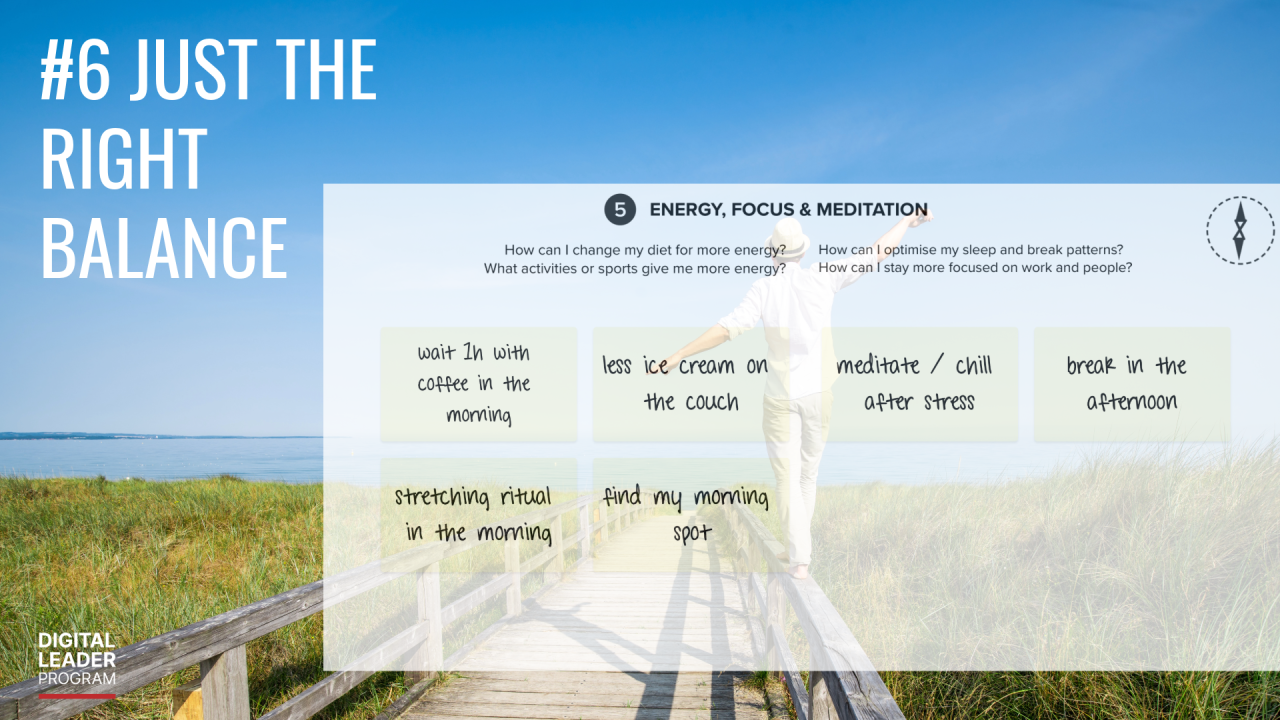
You can see my sticky notes in the cover image of this newsletter. Six small things: wait an hour before my first coffee. Less ice cream on the couch in the evening. A stretching ritual in the morning — and finding the right spot for it. A proper break in the afternoon. And meditating or chilling after stressful moments instead of reaching for a drink.
None of these are big. That's the point. They're my 1% changes — tiny shifts in the foundation that I know will compound over time. I'm not overhauling my life. I'm adjusting six small habits that touch my energy every single day.
Go deeper: podcast episodes on energy and focus
Short episodes from my podcast "3 minutes max. — Human Skills in the Age of AI." One idea, straight into your work.
Eisenhower's AI Focus (#37) — Cut through the noise and protect your focus.
Timeboxing with AI (#39) — Structure for focus blocks and intentional breaks.
Tabs Mastery with AI (#45) — The cognitive cost of too many browser tabs.
AI 1 Percent Method Goals (#48) — Small, consistent changes that compound.
🎧 Listen here: https://www.digital-leader-program.de/podcasts/3-minutes-max-human-skills-in-the-age-of-ai-english-version-2
Your turn
This quadrant isn't about becoming a wellness influencer. It's about looking honestly at the physical foundation your leadership is built on.
What's one habit that's quietly draining your energy? Maybe it's delaying your coffee. Maybe it's putting your phone in another room before bed. Maybe it's turning on "priority only" notifications. Or maybe it's being honest about a habit that's costing you more than you admit.
Don't overhaul your life. Just change one thing. And then notice what shifts.
👉 Download the canvas: https://www.digital-leader-program.de/en/digital-leader-program-digital-leader-canvas
Next week: Quadrant ⑥ — Delegation. What tasks should you kill completely, and what should AI handle?
See you then.
The Digital Leader Canvas is free for individual use. If you'd like to work through it with your team — facilitated, with a coach — have a look at our 90 Day Leadership Journey or book a free consultation.
Recent Posts
Categories
All categories
KNOWLEDGE THAT WORKS IN PRACTICE
This is not a place for buzzwords. Or for theories that don't hold up in real life. Our blog is a space for leaders and professionals who are looking for genuine answers to genuine questions: How do I lead better in a hybrid environment? How do I communicate in a way that actually lands? How do I use AI meaningfully in my daily work? How do I build resilience in my team?
Every article in the Digital Leader Program blog is designed to be directly useful – with insights, methods and examples you can take straight into practice.
TOPICS THAT MATTER TODAY
Leadership in the digital age: How is leadership changing when teams work remotely or hybrid? What do new leaders need – and what do experienced managers need to relearn?
Human Skills under AI influence: Which human capabilities become more important as AI takes over routine tasks – and how do you develop them deliberately?
Hybrid work in practice: Concrete tips, rituals and tools for productive hybrid collaboration – what actually works, and what doesn't.
Culture Design and team dynamics: How do you build an organisational culture that attracts, retains and energises people?
Communication and feedback: The capabilities that separate average performance from real high performance.
FROM PEOPLE WHO WORK IN PRACTICE
Our articles are written by Andre Ottlik and our team – people who work in coaching sessions, workshops and training every single day. What you read here is not copy-pasted from academic studies, but knowledge drawn from lived practice.
And occasionally we feature contributions from external experts sharing insights from their own fields – such as the piece with Pascal Baumgartner on hybrid meeting optimisation.
FREQUENTLY ASKED QUESTIONS (FAQ)
How often are new articles published?
Regularly. Subscribe to our newsletter or follow us on LinkedIn to make sure you don't miss new content.
Are articles available in German too?
Yes. Many of our articles are also available in German – particularly on topics relevant to German-speaking leaders and organisations.
Can I suggest article topics?
Absolutely. Write to us or bring it up in a conversation – we welcome input from our community.
How can I go deeper than the blog?
Our workshops, coaching programmes and the podcast "3 minutes max." go further and support you systematically in your development. Browse our service pages or book an initial consultation.
Author
Andre Ottlik
Author
Andre and his Team are the authors of Digital Leader Programs Blog Posts
