
#7 Delegation — What to Keep, What to Hand Over, What to Automate
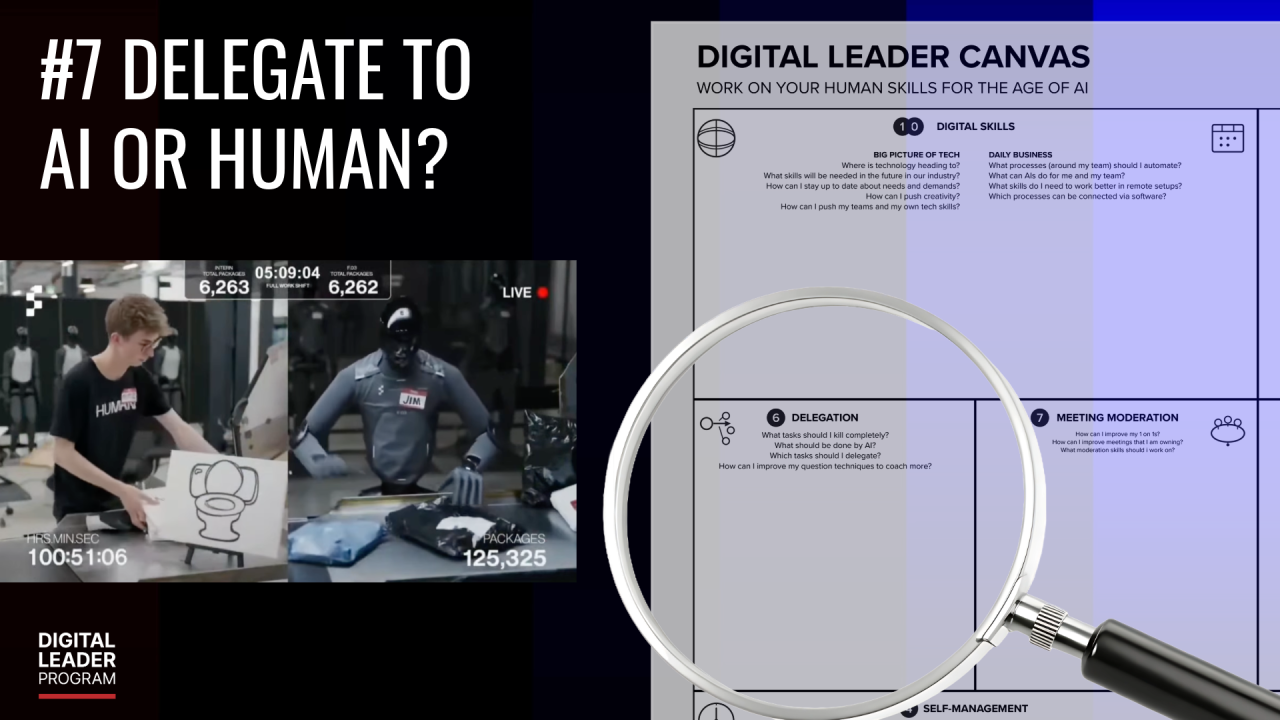
In May 2026, Figure AI staged a "Man vs. Machine" challenge: a human intern named Aime against their F.03 humanoid robot, sorting packages side by side for ten hours straight. Same task, same routine — detect a barcode, pick up a package, place it on a conveyor belt.
The human won. But barely. Aime sorted 12,924 packages; the robot managed 12,732 — a gap of about four-hundredths of a second per package. The robot had actually pulled ahead around hour five, while Aime took a bathroom break. By the end, Aime had blisters on his fingers and said his forearm felt broken. The robot can run across shifts. No breaks. No blisters.
What struck me wasn't who won. It was how little the victory meant. A tired human beat a first-generation machine by a rounding error, and the machine doesn't get tired. Physical work may still hold a slim edge. Desk work holds less. Mustafa Suleyman, the CEO of Microsoft AI, recently made one of the industry's most aggressive predictions: that most desk-based professional work — lawyers, accountants, project managers, marketers — will be substantially automated within 12 to 18 months. Plenty of researchers think that timeline is far too fast. But even the skeptics agree on the direction.
So delegation, the most basic leadership skill there is, has quietly changed shape. It used to be one question: "who on my team should do this?" Now there's a second: "should a human do this at all?"
This is Quadrant ⑥ of the Digital Leader Canvas — Delegation — and the seventh part of my weekly walk through the canvas. It connects tightly to everything we've covered: your team vision, your values, your self-management, and especially your leadership style. If you missed the Leadership Style edition (#3), go back to it — delegation and the telling-vs-coaching spectrum are two sides of the same coin.
(New here? Download the canvas for free: https://www.digital-leader-program.de/en/digital-leader-program-digital-leader-canvas)
The canvas asks:
What tasks should I kill completely? What should be done by AI? Which tasks should I delegate? How can I improve my question techniques to coach more?
The human core: delegation is really about growing people
Before we get to machines, be clear about what delegation is actually for. It's tempting to treat it as offloading — getting things off your plate. The deeper purpose is something else.
In Reinventing Organizations, Frederic Laloux maps how organisations have evolved through stages, each marked by a colour. The most advanced he describes is Teal — organisations that work less like machines and more like living organisms. Their defining principle is self-management: decisions aren't pushed up a hierarchy. They're made by the people closest to the work, guided by trust, transparency, and shared purpose.

Here's why that matters for delegation. The goal isn't to hand off tasks. It's to build a team that barely needs to be delegated to — people who, handed a project, already know what to ask, what to decide themselves, and what to bring back.
That takes one of two things. Either you delegate to senior people who already work this way, or you train your people towards it: coaching them to think independently, helping them develop the judgment to know when to ask and when to act.
And that's the link Laloux makes explicit: Teal requires a high level of self-leadership. You can't run a self-managing organisation full of people waiting to be told what to do. Delegation, done well, is how you grow that capacity — one handover at a time. Which is exactly why the canvas asks how to improve your questioning. The shift from telling to asking is what builds independent thinkers. The better your questions, the less you'll need to delegate at all, because your people will already be a step ahead.
Hold onto that idea — delegation as a way to grow people — because it's about to collide with a second kind of delegation that grows no one at all: handing the work to a machine.
How AI can help you delegate — today
Now the machine side. AI can support delegation right now, not in some distant future — and the most useful place it helps is the one leaders skip.
The obvious uses are real: it turns a vague idea into a clean brief — goal, expectations, resources, deadline, success criteria — before a misunderstanding can form. It's a sparring partner when you're deciding who fits a task. It drafts the handover email, rehearses a sensitive conversation, designs check-in rhythms so you stay informed without micromanaging.
But the one that earns its keep is this: AI will interrogate your reasons for not delegating. Ask it to. "Here's a task I keep doing myself — challenge me on why." It comes back with the uncomfortable questions a good coach would: What are you afraid happens if you let go? Is this really faster, or just more comfortable? In my own use, that's where the value is — not in the email it writes, but in the blind spot it names. Perfectionism. Control. Lack of trust. The things you'd never admit to a colleague, you'll admit to a machine.
One principle runs underneath all of it, and it's identical whether you're delegating to a person or a model: context first. The more you give upfront about your mission, your standards, and your values, the less you specify per task. How good does this need to be — 80% or 100%? How much research? What's the deadline? Good delegation is mostly good context.
What you can already hand over to AI
I don't think every task belongs with an AI. But most leaders are leaving capability untouched — either their organisation restricts the software for data-security reasons, or they simply don't know what these tools can now do. The familiar uses are real enough: writing, analysis, research, planning, creative drafts, code. Useful, all of it. But individual tasks are the beginning, not the leverage.
The first real leap is connecting tasks into automated workflows. Tools like Make.com and n8n chain steps across different apps so an entire sequence runs itself. Picture a new lead: they fill out a form, the data lands in your CRM, an AI drafts a personalised first reply, a task appears for the right team member, a follow-up gets scheduled — and no one touched a thing. That's not delegating a task. That's delegating a whole workflow. One setup, running every day in the background.

The second leap is newer, and bigger: autonomous agents. A workflow follows a path you designed — step one, then two, then three. An agent is given a goal and figures out the steps itself. "Research these ten prospects, draft a tailored note for each, and flag the three most promising" — and it decides how to get there, calling on tools and adjusting as it goes. The same Make.com and n8n now let you build agents directly into your automations, so a sequence can hand off to a reasoning agent at the point where judgment is needed, then carry on. Workflows handle the predictable. Agents handle the parts that used to require a person to think.
One thing neither of them does, though, is run untouched forever. A workflow breaks when an app changes its interface; an agent drifts when its inputs shift, or quietly starts producing worse output as the world moves on. Automation isn't "set it and forget it" — it's "set it and watch it." Someone has to own each one, catching the silent failures and tuning it as things change. You're not removing the human. You're moving the human from doing the task to supervising the system that does the task — a real job, just a higher-leverage one.
This is where delegation to a machine starts to look genuinely like delegation to a person — and where most leaders are furthest behind. Not because the tools are hard, but because no one ever showed them it was possible. It isn't available everywhere; plenty of organisations lock this software down. But scale-ups and growth companies are often free to use these platforms, and the ones who do buy back enormous amounts of human time for the work that actually needs a human.
My background is in business computing; I trained and worked at IBM, always a translator between two worlds — IT and business. From that seat, here's the truth: a modern leader doesn't need to become a programmer. They need a feel for what's technically possible — what to give a machine instead of a person, when to automate a whole workflow instead of a single step, and how the people they delegate to could use AI to work faster and better.
And if this world feels foreign — if "workflow automation" sounds like an IT problem rather than yours — treat that as the signal, not a reason to look away. The leaders who never build this understanding won't simply miss an opportunity. They'll be quietly overtaken: by competitors who move faster, by team members who automate circles around them, by a market that starts to assume this fluency as the floor.
You don't fix that by reading one more article. You fix it by building one. Block the time — this is the important-but-not-urgent work from the Self-Management edition. Then pick a single first project: one repetitive weekly workflow you map out and try to automate, or one process you redesign with AI in the loop. Start small, start clumsy, but start. The understanding doesn't come from theory. It comes from building one thing and watching what it does.
The one thing you can't hand to a machine: the blame
Here's a distinction that's easy to miss in the rush to automate.
When you delegate to a person, you hand over two things: the task, and a share of the responsibility. If your colleague owns a project and it goes wrong, the weight is genuinely shared. That's part of why delegation feels like relief — you're not just freeing your hands, you're lightening your shoulders.
A machine can't carry any of that. When you "delegate" to AI, you hand over the task and nothing else. The responsibility stays entirely with you.
This isn't a philosophical nicety — courts are enforcing it. When Air Canada's chatbot gave a customer wrong information, the company argued the bot was a "separate legal entity." The tribunal rejected that outright: the organisation was liable, full stop. "The AI did it" is not a defence; neither is "a human was technically in the loop" unless that human actually exercised judgment. The logic is simple — a machine has no intention, and you can't hold something accountable for a decision it didn't mean.
So the faster and more capable these tools become, the more important your judgment gets, not less. You remain the last line. Treat AI like a brilliant, tireless intern who will never be the one held responsible — not a reason to use it less, a reason to stay awake while you do.
One caveat that matters: this is a snapshot of today, not a law of nature. AI holds no legal personhood anywhere yet — but that's being worked on fast, from AI-specific legal entities with mandatory insurance to agent-governance frameworks now being drafted in the EU, the US, and Singapore. Some scholars expect that within five to ten years, highly autonomous systems may carry a limited legal capacity of their own. The responsibility gap is real, and it's yours for now. Just don't assume it stays that way — the leaders who track where this is heading will adapt fastest when the rules change.
What's left for the humans
Back to Aime. He won on a rounding error, against a machine that will be faster next year and the year after. So what does a person — what does your career — hold onto when the routine work is gone?
The same things that let Aime matter beyond his sorting speed. My bet is that human work concentrates where machines stay weakest — or where we simply prefer a human anyway. Connection — we want trust and presence from another person, not because a machine can't simulate warmth, but because we care who it comes from. Creativity and taste — not generating a thousand options, machines do that easily, but knowing which one is right. The handmade premium — just as handcrafted goods command a premium in an industrial economy, human-made work may gain value precisely because it's becoming rare. And orchestration — breaking a complex project into the right pieces, handing the machine-suited parts to machines and keeping the rest for people. Data sits trapped between software systems and between rival organisations that guard it, so a machine only ever sees a slice; someone has to stand above the whole board and decide what goes where.
That orchestration is the skill that defines the next decade of leadership. Aime's hands will be automated. The person deciding what Aime should be doing instead will not.
So prepare on two fronts. For yourself: invest in the human skills — empathy, creativity, judgment, the ability to connect what machines can't. (That's what this entire series is about.) For your team: build the self-leadership Laloux describes, so they can run independently in a world where the routine is handled by software.
And from my own canvas, since I ask you to fill in yours: on the machine side, I've already handed my KPI tracking to an AI agent, and I'm mapping which recurring workflows in my business could run on their own instead of landing on someone's desk.
On the human side, my honest note-to-self was about questioning — that I give too much answer and not enough question. So I'm recording myself while delegating to hear it, writing questions down before meetings instead of improvising, and forcing myself to take more time for them. Asking is slower than telling in the moment. It's the only thing that compounds.
Your turn
Take your current task list and run every item through three filters.
Kill it — does this need to exist at all, or could you simply stop? Automate it — could AI or a workflow tool handle this, fully or partly? If you're unsure, that uncertainty is the assignment. Delegate it — if a human should do it, who, and are you holding on only out of control, perfectionism, or fear?
Then the coaching question: for what you delegate, are you handing over answers, or asking the questions that make people grow?
Pick one task this week and hand it over properly — with context, the right standard, and a check-in rhythm that stops short of micromanaging. That's your 1%.
Before you go, I'd genuinely like to hear from you: what's your hardest part of delegation — letting go, trusting, or knowing what to automate? And what would you most like me to dig into in the coming editions? Reply or drop a comment. I read all of it, and the struggles you name are usually the ones hundreds of other readers are sitting with quietly too.
👉 Download the canvas: https://www.digital-leader-program.de/en/digital-leader-program-digital-leader-canvas
Next week: Quadrant ⑦ — Meeting Moderation. How do you improve your 1-on-1s and the meetings you own?
See you then.
The Digital Leader Canvas is free for individual use. If you'd like to work through it with your team — facilitated, with a coach — have a look at our 90 Day Leadership Journey or book a free consultation.

Recent Posts
Categories
All categories
KNOWLEDGE THAT WORKS IN PRACTICE
This is not a place for buzzwords. Or for theories that don't hold up in real life. Our blog is a space for leaders and professionals who are looking for genuine answers to genuine questions: How do I lead better in a hybrid environment? How do I communicate in a way that actually lands? How do I use AI meaningfully in my daily work? How do I build resilience in my team?
Every article in the Digital Leader Program blog is designed to be directly useful – with insights, methods and examples you can take straight into practice.
TOPICS THAT MATTER TODAY
Leadership in the digital age: How is leadership changing when teams work remotely or hybrid? What do new leaders need – and what do experienced managers need to relearn?
Human Skills under AI influence: Which human capabilities become more important as AI takes over routine tasks – and how do you develop them deliberately?
Hybrid work in practice: Concrete tips, rituals and tools for productive hybrid collaboration – what actually works, and what doesn't.
Culture Design and team dynamics: How do you build an organisational culture that attracts, retains and energises people?
Communication and feedback: The capabilities that separate average performance from real high performance.
FROM PEOPLE WHO WORK IN PRACTICE
Our articles are written by Andre Ottlik and our team – people who work in coaching sessions, workshops and training every single day. What you read here is not copy-pasted from academic studies, but knowledge drawn from lived practice.
And occasionally we feature contributions from external experts sharing insights from their own fields – such as the piece with Pascal Baumgartner on hybrid meeting optimisation.
FREQUENTLY ASKED QUESTIONS (FAQ)
How often are new articles published?
Regularly. Subscribe to our newsletter or follow us on LinkedIn to make sure you don't miss new content.
Are articles available in German too?
Yes. Many of our articles are also available in German – particularly on topics relevant to German-speaking leaders and organisations.
Can I suggest article topics?
Absolutely. Write to us or bring it up in a conversation – we welcome input from our community.
How can I go deeper than the blog?
Our workshops, coaching programmes and the podcast "3 minutes max." go further and support you systematically in your development. Browse our service pages or book an initial consultation.
Author
Andre Ottlik
Author
Andre and his Team are the authors of Digital Leader Programs Blog Posts
