
#5 Self-Management — Where Your Intentions Become Actions
"Yeah, we've done that already."
That's what I hear every time I include a self-management module in a workshop series. And I get it. Self-management sounds basic. Everyone thinks they know how to manage their time.
But here's what I keep seeing: people who are very good at managing others and have real problems managing themselves. They can build a project plan for their team in an hour but haven't looked at their own priorities in months.
In a recent workshop, a team lead told me she had been timeboxing everything meticulously — except the one strategic project that would actually move her career forward. She'd been protecting time for everyone else's priorities and leaving none for her own. It took a 10-minute exercise with the Eisenhower matrix and honest feedback from her peers to see it. She could have read about Eisenhower a hundred times. But she needed someone to point at her board and say: "Where are you on this?"
That's Quadrant ④ on the Digital Leader Canvas — Self-Management. And this is part five of my weekly series walking through the canvas. (New here? Download it for free: https://www.digital-leader-program.de/en/digital-leader-program-digital-leader-canvas)
The canvas asks:
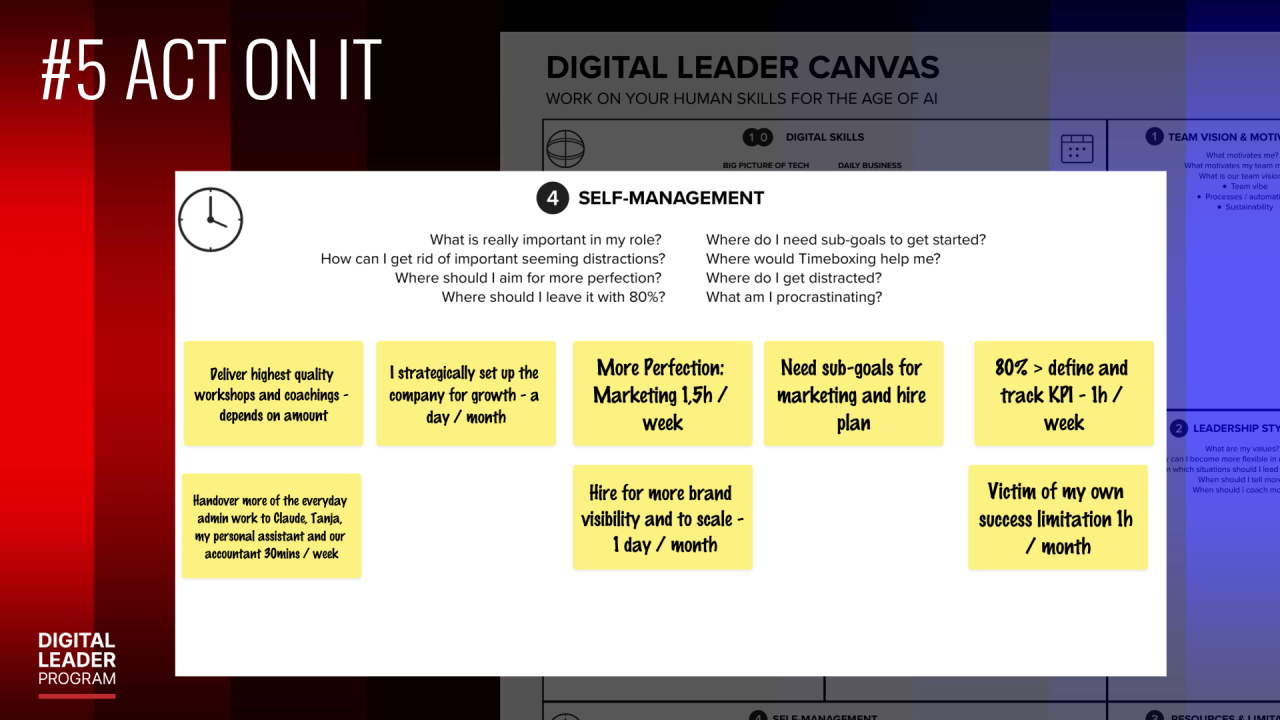
What is really important in my role? How can I get rid of important-seeming distractions? Where should I aim for more perfection? Where should I leave it with 80%? Where do I need sub-goals to get started? Where would timeboxing help me? Where do I get distracted? What am I procrastinating?
If the first three quadrants were about reflection, this one is about execution. And since this newsletter is called "Human Skills in the Age of AI" — here's a way to combine both right from the start.
Try giving your favourite LLM a prompt like this:
"I'm a [your role] leading a team of [size]. My three most important responsibilities are [list them]. Right now, I'm struggling with [describe your biggest time/priority challenge]. Help me sort my current tasks using the Eisenhower matrix. Then suggest which ones I could timebox, which ones could be done at 80% instead of 100%, and where I might need sub-goals to stop procrastinating. Ask me clarifying questions first before giving me suggestions."
The last line is key. You want the AI to ask questions first, not jump to generic advice. The better it understands your context, the more useful the output. It won't replace honest self-reflection — but it's a surprisingly good sparring partner when you don't have a coach or colleague available.
But before you hit enter — here's what those questions are really getting at.
The three tools I keep coming back to
1. Eisenhower — important vs. urgent
Most leaders know the Eisenhower matrix. Few actually use it on themselves. The pattern I see constantly: people spend their days on urgent things — emails, requests, small fires — because those find you whether you like it or not. What doesn't find you is the strategic work. The hiring plan. The development conversation you've been postponing. These things sit quietly until they become urgent too — and by then it's too late to do them well.
The real discipline isn't knowing the matrix. It's protecting time for what's important before it becomes urgent.
2. Pareto — when is 80% enough?
The question isn't just "what should I work on?" — it's "to what standard?" Some tasks need 100%. Your client workshops. Your product quality. Your hiring decisions. But tracking KPIs? Internal documentation? That weekly status report? Those might be perfectly fine at 80%.
The trap I see most often: perfectionists who deliver highest quality on everything — even when nobody asked for it. They wear it as a badge of honour. And it quietly destroys their capacity for the things that actually matter. Learning to consciously choose between 100% and 80% is one of the highest-leverage self-management skills there is.
3. Timeboxing — Parkinson's Law in practice
Work expands to fill the time available. The antidote: decide in advance how much time a task deserves, and stop when the box is full.
But before you set the timebox, challenge the task itself. Should you do it at all? Did someone give it to you, but it shouldn't actually be in your possession? Do you need to give it back? Say no?
If it is your task: is 80% enough? What's the deadline? Could it be automated? Delegated? Handed over entirely? Timeboxing isn't just about efficiency — it's about forcing yourself to make decisions about what deserves your energy.
The sub-goal problem
I recently added a new question to this quadrant on the canvas: Where do I need sub-goals to get started?
This came from a pattern I keep seeing. Many people are great at jumping into big projects. But plenty of others procrastinate — not because they're lazy, but because they don't know where to begin.
Take something like "explore what AI can do for my team." It's a huge topic. Where do you even start? You put it on the to-do list, it sits there for weeks, and eventually it moves to the "someday" pile.
The fix is almost always the same: break it into sub-goals. Not a full project plan — just enough structure to make the first step obvious. "Spend 30 minutes trying one AI tool for email drafting." That's a sub-goal you can actually do tomorrow morning.
If you're procrastinating on something, the task probably isn't small enough yet.
A real example: how I filled in this field
If you've been following this series, here's something you might have noticed: the first three quadrants generate a lot of ideas — and with them, a lot of potential work. Self-Management is where you turn those ideas into concrete action. So I went back to my first three quadrants and pulled specific items. Here's what that looks like:
What's really important in my role?
Three things. First, delivering the highest quality workshops and coachings — this depends on volume, so I don't timebox it, I protect it. Second, strategically setting up the company for growth — one day a month. Third, hiring for more brand visibility and to scale — also one day a month.
Where can I get rid of distractions?
Everyday admin work. I'm giving myself 30 minutes per week to hand over more of it to Claude Cowork, Tanja, my personal assistant, and our accountant. That's not the admin work itself — it's the handover. Making sure the right things move to the right person.
Where should I aim for more perfection?
Marketing. I've been doing it inconsistently, and it shows. One and a half hours per week — roughly 30 minutes every other day. This is also the thing I've been procrastinating on the most, which is usually a sign that it matters.
Where is 80% enough?
Defining and tracking KPIs. I've already set up an AI agent for the daily tracking. My job is to review and update — about an hour per week. It doesn't need to be perfect. It needs to be consistent.
Where do I need sub-goals?
The marketing and hiring plan. Both are big enough to feel overwhelming, which is exactly why they've been sitting on the to-do list. Breaking them into sub-goals is what will actually get them moving.
Go deeper: podcast episodes on self-management
I've covered each of these frameworks in short episodes of my podcast "3 minutes max. — Human Skills in the Age of AI." Each episode is capped at 3 minutes — one idea, straight into your work.

Eisenhower's AI Focus (Episode #37) — Cut through the noise and focus on what matters.
Pareto's AI Time Saver (Episode #38) — Stop over-delivering on tasks that don't need it.
Timeboxing with AI (Episode #39) — How timeboxing improves your focus and quality of work.
AI 1 Percent Method Goals (Episode #48) — How to stick to your goals using the one percent method.
🎧 Listen here: https://www.digital-leader-program.de/podcasts/3-minutes-max-human-skills-in-the-age-of-ai-english-version-2
Your turn — but start with 1%
If you've been filling in the canvas along with this series, you've probably generated more ideas than you can act on. That's normal. And it's exactly the trap this quadrant is designed to solve.
I'm a big fan of the one percent method, which James Clear describes in Atomic Habits: meaningful change comes from tiny, consistent improvements — not from overhauling everything at once.
So look at your canvas. All the ideas, the insights, the things you want to change. Now ask yourself: which one or two of these, if I acted on them consistently, would have the biggest impact right now?
Pick that one thing. Run it through the filter: should I even do this? What's the standard — 100% or 80%? How much time per week? Do I need sub-goals? Can I delegate instead?
Give it a timebox. Put it in your calendar. That's your 1%. The rest will follow.
I've seen hundreds of people fill in this quadrant on their own and make real progress. But the ones who changed fastest did it in a group — with peers who challenged their blind spots and a coach who didn't let them off the hook. Self-reflection is powerful. But at some point, you need someone in the room who asks the question you've been avoiding.
👉 Download the canvas: https://www.digital-leader-program.de/en/digital-leader-program-digital-leader-canvas
Next week: Quadrant ⑤ — Energy, Focus & Meditation. How do you manage your energy, your sleep, and your ability to stay present?
See you then.
The Digital Leader Canvas is free for individual use. If you'd like to work through it with your team — facilitated, with a coach — have a look at our leadership workshop series or book a free consultation.

Recent Posts
Categories
All categories
KNOWLEDGE THAT WORKS IN PRACTICE
This is not a place for buzzwords. Or for theories that don't hold up in real life. Our blog is a space for leaders and professionals who are looking for genuine answers to genuine questions: How do I lead better in a hybrid environment? How do I communicate in a way that actually lands? How do I use AI meaningfully in my daily work? How do I build resilience in my team?
Every article in the Digital Leader Program blog is designed to be directly useful – with insights, methods and examples you can take straight into practice.
TOPICS THAT MATTER TODAY
Leadership in the digital age: How is leadership changing when teams work remotely or hybrid? What do new leaders need – and what do experienced managers need to relearn?
Human Skills under AI influence: Which human capabilities become more important as AI takes over routine tasks – and how do you develop them deliberately?
Hybrid work in practice: Concrete tips, rituals and tools for productive hybrid collaboration – what actually works, and what doesn't.
Culture Design and team dynamics: How do you build an organisational culture that attracts, retains and energises people?
Communication and feedback: The capabilities that separate average performance from real high performance.
FROM PEOPLE WHO WORK IN PRACTICE
Our articles are written by Andre Ottlik and our team – people who work in coaching sessions, workshops and training every single day. What you read here is not copy-pasted from academic studies, but knowledge drawn from lived practice.
And occasionally we feature contributions from external experts sharing insights from their own fields – such as the piece with Pascal Baumgartner on hybrid meeting optimisation.
FREQUENTLY ASKED QUESTIONS (FAQ)
How often are new articles published?
Regularly. Subscribe to our newsletter or follow us on LinkedIn to make sure you don't miss new content.
Are articles available in German too?
Yes. Many of our articles are also available in German – particularly on topics relevant to German-speaking leaders and organisations.
Can I suggest article topics?
Absolutely. Write to us or bring it up in a conversation – we welcome input from our community.
How can I go deeper than the blog?
Our workshops, coaching programmes and the podcast "3 minutes max." go further and support you systematically in your development. Browse our service pages or book an initial consultation.
Author
Andre Ottlik
Author
Andre and his Team are the authors of Digital Leader Programs Blog Posts
